



1. Disconnect the lambda probe connectors.
2. Unscrew the nuts securing the intake pipe flange to the exhaust manifold and disconnect the pipe, removing the gasket. On some models, the downpipe is secured with bolts.
3. Disconnect all other system components, referring to the corresponding illustration.
Dismantling the entire exhaust system
4. Disconnect the exhaust pipe from the exhaust manifold.
5. Release the entire system from the rubber mounting pads and remove it. To perform this operation, you will need an assistant to support the pipes so they don't fall out after being released from the pads.
6. Inspect the exhaust system mounting components. When installing the exhaust pipes, the mounting should not be under tension, as it will break after a while. The exhaust system must be mounted on a suspension with a shock-absorbing effect.
7. Clean the connecting flanges. Use sandpaper if necessary.
8. Replace all sealing gaskets with new ones.
9. Check the rubber mountings of the exhaust system suspension and replace them if necessary.
10. Lubricate the surfaces to be joined with heat-resistant grease.
11. Tighten the clamp bolts to a torque of 15 Nm (see illustration).
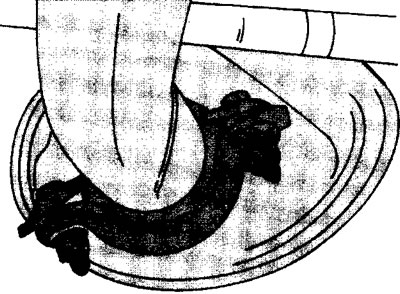
2.11 Tighten the clamp bolts. The clamps should be tightened evenly. The distance between the connected halves of the clamps after tightening the bolts should be the same on both sides.
(Original publication on the website: «PEUGEOTBOOK.ru»)
The clamps should be tightened evenly. The distance between the connected halves of the clamps after tightening the bolts should be the same on both sides.
12 Connect the exhaust pipe to the exhaust manifold and tighten the mounting nuts. The tightening torque of the nuts is 35 Nm.
13 Make sure that the exhaust system is mounted on the suspension so that no element of the system hits other parts of the car, but at the same time the suspension provides the required level of shock absorption of the system when driving.