
English Русский
Български
Беларускі
Український
Српски
Hrvatski
Română
Polski
Slovenský
Magyar
Bookmark Articles Sitemap Contacts
Company Hyundai Company Opel Company Skoda Company Kia Company Mitsubishi Company LADA Company Audi
PeugeotBook.ru


Series 100   Series 200   Series 300   400-500   Series 600   Crossovers   Others
 
Partner I (1996-2008) Peugeot 807 (2002-2014) Peugeot 806 (1994-2002) Peugeot J5 (1981-1993)

Starting system check (Peugeot Partner I)

  • Main
  • Пежо
  • Partner I (1996-2008)
  • Power unit
  • Starting and charging system
  • Starting system check
0
Note: Before starting work, please read the safety precautions described in paragraph "Safety first!" and in paragraph 1 this chapter.


1. If the starter does not work when the ignition key is turned to the appropriate position, this may be due to the following factors:
  • a) The engine immobilizer is faulty.
  • b) The battery is faulty.
  • c) The electrical connections between the ignition switch, traction electromagnet, battery and starter are not capable of transmitting the required current from the battery through the starter to ground.
  • d) The traction electromagnet is faulty,
  • d) Mechanical or electrical failure of the starter.

2. To check the battery, turn on the headlights. If after a few seconds they become dim, this indicates that the battery is discharged - recharge it (see paragraph 3) or replace. If the headlights are bright, turn the ignition switch to the start position and observe the headlights. If they dim, this indicates that current is reaching the starter, and therefore the fault must lie in the starter. If the headlights continue to burn brightly (and there is no click from the starter solenoid), this means that the fault lies in the electrical circuit or in the electromagnet (see the following points). If the starter turns slowly when turned on, and the battery is in good condition, this indicates either a faulty starter or significant resistance somewhere in the electrical circuit.

3. If you suspect a fault in the electrical circuit, disconnect the battery cables (including the ground wire going to the body), starter/solenoid wiring and the engine/gearbox ground bus, which is located on the gearbox housing (figure 10.3). Clean the contacts thoroughly and reconnect the wires and wiring. Using a voltmeter or test light, ensure that full battery voltage is being applied to the positive terminal of the starter. Check the quality of grounding. Apply petroleum jelly to the battery terminals to prevent corrosion. Corrosion in connections is one of the most common causes of failures in electrical systems.
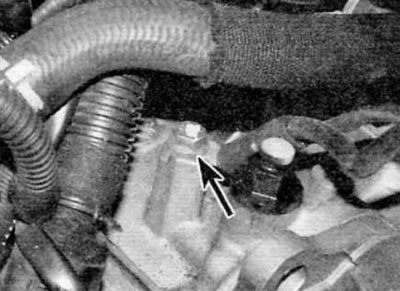


Figure 10.3. Engine/gearbox ground bus (marked with an arrow)

Figure 10.3. Engine/gearbox ground bus (marked with an arrow)


4. If the battery and all connections are in good condition, check the electrical circuit by disconnecting the wire from the traction solenoid terminal. Connect a voltmeter or test lamp between the end of the wire and a good "ground" point (such as the negative terminal of a battery), and check if the wire is live when the ignition switch is turned to the start position. If everything is ok, the electrical circuit is normal. If not, the wiring can be checked as described in chapter 12.

Original is located at: peugeotbook.ru

5. The solenoid contacts can be checked by connecting a voltmeter or test lamp between the terminal that connects the positive battery cable to the starter solenoid and ground. When the ignition switch is turned to the start position, the voltmeter should show voltage or the test lamp should light (depending on what is used). If there is no reading or the lamp does not light, the electromagnet is faulty and must be replaced.

6. If it is proven that the electrical circuit and the electromagnet are normal, the fault must lie in the starter itself. You can give the starter to a specialist for repair. But first, estimate the cost of spare parts, as it may be cheaper to buy a new or refurbished starter on an exchange basis.
This article is available at russian, bulgarian, belarusian, ukrainian, serbian, croatian, romanian, polish, slovak, hungarian
Article reviewed by editor: Nikonova Veronica
Share information:
Previous
Partner I: Starting and charging system
Next

Generator — inspection and overhaul
Generator — removal and installation
Charging system — check
Battery Shelf and Support Plate — removal and installation
Battery — removal and installation
Starter — removal and installation
Starter — inspection and repair
Low oil pressure warning light switch
Oil level sensor — removal and installation
Ignition system specifications
See similar information for other Peugeot models

➨ Air conditioning system refrigerant check Peugeot 106 (1991-2003)
➨ Starting and charging system (petrol engines) Peugeot 207 (2006-2014)
➨ Fig. 8.36. Assembly diagram (205 models): Typical design of the… Peugeot 305 (1977-1989)
➨ Engine Starting System — Check Peugeot 406 (1995-2004)
➨ Fuel injection system — general check Peugeot 605 (1989-2000)
Link to this article in different formats
Comments and feedback from visitors
No comments yet


Add two numbers 25 + 38


Partner I (1996-2008) 
  • General information
  • Introduction to the guide
  • Faults en route
  • Weekly checks
  • User manual
  • Maintenance (petrol)
  • Maintenance (diesel)
  • Power unit
  • Petrol engines
  • Diesel engines «XUD»
  • Diesel engines «DW»
  • Overhaul of petrol engines
  • Overhaul of diesel engines
  • Cooling and heating
  • Power and exhaust (petrol)
  • Power and exhaust (XUD diesels)
  • Power and exhaust (DW diesels)
  • Emission reduction
  • Starting and charging system
  • Transmission
  • Clutch
  • Mechanical gearbox
  • Drive shafts
  • Chassis, running gear
  • Brake system
  • Car suspension
  • Steering
  • Body and interior
  • Exterior (external elements)
  • Interior (internal elements)
  • Doors, locks and windows
  • Electrical equipment
  • Equipment and devices
  • Electrical circuits
Peugeot 807 (2002-2014) 
  • General information
  • Operating instructions
  • Maintenance
  • Troubleshooting
  • Power unit
  • Gasoline engines
  • Diesel engines
  • Cooling and heating
  • Fuel injection (petrol)
  • Fuel system (diesel)
  • Fuel system
  • Exhaust system
  • Ignition system
  • Transmission
  • Clutch
  • Manual gearbox
  • Automatic gearbox
  • Chassis, running gear
  • Brake system
  • Car suspension
  • Steering system
  • Body and interior
  • Exterior (external elements)
  • Interior (internal elements)
  • Electrical equipment
  • Power devices
  • Electrical circuits
Peugeot 806 (1994-2002) 
  • General information
  • User manual
  • Maintenance
  • Power unit
  • Petrol engines
  • Diesel engines
  • Lubrication system
  • Cooling system
  • Fuel injection (petrol)
  • Fuel system (diesel)
  • Ignition and exhaust systems
  • ECM Bosch Motronic MP 3.2
  • ECM Magneti-Marelli (MM)
  • Transmission
  • Clutch
  • Mechanical gearbox
  • Chassis, running gear
  • Brake system
  • Car suspension
  • Steering
  • Electrical equipment
  • Equipment and devices
  • Electrical circuits
Peugeot J5 (1981-1993) 
  • General information
  • Introduction to manual
  • Specifications
  • Gasoline engine
  • Engine repair
  • Lubrication system
  • Cooling system
  • Fuel system
  • Ignition system
  • Diesel engine
  • Engine repair (DB9)
  • Lubrication system (DB9)
  • Cooling system (DB9)
  • Fuel injection (DB9)
  • Engine repair (U25)
  • Lubrication system (U25)
  • Cooling system (U25)
  • Fuel injection (U25)
  • Transmission
  • Clutch
  • Gearbox
  • Drive shafts
  • Chassis, running gear
  • Steering system
  • Car suspension
  • Brake system
  • Electrical equipment
  • Power devices
  • Electrical circuits
PeugeotBook.ru © 2018–2026 | Mobile version | Sitemap: EN BG BY UA RS HR RO PL SK HU | Write message | Site search | Add to bookmarks | Peugeot owners
106 (1991-2003) | 206 (1998-2012) | 207 (2006-2014) | 305 (1977-1989) | 306 (1993-2002) | 307 (2001-2008) | 405 (1987-1997) | 406 (1995-2004) | 605 (1989-2000) | Partner-I (1996-2008) | Eurovans-807 (2002-2014) | Eurovans-806 (1994-2002) | J5 (1981-1993) |
Cookies are used to ensure the correct display of pages on the site.