



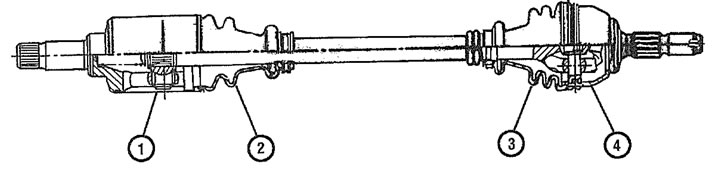
1.1. Typical driveshaft 1. Inner constant velocity joint; 2. Inner joint gaiter; 3. Outer joint gaiter; 4. Outer constant velocity joint
Both driveshafts are splined at their outer ends, to accept the wheel hubs and are threaded so that each hub can be fastened to the driveshaft by a large nut. The inner end of each driveshaft is also splined, to accept the differential sun gear.
Constant velocity (GV) joints are fitted to each end of the driveshafts, to ensure the smooth and efficient transmission of power at all suspension and steering angles. The inner and outer constant velocity joints are of the spider-and-yoke type.
On later 1294 cm³, 1360 cc and 1587 cc engine models (from approximately July 1993-on), due to the length of the right-hand driveshaft, the inner constant velocity joint is situated approximately halfway along the length of the shaft and an intermediate bearing is mounted in a bracket bolted to the rear of the cylinder block. The inner section of the driveshaft passes through the bearing, which prevents lateral flexing of the driveshaft.
View the original on the website [www.PEUGEOTBOOK.ru]