



| Piston protrusion | Identification of gasket by thickness |
| From 0.54 to 0.65 mm | 1 cut |
| From 0.65 to 0.77 mm | 2 cuts |
| From 0.77 to 0.82 mm | 3 cuts |
1. Check that the toothed belt is removed from the high-pressure fuel pump pulley, then turn the crankshaft until the pistons of the 1st and 4th cylinders are at TDC. Mount a dial indicator on a bracket on the cylinder block. Mount the measuring tip on the cylinder block and set the indicator scale to zero. Mount the measuring tip on the piston of the first cylinder and turn the crankshaft slightly in both directions. Note the highest value on the indicator and write this value down.
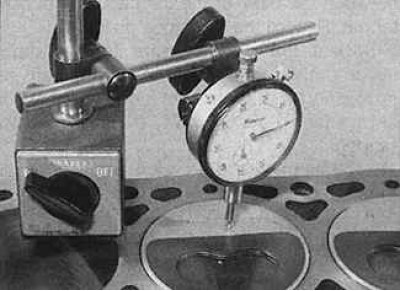
2. Similarly, measure the piston protrusion on cylinder #4, then rotate the crankshaft 180° and repeat the piston protrusion measurements on cylinders 2 and 3.
3. In the absence of a dial indicator, the amount of piston protrusion can be measured with a caliper, but with less accuracy.
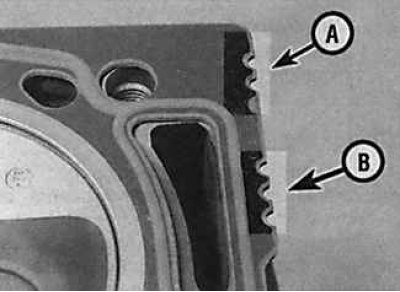
4. Using the largest piston protrusion value, determine the required cylinder head gasket (A - notches indicating gasket thickness). Note that the notches on the gasket located closer to the center are identification notches (B) and have no effect on gasket thickness.