



Table of contents: Voltage values on the primary…🠇 Resistance values on the primary…🠇 Ignition coil primary winding duty…🠇 Checking the primary winding of the…🠇 Checks with the engine off 🠇 Ignition Coil Primary Winding Tests:…🠇 Oscilloscope 🠇 Primary waveform is unclear or…🠇 No voltage at terminal No. 1 of the…🠇 Control signal checks - amplifiers A…🠇 Evaluation of the inspection results 🠇 Checks on a running engine 🠇 Checking the amplifier's condition 🠇 Secondary winding of the ignition…🠇
Ignition coils (see illustration 11.19) use low resistance on the primary winding of the ignition coil to increase the current in the primary winding and the primary energy. The amplifier limits the current in the primary winding to approximately 8 A in order to accumulate the necessary energy reserve to create a spark discharge.
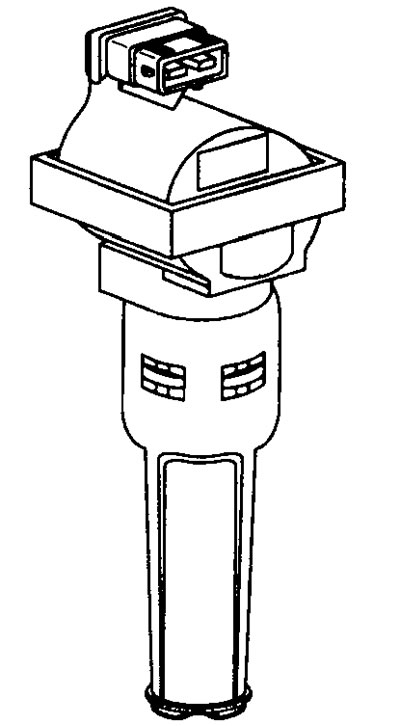
11.19 Ignition coils of the direct ignition system
The ignition timing is not adjustable on models equipped with Bosch Motronic MP3.2.
Voltage values on the primary winding of the ignition coil
Terminal numbers
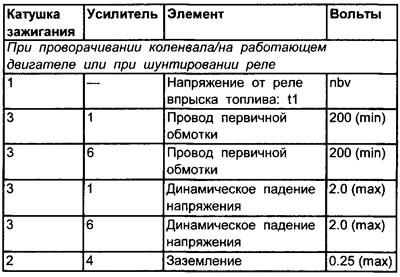
See illustration 11.11
Resistance values on the primary winding of the ignition coil
Terminal numbers
| Ignition coil | Element | Resistance (Q) |
| 1 and 3 | Primary winding resistance | 0,65 |
| 15 and 2 | Secondary winding resistance | See note |
Note: The ignition coil secondary winding circuit is connected in series with the diode, so it is not possible to test for resistance or continuity.
Ignition coil primary winding duty cycle table
Original text is located at [Peugeotbook.ru]
| RPM | Duty cycle % | milliseconds (ms) |
| When turning the crankshaft | 15-30 | 15.0-20.0 |
| 1000 | 5-20 | 4.0-6.0 |
| 2000 | 25-35 | 4.0-6.0 |
| 3000 | 30-40 | 4.0-6.0 |
Checking the primary winding of the ignition coil (general check)
1. This static ignition system includes twin boosters and four ignition coils (one per spark plug).
2. The ignition test is carried out individually for each cylinder.
3. Unscrew the eight screws and remove the ignition coil cover and remove the spark plugs.
4. Check that all four terminals of the ignition coil multi-pin connector are securely connected.
5. Unscrew the round multi-pin connector in the wiring harness at the rear of the cylinder head and check that the wire connectors are securely connected to the ignition coils.
Checks with the engine off
- Connect the negative probe of an oscilloscope or breaker duty cycle meter to ground on the engine.
Note: The following test is similar for both ignition coils of both ignition amplifiers. If necessary, amplifier A or B and ignition coils No. 1, 2, 3 or 4 should be replaced according to the test procedure described. Amplifier A controls ignition coils 4 and 2, amplifier B controls ignition coils 1 and 3.
Checking amplifier A or B, ignition coils No. 1, No. 2, No. 3 or No. 4
Ignition Coil Primary Winding Tests: Amplifier A or B, Ignition Coils #1, #2, #3, or #4
1. Fold back the insulation to amplifier A or B and connect the positive probe of an oscilloscope or breaker duration meter to terminals #1 or #6.
2. Turn the crankshaft.
3. The instrument should display either the primary waveform or the duty cycle reading. If the device can measure readings in milliseconds, then this is the most successful measurement.
Oscilloscope
In addition to a clear waveform, the peak voltage in the primary winding should be at least 300 volts (see illustration 5.17)
4. A peak value less than 300V may be due to a faulty primary winding of the ignition coils.
5. Clear Primary Waveform or Sufficient Signal: The ignition coil primary winding (including the crank angle sensor (CAS)) is supplying a sufficient signal. The fault is not related to the low voltage circuit of the ignition system. However, if there is no output signal from the secondary winding of the ignition coil, the ignition coil may still be faulty.
Primary waveform is unclear or signal is insufficient
6. Check the signal from the crankshaft angle sensor (CAS).
7. Since voltage is supplied to the ignition coils only when the crankshaft is cranking and the engine is running, it is necessary to bypass the relay to check.
8. Turn off the ignition.
9. Disconnect the multi-pin connector from the ignition amplifier.
10. Check amplifier #1 for nominal battery voltage. If voltage is present, the ignition coil circuit is good.
No voltage at terminal No. 1 of the ignition coil
11. Pull back the ignition coil insulation and check for voltage to negative terminal #3 on ignition coil 4.
12. If voltage is now present, check the continuity of the wire running from the amplifier to the ignition coil.
13. If there is still no voltage, check for voltage at the positive terminal #1 on ignition coil #4.
14. If voltage is now present, check the resistance on the primary winding of the ignition coil.
15. If there is still no voltage, check the voltage supply from the fuel injection relay.
Control signal checks - amplifiers A and B
10. Fold back the insulation to amplifier A or B and connect the positive probe of an oscilloscope or breaker duration meter to terminal #2.
Note: If the output block (EB) is available, tests can be performed by connecting the output block to the contact pins of the electronic control unit.
11. Turn the crankshaft. The device will display the control signal as a square wave (see illustration 11.18) or duty cycle indication.
12. Connect the positive probe of an oscilloscope or a breaker duration meter to terminal #7.
13. Turn the crankshaft. The instrument will display the control signal as a square wave or a duty cycle reading.
14. If the signal is not received at one or the other terminal of the amplifier, then perform the following checks.
15. Turn off the ignition and disconnect the multi-pin connector of the electronic control unit and amplifier.
16. Check for continuity between ECU pin No. 21 and amplifier A terminal No. 2.
17. Check for continuity between ECU pin #38 and amplifier A terminal #7.
18. Check for continuity between ECU pin No. 1 and amplifier terminal No. 2.
19. Check for continuity between ECU pin No. 20 and amplifier terminal No. 7.
20. Check the grounding of terminal No. 4 of the amplifier.
Evaluation of the inspection results
1. If there are control signals, but no primary winding signal, the amplifier may be faulty.
2. If there are no control signals and the wiring is in good condition, check the voltage supply to the electronic control unit and its grounding. If the voltage supply and grounding are normal, then the electronic control unit may be faulty.
3. If there are control signals and primary winding signals, but there is no output signal from the secondary winding of the ignition coil, the corresponding ignition coil may be faulty.
Checks on a running engine
1. Connect the oscilloscope or the breaker contact duration meter in turn to terminals No. 1 and No. 6 first of amplifier A and then of amplifier B.
2. Start the engine in idle mode and let it run at different speeds. Record the duty cycle, maximum primary voltage level, and dynamic voltage drop values for each coil. The device should display four readings.
3. Compare the obtained results with the values given in the specifications. Please note that duty cycle readings vary between different vehicles of the same model. However, the readings in ms must be as accurate as possible.
4. All four readings should give similar results.
5. It is important that as engine speed increases, the duty cycle values as a percentage (%) for each ignition coil increase.
6. It is important that as the engine speed increases, the duty cycle values in ms do not differ too much.
7. If the dynamic voltage drop is high (typically over 2.5 volts) in combination with a low peak voltage value in the primary winding and high pulse width % (in idle mode), then you should check the amplifier's functionality.
Warning. If the dynamic voltage drop is high (typically over 2.5 volts), but the peak voltage value in the primary winding and the pulse width % correspond to the norm, then the amplifier may be in good working order.
Warning. The readings will not improve by replacing the amplifier just because the dynamic voltage drop is too high.
Checking the amplifier's condition
1. Check the amplifier grounding.
2. Make sure that wires from devices such as an RFI suppressor or alarm system are not connected to the (-) terminal of the ignition coil.
3. If the grounding and wiring are normal, and the peak value of the primary winding voltage and pulse width % in idle mode are very high, then the amplifier is definitely faulty. Please read the warning above before replacing the amplifier.
Secondary winding of the ignition coil
Ignition coil secondary winding voltage values (DI)
| State | Size |
| Ignition kV (in idle mode) | 8-20 kV |
| Ignition kV (1500) | 8-15 kV (max 4 kV between the upper and lower cylinders) |
| Runner kV | Not used |
| KV acceleration | +8 kV |
| Spark discharge duration | 1.3-1.5 m/sec |
Resistance values of the secondary winding of the ignition coil
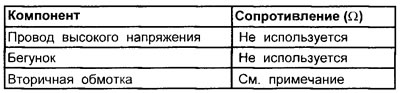
Spark plugs
| Type | Spark plug | Gap |
| Citroen ZX, Xantia 2.0i | Champion RC7YCC | 0.80±0.05 mm |
| 16vcat 1992-1996. | ||
| Peugeot 306, 405 2.0i S | Champion RC7YCC | 0.80±0.05 mm |
| 16vcat 1994-1996 rr. |
Engine operating order
| no. of cylinders | Rotation | Cylinder firing order |
| 4 | Counterclockwise | 1-3-4-2 |