



Table of contents: Throttle body heater voltage values 🠇 Intake manifold heater resistance 🠇 Intake manifold heater type 🠇 Rapid test 🠇 Intake Manifold Heater Tests 🠇 Lack of supply voltage 🠇
Intake manifold heater (IMH) (see illustration 11.34) it is designed to heat the throttle body so that it does not freeze in cold weather. When the engine is running, the heater operates continuously. A positive temperature coefficient (PTC) heater allows current to quickly heat the throttle body during the warm-up process. As the heater heats up, the resistance increases and the current decreases. Since the supply voltage is generated from the second contact of the fuel injection (FI) relay, voltage is therefore only available when the engine is running.
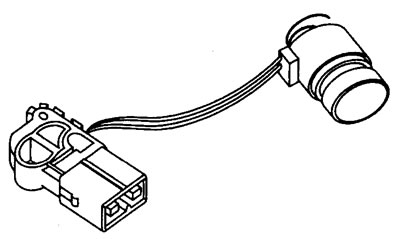
11.34 Intake Manifold Heater (IMH)
Throttle body heater voltage values
Terminal numbers
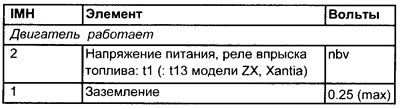
See illustrations 11.2, 11.3, 11.4, 11.5, 11.6
Intake manifold heater resistance
| Terminals | Resistance |
| 1 and 2 | Not specified (check for conductivity) |
Intake manifold heater type
Positive temperature coefficient (PTC).
Rapid test
Start the engine from a cold state and touch the area around the throttle body. If the heater is working, this area should become very hot in a very short time. Be careful not to burn your fingers!
Source can be seen at [PEUGEOTBOOK]
Intake Manifold Heater Tests
1. Let the engine idle.
2. Connect the negative probe of the voltmeter to ground.
3. Connect the positive probe of the voltmeter to the heater power connector.
4. The voltmeter should show the nominal voltage of the battery.
Lack of supply voltage
5. Check the output voltage from the relay
6. Check the continuity of the wires between the relay and the heater
7. If battery voltage is supplied, but the heater does not use it
8. Check the heater resistance
9. Check the heater grounding