
English Русский
Български
Беларускі
Український
Српски
Hrvatski
Română
Polski
Slovenský
Magyar
Bookmark Articles Sitemap Contacts
Company Hyundai Company Opel Company Skoda Company Kia Company Mitsubishi Company LADA Company Audi
PeugeotBook.ru


Series 100   Series 200   Series 300   400-500   Series 600   Crossovers   Others
 
Partner I (1996-2008) Peugeot 807 (2002-2014) Peugeot 806 (1994-2002) Peugeot J5 (1981-1993)

Induction Changeover Valve (ICOV) (non-turbocharged models only) (Peugeot Eurovans 806)

  • Main
  • Пежо
  • Peugeot 806 (1994-2002)
  • Power unit
  • ECM Bosch Motronic MP 3.2
  • Induction Changeover Valve (ICOV) (non-turbocharged models only)
0
Table of contents: Induction Changeover Valve (ICOV)…🠇 Inductive Changeover Valve (ICOV)…🠇 Induction Changeover Valve (ICOV)…🠇 Testing the performance of the…🠇 Testing the resistance of the…🠇 Checking the mechanical operation of…🠇 Checking the operation of the ICOV…🠇
Under all operating conditions, air enters the intake manifold through the throttle valve into the throttle body. However, on Citroen and Peugeot vehicles equipped with Bosch Motronic MP3.2, an induction changeover valve is used to improve air flow into the engine at both low and high engine speeds (see illustration 11.31).
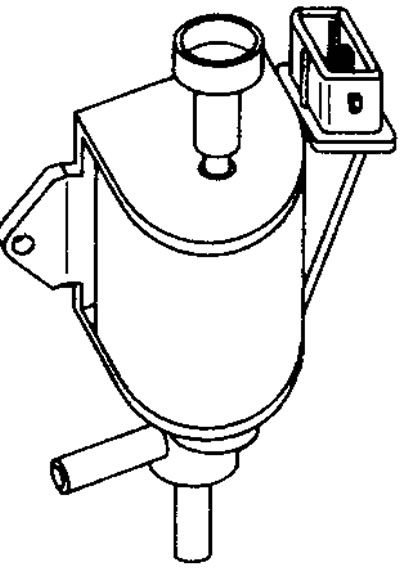
11.31 Induction Changeover Valve (ICOV)

11.31 Induction Changeover Valve (ICOV)


Induction Changeover Valve (ICOV) voltage values


Terminal numbers
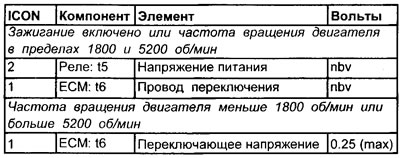


Terminal numbers
See illustrations 11.2, 11.3, 11.4, 11.5, 11.6


Inductive Changeover Valve (ICOV) Resistance Values


Terminal numbers



Terminal numbers

Induction Changeover Valve (ICOV) Testing (general check)


1. Inspect the induction changeover valve multi-pin connector for signs of corrosion or damage.

2. Make sure the contact pins of the multi-pin connector terminals are installed properly and have good contact with the induction switching valve.

3. Check the vacuum hoses for leaks and make sure they are securely fastened.

[Original can be viewed at peugeotbook]

Testing the performance of the induction changeover valve (ICOV)


1. Connect the negative probe of the oscilloscope or voltmeter to ground on the engine.

2. Connect the positive probe of an oscilloscope or voltmeter to the wire attached to terminal No. 2 of the induction switching valve.

3. Turn on the ignition. The voltmeter should indicate the nominal voltage of the battery.

4. If there is no voltage, check the supply voltage from terminal No. 5 of the main relay.

5. Connect the positive probe of the oscilloscope or voltmeter to the wire attached to terminal No. 1 of the induction switching valve.

6. Turn on the ignition. The voltmeter should indicate the nominal voltage of the battery.


7. If there is no voltage, check the resistance of the induction switching valve.

8. Start the engine and let it idle. The voltmeter should show a voltage of less than 1.0 volts.

9. If the voltage from terminal 8 exceeds the rated battery voltage, the following I/C valve tests should be skipped.

10. Check the continuity of the wiring back to the ECU pin #6.

11. If the wiring of the induction switching valve is OK, then check the power and ground contacts of the electronic control unit. If the contacts are in working order, then the electronic control unit may be faulty.

12. Increase the engine speed above the specified rpm. The voltage should increase from less than 1.0 V to the nominal battery voltage.

13. If this is not the case, the electronic control unit may be faulty.

14. Gradually increase the engine speed above the specified maximum rpm. The voltage should decrease by less than 1.0 volts.

15. If this is not the case, the electronic control unit may be faulty.

16. Check the mechanical operation of the induction changeover valve.

Testing the resistance of the inductive changeover valve (ICOV)


1. Disconnect the electrical multi-pin connector from the induction changeover valve.

2. Connect an ohmmeter between the two terminals on the induction switching valve. Compare the obtained value with the resistance specified in the specifications.

3. Connect an ohmmeter between one of the two terminals on the inductive switching valve (ICOV) and the ICOV body. The ohmmeter should indicate infinite resistance.


Checking the mechanical operation of the induction changeover valve


1. Disconnect the electrical multi-pin connector from the induction changeover valve.

2. Disconnect the two vacuum hoses going to the induction switching valve.

3. Connect the vacuum pump to the inlet pipe.

4. Using a pump, create a vacuum in the inlet pipe. The created vacuum must be maintained.

Note: If you don't have a vacuum pump, try blowing out the pipe. The attempt must fail.


5. Connect a temporary jumper wire from one terminal of the induction switching valve to the positive terminal of the battery.

6. Connect a temporary jumper wire from the other terminal of the induction switching valve to the negative terminal of the battery.

7. Using a pump, create a vacuum in the inlet pipe. The vacuum created should not be maintained, and it is now possible to purge the intake pipe to the exhaust pipe.

Checking the operation of the ICOV control valve


1. Disconnect the vacuum hose from the ICOV control valve.

2. Connect a vacuum pump to the inlet pipe of the ICOV control valve.

3. Create a 300 mmHg vacuum for the ICOV control valve. The control valve should move quickly and smoothly to fully open the ICOV flap.

4. Remove the vacuum. The control valve must move quickly and smoothly to fully open the ICOV valve.

5. Connect the vacuum hose to the ICOV control valve.
This article is available at russian, bulgarian, belarusian, ukrainian, serbian, croatian, romanian, polish, slovak, hungarian
Article reviewed by editor: Shirokov Arseny
Share information:
Previous
Peugeot 806: ECM Bosch Motronic MP 3.2
Next

Vehicle Speed Sensor (VSS)
Throttle position sensor (TPS)
Manifold Absolute Pressure (MAP) Sensor
Knock sensor (KS)
Intake air temperature sensor and coolant temperature sensor…
Idle Air Control Valve (ISCV)
Intake Manifold Heater (IMH)
Turbocharger Wastegate (WCS) (with turbocharger only)
Fuel injection system
Fuel system
See similar information for other Peugeot models

➨ Fuel filter renewal — carburetor models Peugeot 106 (1991-2003)
➨ Valve mechanism characteristics (petrol engines 1.4 and 1.6 l,… Peugeot 207 (2006-2014)
➨ Timing Housing Seal (all models) Peugeot 305 (1977-1989)
➨ ACAV Air Supply System (16-valve models) Peugeot 405 (1987-1997)
➨ Engine bay. Cars with 2.0L turbocharged petrol engine Peugeot 605 (1989-2000)
Link to this article in different formats
Comments and feedback from visitors
No comments yet


Add two numbers 11 + 50


Partner I (1996-2008) 
  • General information
  • Introduction to the guide
  • Faults en route
  • Weekly checks
  • User manual
  • Maintenance (petrol)
  • Maintenance (diesel)
  • Power unit
  • Petrol engines
  • Diesel engines «XUD»
  • Diesel engines «DW»
  • Overhaul of petrol engines
  • Overhaul of diesel engines
  • Cooling and heating
  • Power and exhaust (petrol)
  • Power and exhaust (XUD diesels)
  • Power and exhaust (DW diesels)
  • Emission reduction
  • Starting and charging system
  • Transmission
  • Clutch
  • Mechanical gearbox
  • Drive shafts
  • Chassis, running gear
  • Brake system
  • Car suspension
  • Steering
  • Body and interior
  • Exterior (external elements)
  • Interior (internal elements)
  • Doors, locks and windows
  • Electrical equipment
  • Equipment and devices
  • Electrical circuits
Peugeot 807 (2002-2014) 
  • General information
  • Operating instructions
  • Maintenance
  • Troubleshooting
  • Power unit
  • Gasoline engines
  • Diesel engines
  • Cooling and heating
  • Fuel injection (petrol)
  • Fuel system (diesel)
  • Fuel system
  • Exhaust system
  • Ignition system
  • Transmission
  • Clutch
  • Manual gearbox
  • Automatic gearbox
  • Chassis, running gear
  • Brake system
  • Car suspension
  • Steering system
  • Body and interior
  • Exterior (external elements)
  • Interior (internal elements)
  • Electrical equipment
  • Power devices
  • Electrical circuits
Peugeot 806 (1994-2002) 
  • General information
  • User manual
  • Maintenance
  • Power unit
  • Petrol engines
  • Diesel engines
  • Lubrication system
  • Cooling system
  • Fuel injection (petrol)
  • Fuel system (diesel)
  • Ignition and exhaust systems
  • ECM Bosch Motronic MP 3.2
  • ECM Magneti-Marelli (MM)
  • Transmission
  • Clutch
  • Mechanical gearbox
  • Chassis, running gear
  • Brake system
  • Car suspension
  • Steering
  • Electrical equipment
  • Equipment and devices
  • Electrical circuits
Peugeot J5 (1981-1993) 
  • General information
  • Introduction to manual
  • Specifications
  • Gasoline engine
  • Engine repair
  • Lubrication system
  • Cooling system
  • Fuel system
  • Ignition system
  • Diesel engine
  • Engine repair (DB9)
  • Lubrication system (DB9)
  • Cooling system (DB9)
  • Fuel injection (DB9)
  • Engine repair (U25)
  • Lubrication system (U25)
  • Cooling system (U25)
  • Fuel injection (U25)
  • Transmission
  • Clutch
  • Gearbox
  • Drive shafts
  • Chassis, running gear
  • Steering system
  • Car suspension
  • Brake system
  • Electrical equipment
  • Power devices
  • Electrical circuits
PeugeotBook.ru © 2018–2026 | Mobile version | Sitemap: EN BG BY UA RS HR RO PL SK HU | Write message | Site search | Add to bookmarks | Peugeot owners
106 (1991-2003) | 206 (1998-2012) | 207 (2006-2014) | 305 (1977-1989) | 306 (1993-2002) | 307 (2001-2008) | 405 (1987-1997) | 406 (1995-2004) | 605 (1989-2000) | Partner-I (1996-2008) | Eurovans-807 (2002-2014) | Eurovans-806 (1994-2002) | J5 (1981-1993) |
Cookies are used to ensure the correct display of pages on the site.