
English Русский
Български
Беларускі
Український
Српски
Hrvatski
Română
Polski
Slovenský
Magyar
Bookmark Articles Sitemap Contacts
Company Hyundai Company Opel Company Skoda Company Kia Company Mitsubishi Company LADA Company Audi
PeugeotBook.ru


Series 100   Series 200   Series 300   400-500   Series 600   Crossovers   Others
 
Partner I (1996-2008) Peugeot 807 (2002-2014) Peugeot 806 (1994-2002) Peugeot J5 (1981-1993)

Catalytic converter and emission control system (Peugeot Eurovans 806)

  • Main
  • Пежо
  • Peugeot 806 (1994-2002)
  • Power unit
  • ECM Bosch Motronic MP 3.2
  • Catalytic converter and emission control system
0
Table of contents: Carbon Filter Solenoid Valve (CFSV) 🠇 Values of voltage of the solenoid…🠇 The resistance value of the carbon…🠇 Influence of external factors 🠇 Checking the Carbon Filter Solenoid…🠇 Checking the performance of the…🠇 Carbon Filter Solenoid Valve (CFSV)…🠇
All versions of the Bosch Motronic MP3.2 fuel injection system are equipped with a catalytic converter and have a closed-loop system, thanks to which harmful exhaust emissions can be minimized. Closed loop systems are equipped with an oxygen sensor that monitors the oxygen content in the exhaust gases. Low exhaust oxygen levels indicate a rich mixture, while high exhaust oxygen levels indicate a lean mixture.

Carbon Filter Solenoid Valve (CFSV)


Carbon Filter Solenoid Valve (CFSV) (see illustration 11.43) and a carbon canister are used by vehicles equipped with a catalytic converter to reduce fuel vapor emissions into the atmosphere. The charcoal canister stores and absorbs fuel vapors until, under certain operating conditions, the Bosch Motronic electronic control unit opens the charcoal canister solenoid valve (CFSV). Once the electronic control unit activates the CFSV, fuel vapors enter the engine through the throttle valve for complete combustion.
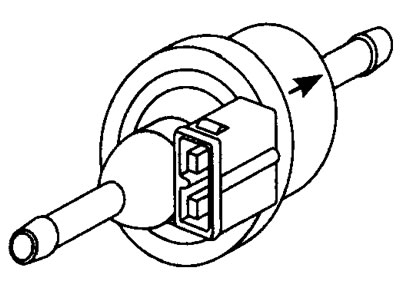
11.43 Carbon Filter Solenoid Valve (CFSV)

11.43 Carbon Filter Solenoid Valve (CFSV)


When the ignition is off, the solenoid valve of the carbon filter is open. As soon as the ignition is turned on, the solenoid valve of the carbon filter closes.

With the engine running, the solenoid valve will switch (turn on and off) by the electronic control unit at intervals determined by the control unit. When the engine is turned off and the ignition is turned off, the electronic control unit will close the carbon canister solenoid valve for a few seconds to prevent the engine from starting accidentally.

Values of voltage of the solenoid valve of the carbon filter


Terminal numbers
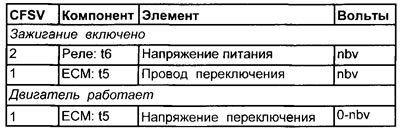


Terminal numbers

See illustrations 11.2, 11.3, 11.4, 11.5, 11.6

The resistance value of the carbon filter solenoid valve


Terminal numbers



Terminal numbers


Influence of external factors


  • Damaged or leaking vacuum hoses and joints

Checking the Carbon Filter Solenoid Valve (CFSV) (general check)


1. Inspect the carbon canister solenoid valve multi-pin connector for signs of corrosion or damage.

2. Make sure the connector terminal pins are properly installed and have good contact with the carbon canister solenoid valve multi-pin connector.

Checking the performance of the carbon filter solenoid valve (CFSV)


1. The carbon canister solenoid valve can be controlled via the self-diagnosis (SD) serial port. Please familiarize yourself with the self-diagnosis function and error codes.

2. If the carbon canister solenoid valve does not operate, perform the following checks.

3. Turn on the ignition, check for battery voltage at the power terminal of the carbon filter solenoid valve.

4. If there is no voltage, trace the wiring back to the main fuel injection relay.

5. Check the resistance of the carbon filter solenoid valve.

6. Disconnect the multi-contact connector of the electronic control unit and use a jumper wire to connect the switching terminal in the multi-contact connector of the electronic control unit to ground for a very short time.

7. If the carbon filter solenoid valve is activated, check the main power and ground contacts of the electronic control unit. If the tests do not reveal any faults, then the electronic control unit may be faulty.

8. If the solenoid valve of the carbon filter does not operate, check the continuity of the wiring between the solenoid valve of the carbon filter and the switching terminal of the electronic control unit.


9. If the wiring is OK, then the carbon filter solenoid valve may be faulty.

Carbon Filter Solenoid Valve (CFSV) resistance


  • Disconnect the multi-pin connector and measure the resistance of the carbon canister solenoid valve between the two terminals.
This article is available at russian, bulgarian, belarusian, ukrainian, serbian, croatian, romanian, polish, slovak, hungarian
Article reviewed by editor: Shirokov Arseny
Share information:
Previous
Peugeot 806: ECM Bosch Motronic MP 3.2
Next

Fuel pump relay
Fuel pressure regulator
Fuel pump
Fuel system
Fuel injection system
Oxygen sensor (OS)
See similar information for other Peugeot models

➨ Emission control systems check Peugeot 106 (1991-2003)
➨ MSR system — trajectory control during deceleration Peugeot 207 (2006-2014)
➨ Traction control system (ASR) and electronic stability program… Peugeot 307 (2001-2008)
➨ Exhaust emission control system Peugeot 405 (1987-1997)
➨ Anti-theft system (immobilizer) Peugeot 605 (1989-2000)
Link to this article in different formats
Comments and feedback from visitors
No comments yet


Add two numbers 25 + 10


Partner I (1996-2008) 
  • General information
  • Introduction to the guide
  • Faults en route
  • Weekly checks
  • User manual
  • Maintenance (petrol)
  • Maintenance (diesel)
  • Power unit
  • Petrol engines
  • Diesel engines «XUD»
  • Diesel engines «DW»
  • Overhaul of petrol engines
  • Overhaul of diesel engines
  • Cooling and heating
  • Power and exhaust (petrol)
  • Power and exhaust (XUD diesels)
  • Power and exhaust (DW diesels)
  • Emission reduction
  • Starting and charging system
  • Transmission
  • Clutch
  • Mechanical gearbox
  • Drive shafts
  • Chassis, running gear
  • Brake system
  • Car suspension
  • Steering
  • Body and interior
  • Exterior (external elements)
  • Interior (internal elements)
  • Doors, locks and windows
  • Electrical equipment
  • Equipment and devices
  • Electrical circuits
Peugeot 807 (2002-2014) 
  • General information
  • Operating instructions
  • Maintenance
  • Troubleshooting
  • Power unit
  • Gasoline engines
  • Diesel engines
  • Cooling and heating
  • Fuel injection (petrol)
  • Fuel system (diesel)
  • Fuel system
  • Exhaust system
  • Ignition system
  • Transmission
  • Clutch
  • Manual gearbox
  • Automatic gearbox
  • Chassis, running gear
  • Brake system
  • Car suspension
  • Steering system
  • Body and interior
  • Exterior (external elements)
  • Interior (internal elements)
  • Electrical equipment
  • Power devices
  • Electrical circuits
Peugeot 806 (1994-2002) 
  • General information
  • User manual
  • Maintenance
  • Power unit
  • Petrol engines
  • Diesel engines
  • Lubrication system
  • Cooling system
  • Fuel injection (petrol)
  • Fuel system (diesel)
  • Ignition and exhaust systems
  • ECM Bosch Motronic MP 3.2
  • ECM Magneti-Marelli (MM)
  • Transmission
  • Clutch
  • Mechanical gearbox
  • Chassis, running gear
  • Brake system
  • Car suspension
  • Steering
  • Electrical equipment
  • Equipment and devices
  • Electrical circuits
Peugeot J5 (1981-1993) 
  • General information
  • Introduction to manual
  • Specifications
  • Gasoline engine
  • Engine repair
  • Lubrication system
  • Cooling system
  • Fuel system
  • Ignition system
  • Diesel engine
  • Engine repair (DB9)
  • Lubrication system (DB9)
  • Cooling system (DB9)
  • Fuel injection (DB9)
  • Engine repair (U25)
  • Lubrication system (U25)
  • Cooling system (U25)
  • Fuel injection (U25)
  • Transmission
  • Clutch
  • Gearbox
  • Drive shafts
  • Chassis, running gear
  • Steering system
  • Car suspension
  • Brake system
  • Electrical equipment
  • Power devices
  • Electrical circuits
PeugeotBook.ru © 2018–2026 | Mobile version | Sitemap: EN BG BY UA RS HR RO PL SK HU | Write message | Site search | Add to bookmarks | Peugeot owners
106 (1991-2003) | 206 (1998-2012) | 207 (2006-2014) | 305 (1977-1989) | 306 (1993-2002) | 307 (2001-2008) | 405 (1987-1997) | 406 (1995-2004) | 605 (1989-2000) | Partner-I (1996-2008) | Eurovans-807 (2002-2014) | Eurovans-806 (1994-2002) | J5 (1981-1993) |
Cookies are used to ensure the correct display of pages on the site.