



Table of contents: Examination 🠇 Removal 🠇
When the brake disc wears down to the minimum permissible residual thickness, it must be replaced with a new one. When checking the thickness of the disc, please refer to the specifications.
The thickness of the brake disc is usually checked when replacing the brake pads. When replacing the pads, it is also recommended to inspect the working surface of the disc and, if it is damaged, replace the disc with a new one, despite the fact that its thickness meets the requirements.
Examination
1. Check the brake disc for ribbing by running your hand over it. Replace the ribbed brake discs with new ones. Clean brake discs with a grey or bluish tint before installing new brake pads.
Assuming that the brake disc is sufficiently worn and has reached the maximum permissible thickness, this can be checked without removing the brake disc from the car.
2. Measure the thickness of the brake disc using a micrometer. Since the surface of the brake disc wears unevenly, the measurement should be taken at several points around the entire circumference of the disc (see illustration).
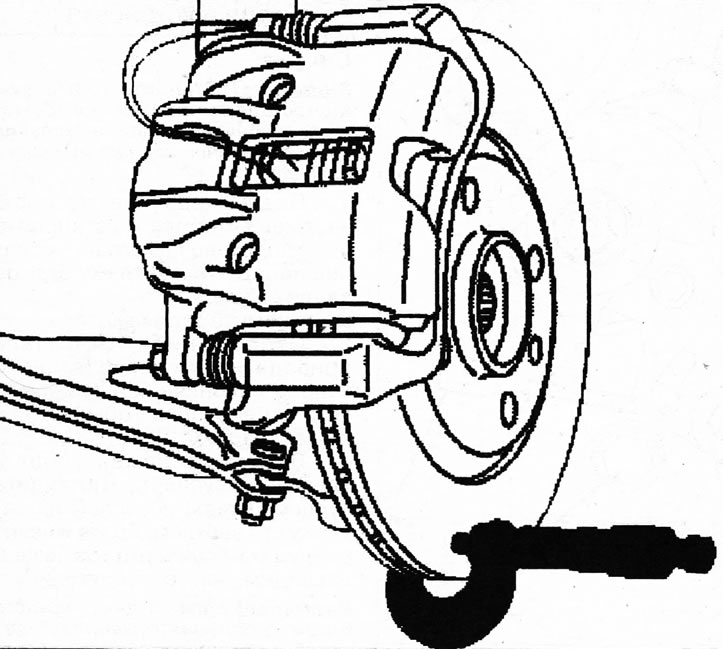
6.2. Measuring the residual thickness of a brake disc without removing the disc from the vehicle
The permissible overall deviation should not exceed 0.025 mm. If the brake disc has been removed, the remaining thickness can be checked by clamping the disc in a vice.
Removal
Important! If the caliper will be removed only to remove the brake disc, do not disconnect the wheel cylinder brake hose from the caliper, as the brake system will need to be bled after installation. Secure the caliper to the body using a wire hook you make yourself. The brake hose should not be twisted or stretched.
3. Unscrew the brake pad guide bolts and remove the guide together with the caliper from the brake disc.
4. Unscrew bolt 1 securing the brake disc to the hub with a socket wrench and remove the brake disc (see illustration). If the brake disc is tightly seated on the hub, it can be knocked off with a rubber hammer.
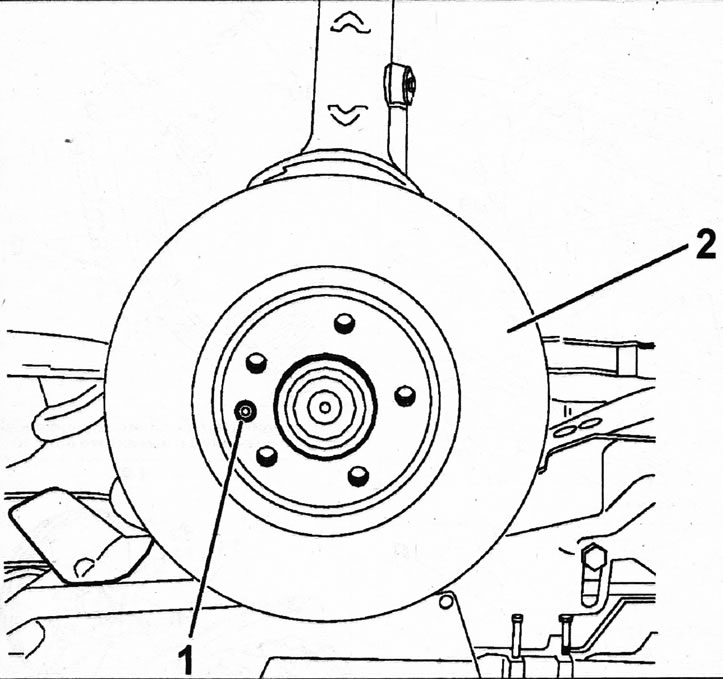
6.4. Unscrew bolt 1 securing the brake disc to the hub using a socket wrench and remove the brake disc. The illustration shows the rear wheel brake disc
Installation of the brake disc is carried out in reverse order.
To ensure uniform braking on both sides, both brake discs must have identically ground surfaces with the same degree of roughness. Therefore, be sure to replace or grind both brake discs at once.
5. Install the new brake disc and secure it to the hub by screwing in the mounting bolt.
6. Install the brake pad guide and caliper and tighten the mounting bolts to the appropriate torque.
7. Perform a test drive and check the operation of the brakes. Brake pads and brake discs need to be worked in, which takes some time.