



Table of contents: Brake discs 🠇 Brake drums 🠇
1. If the wear of the brake discs or drums is within acceptable limits, and the discs themselves and, apart from wear, are in good condition, they can be put in order by regrinding. This work should be done by a specialist, but in any case it will cost less than replacing drums or discs.
Brake discs
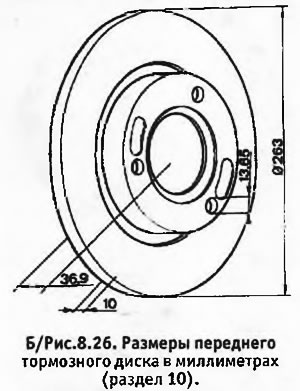
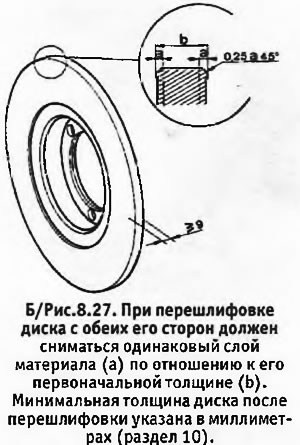
2. Inspect the disk for damage that may require replacement. If the disc is heavily corroded, has cracks, deep grooves, etc., the only solution is to replace the disc. If the inspection shows that the disk is in decent condition, measure its thickness in a number of places using a micrometer. The minimum permissible thickness of the disc after regrinding is specified in the Specifications. The thickness of the disc must allow regrinding, after which the disc can continue to be used until its thickness is reduced to the minimum permissible (see Specifications), after which it must be replaced regardless of their condition. When regrinding, the same layer of metal must be removed from both sides of the disc. For disc control dimensions see. in B/Figure 8.26 and 8.27 and in the Specifications. The disc can only be removed after the hub has been removed. Since this requires special tools, it is better to entrust this work to a specialist (additional information see Chapter 7, Section 4).
 |
 |
Brake drums
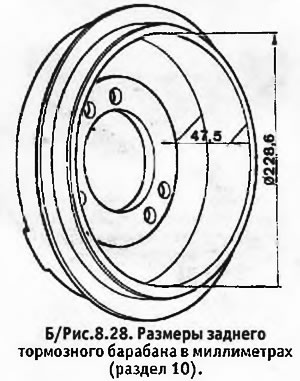
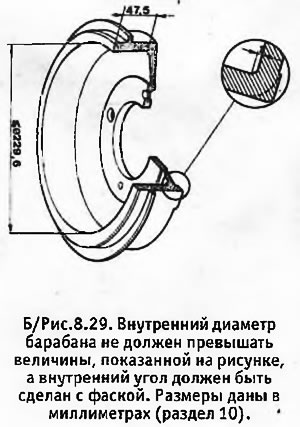
3. As with brake discs, brake drums should first be inspected for damage that may require replacement (severe corrosion, cracks, deep grooves, etc.). The difference between the largest and smallest diameters of the drum characterizes its ovality, which should not exceed the permissible limits. The maximum diameter to which the drum can be reground is indicated in Specifications. Please note that for drums located on the same axle, the difference in internal diameters after regrinding should not exceed 0.15 mm. For brake drum control dimensions, see. in B/Figure 8.29.
 |
 |