
English Русский
Български
Беларускі
Український
Српски
Hrvatski
Română
Polski
Slovenský
Magyar
Bookmark Articles Sitemap Contacts
Company Hyundai Company Opel Company Skoda Company Kia Company Mitsubishi Company LADA Company Audi
PeugeotBook.ru


Series 100   Series 200   Series 300   400-500   Series 600   Crossovers   Others
 
Peugeot 305 (1977-1989) Peugeot 306 (1993-2002) Peugeot 307 (2001-2008)

Brake compensator — general information (Peugeot 305)

  • Main
  • 30X
  • Peugeot 305 (1977-1989)
  • Chassis, running gear
  • Brake system
  • Brake compensator — general information
0
Table of contents: Adjusting the brake compensator on…🠇 Adjusting the brake compensator on…🠇 Adjusting the brake compensator on…🠇
1. The brake compensator is located in the rear brake circuit under the floor of the passenger compartment, immediately in front of the rear suspension. Its purpose is to provide equal braking effect on the front and rear wheels and prevent the rear wheels from locking.

2. If you find that when you press the brake pedal, the front wheels are mainly braked, and that it is impossible to lock the rear wheels without using the handbrake, or, conversely, when braking sharply, the rear wheels invariably lock, then this indicates a malfunction of the compensator.

3. Early models were equipped with an adjustable, load-sensitive compensator, but the latest models are now equipped with a non-adjustable compensator (see photo). The compensator must be checked in a Peugeot workshop that has the necessary equipment. Do not attempt to disassemble the compensator yourself.
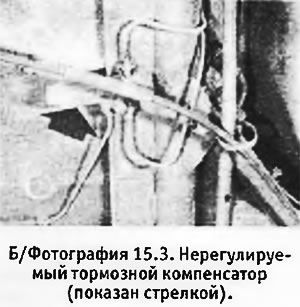
3. Early models were equipped with an adjustable, load-sensitive compensator, but the latest models…


4. To replace the compensator, simply remove the old compensator and install a new one, then bleed the brake system. Adjustable compensators on early models should be adjusted as follows after installation.


5. Check that the rear tire pressure is correct.

6. Load the rear of the car so that the distance between the center of the rear axle and the upper edge of the wheel arch is 305-315 mm.

7. See B/Figure 8.35. In Peugeot workshops, special tool 8.0803, shown in the figure, is used to adjust the compensator, but you can replace it with a 9 mm thick metal block with a slot into which the spring link fits when the block is installed as shown in the figure. Install the block in place and loosen the lock nut ("1" in B/Figure 8.35). Using screw "2", adjust the total distance "X" to 223.5 mm. Do not change or adjust the position of the thrust block "3" under any circumstances. Hold the adjusting screw and tighten the lock nut. If for some reason you change the position of the thrust block "3", you will have to contact a Peugeot workshop to adjust the compensator, since in this case it will be necessary to measure the pressure in the front and rear brake circuits.
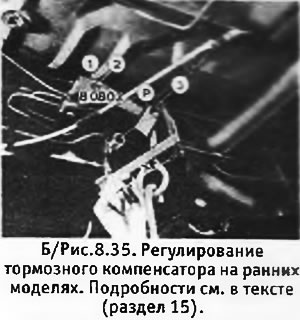
7. See B/Figure 8.35. In Peugeot workshops, special tool 8.0803, shown in the figure, is used to…


8. After the appearance of non-adjustable compensators, adjustable ones stopped being installed. If your car has an early warning compensator (adjustable) type, and you suspect it's faulty, you should contact a Peugeot workshop. If the compensator needs to be replaced, a non-adjustable compensator can be installed instead, provided the universal joint has a special support bracket for it. When installing a new compensator, the brake line will need to be replaced.


Adjusting the brake compensator on Estate models


1. The brake compensator fitted to Estate models is an adjustable, load sensing compensator (see above).

Adjusting the brake compensator on models with XL or XR engines


2. Raise and support the rear of the car. Check that the suspension arm stops are in place and in good condition. If this is not the case, replace the stops.

3. Insert a 5mm thick slotted metal block between the spring adjusting screw and the suspension control arm.

4. Using the control arm adjusting screw or the spring adjusting screw, ensure that the inserted block just slides between the spring adjusting screw and the suspension control arm.

5. Remove the metal block and lower the car to the ground.

Adjusting the brake compensator on models with XU engines
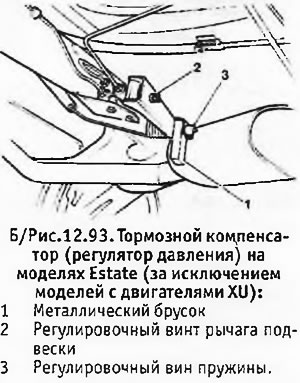


Adjusting the brake compensator on models with XU engines


6. To adjust the brake compensator on these models, special equipment is required, so this work should be carried out in a Peugeot workshop.
This article is available at russian, bulgarian, belarusian, ukrainian, serbian, croatian, romanian, polish, slovak, hungarian
Article reviewed by editor: Ostrovsky Fedor
Share information:
Previous
Peugeot 305: Brake system
Next

Vacuum servo booster — overhaul
Vacuum servo booster — removal and installation
Master cylinder — removal, overhaul and installation
Hydraulic tubes — inspection and replacement
Brake discs and drums — refurbishment by regrinding
Handbrake — general information
Brake system fault diagnostics
See similar information for other Peugeot models

➨ Front brake pad check Peugeot 106 (1991-2003)
➨ Brake and Clutch Hydraulic Fluid Peugeot 207 (2006-2014)
➨ Steering wheel, gear shift and brake Peugeot 405 (1987-1997)
➨ Brake fluid Peugeot 605 (1989-2000)
➨ Brake fluid level — checking Peugeot 806 (1994-2002)
Link to this article in different formats
Comments and feedback from visitors
No comments yet


Add two numbers 32 + 25


Peugeot 307 (2001-2008) 
  • User manual
  • Keys, doors and alarm
  • Controls and instruments
  • Driving and operation
  • Maintenance
  • Power unit
  • Petrol engines TU3 and TU5
  • Petrol engines EW10
  • Diesel engines DV10
  • Diesel engines DW10
  • Transmission
  • Clutch and drive shafts
  • Mechanical gearbox
  • Automatic gearbox
  • Chassis, running gear
  • Front suspension
  • Rear suspension
  • Steering
  • Brake system
  • Body and interior
  • Exterior (external elements)
  • Interior (internal elements)
  • Doors, locks and windows
  • Heating and air conditioning
  • Electrical equipment
  • Equipment and devices
  • Power devices
  • Airbags
  • Electrical circuits
Peugeot 306 (1993-2002) 
  • General information
  • Introduction to manual
  • Specifications
  • Gasoline engine
  • Engine repair
  • Lubrication system
  • Cooling system
  • Fuel injection
  • Ignition system
  • Diesel engine
  • Engine repair
  • Lubrication system
  • Cooling system
  • Fuel injection
  • Transmission
  • Clutch
  • Gearbox
  • Drive shafts
  • Chassis, running gear
  • Steering system
  • Front suspension
  • Rear suspension
  • Brake system
  • Electrical equipment
  • Power devices
  • Electrical circuits
Peugeot 305 (1977-1989) 
  • General information
  • Maintenance
  • Power unit
  • Gasoline engines
  • Diesel engines
  • Cooling system (gasoline)
  • Cooling system (diesel)
  • Fuel system (gasoline)
  • Fuel system (diesel)
  • Ignition system
  • Transmission
  • Clutch
  • Mechanical gearbox BB8
  • Mechanical gearbox BE1
  • Automatic gearbox ZF4
  • Shafts, hubs and wheels
  • Chassis, running gear
  • Brake system
  • Car suspension
  • Steering
  • Body and interior
  • Exterior (external elements)
  • Interior (internal elements)
  • Electrical equipment
  • Equipment and devices
  • Headlights and lighting
  • Power devices
  • Electrical circuits
  • Wiring diagrams (diesel)
PeugeotBook.ru © 2018–2026 | Mobile version | Sitemap: EN BG BY UA RS HR RO PL SK HU | Write message | Site search | Add to bookmarks | Peugeot owners
106 (1991-2003) | 206 (1998-2012) | 207 (2006-2014) | 305 (1977-1989) | 306 (1993-2002) | 307 (2001-2008) | 405 (1987-1997) | 406 (1995-2004) | 605 (1989-2000) | Partner-I (1996-2008) | Eurovans-807 (2002-2014) | Eurovans-806 (1994-2002) | J5 (1981-1993) |
Cookies are used to ensure the correct display of pages on the site.