
English Русский
Български
Беларускі
Український
Српски
Hrvatski
Română
Polski
Slovenský
Magyar
Bookmark Articles Sitemap Contacts
Company Hyundai Company Opel Company Skoda Company Kia Company Mitsubishi Company LADA Company Audi
PeugeotBook.ru


Series 100   Series 200   Series 300   400-500   Series 600   Crossovers   Others
 
Peugeot 305 (1977-1989) Peugeot 306 (1993-2002) Peugeot 307 (2001-2008)

Front Hubs (1983 and later models) — removal and installation (Peugeot 305)

  • Main
  • 30X
  • Peugeot 305 (1977-1989)
  • Transmission
  • Shafts, hubs and wheels
  • Front Hubs (1983 and later models) — removal and installation
0
1. Install the shock absorber retaining cables (tool 8.0903 AE - see chapter 9) on the shock absorber spring from the side you need.

2. Loosen the 3 nuts securing the upper strut mount.

3. Remove the hub nut.

4. Raise and securely support the front of the vehicle. Remove the wheel, brake caliper and brake disc from the desired side. Tie the caliper to the side so that the brake hose is not stretched.

5. Secure the drive shaft using tool 8.0615 N or similar so that it does not come out of the final drive housing.

6. Disconnect the lower stabilizer bar link.

7. Remove the clamp bolt and nut securing the steering knuckle to the front strut (see photo).
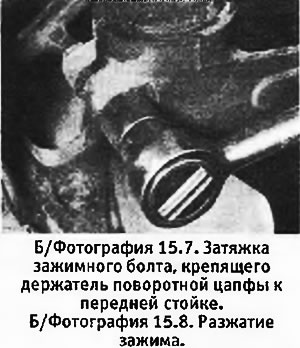
7. Remove the clamp bolt and nut securing the steering knuckle to the front strut (see photo).


[Original is contained on the portal PeugeotBook.ru]

8. Release the clamp using the handle of a 1/4-inch square socket wrench (see photo). Push the steering knuckle downwards to release it from the strut and rotate it outwards to clear the drive shaft.

9. If the drive shaft has a fixed fit in the hub, it should be removed using a puller. Do not attempt to drive the shaft out of the hub.

10. To remove the hub with the bearing from the steering knuckle, a number of special tools are required. Therefore, we recommend that you remove the steering knuckle assembly (separating the ball joints) and deliver it to a specialized workshop where they will remove the hub.


11. Replacing the wheel bearing also requires the use of special tools and should be performed by a specialist. Once the hub is disconnected from the steering knuckle, the bearing must be replaced. Please note that from 1985 onwards, later Peugeot models were fitted with larger wheel bearings.

12. The hub is installed in reverse order. Replace the nuts on the ball joints with new ones (if they were filmed) and on the drive shaft and tighten all fasteners to the required torque. Check the correct position of the rack (see chapter 9).
This article is available at russian, bulgarian, belarusian, ukrainian, serbian, croatian, romanian, polish, slovak, hungarian
Article reviewed by editor: Ostrovsky Fedor
Share information:
Previous
Peugeot 305: Shafts, hubs and wheels
Next

Drive shaft CV joints — maintenance
Drive shafts (models with XU engines)
Drive shafts — removal and installation
General description of drive shafts
Specification of drive shafts, hubs, wheels and tires
Rear wheel bearings — removal and installation
Rear Wheel Bearings (Late Models) — removal and installation
Wheels and tires — general information and maintenance
Diagnosing drive shaft faults
See similar information for other Peugeot models

➨ Fuel filter renewal — carburetor models Peugeot 106 (1991-2003)
➨ Removal and installation the front wheel drive (models with… Peugeot 206 (1998-2012)
➨ Adjusting the front seats and headrests Peugeot 405 (1987-1997)
➨ Front crankshaft oil seal (timing belt side) — replacement Peugeot 605 (1989-2000)
➨ Front doors Peugeot 806 (1994-2002)
Link to this article in different formats
Comments and feedback from visitors
No comments yet


Add two numbers 45 + 11


Peugeot 307 (2001-2008) 
  • User manual
  • Keys, doors and alarm
  • Controls and instruments
  • Driving and operation
  • Maintenance
  • Power unit
  • Petrol engines TU3 and TU5
  • Petrol engines EW10
  • Diesel engines DV10
  • Diesel engines DW10
  • Transmission
  • Clutch and drive shafts
  • Mechanical gearbox
  • Automatic gearbox
  • Chassis, running gear
  • Front suspension
  • Rear suspension
  • Steering
  • Brake system
  • Body and interior
  • Exterior (external elements)
  • Interior (internal elements)
  • Doors, locks and windows
  • Heating and air conditioning
  • Electrical equipment
  • Equipment and devices
  • Power devices
  • Airbags
  • Electrical circuits
Peugeot 306 (1993-2002) 
  • General information
  • Introduction to manual
  • Specifications
  • Gasoline engine
  • Engine repair
  • Lubrication system
  • Cooling system
  • Fuel injection
  • Ignition system
  • Diesel engine
  • Engine repair
  • Lubrication system
  • Cooling system
  • Fuel injection
  • Transmission
  • Clutch
  • Gearbox
  • Drive shafts
  • Chassis, running gear
  • Steering system
  • Front suspension
  • Rear suspension
  • Brake system
  • Electrical equipment
  • Power devices
  • Electrical circuits
Peugeot 305 (1977-1989) 
  • General information
  • Maintenance
  • Power unit
  • Gasoline engines
  • Diesel engines
  • Cooling system (gasoline)
  • Cooling system (diesel)
  • Fuel system (gasoline)
  • Fuel system (diesel)
  • Ignition system
  • Transmission
  • Clutch
  • Mechanical gearbox BB8
  • Mechanical gearbox BE1
  • Automatic gearbox ZF4
  • Shafts, hubs and wheels
  • Chassis, running gear
  • Brake system
  • Car suspension
  • Steering
  • Body and interior
  • Exterior (external elements)
  • Interior (internal elements)
  • Electrical equipment
  • Equipment and devices
  • Headlights and lighting
  • Power devices
  • Electrical circuits
  • Wiring diagrams (diesel)
PeugeotBook.ru © 2018–2026 | Mobile version | Sitemap: EN BG BY UA RS HR RO PL SK HU | Write message | Site search | Add to bookmarks | Peugeot owners
106 (1991-2003) | 206 (1998-2012) | 207 (2006-2014) | 305 (1977-1989) | 306 (1993-2002) | 307 (2001-2008) | 405 (1987-1997) | 406 (1995-2004) | 605 (1989-2000) | Partner-I (1996-2008) | Eurovans-807 (2002-2014) | Eurovans-806 (1994-2002) | J5 (1981-1993) |
Cookies are used to ensure the correct display of pages on the site.