



2. Apply the handbrake and engage first gear. Remove one of the wheel nuts and the hub cap. Unscrew and remove the hub nut. Remove the washer located underneath it. Loosen the remaining 2 wheel nuts.
3. While working under the machine, clean the surfaces near both ends of the drive shaft from dirt and grease. When removing the drive shaft, it is extremely important to prevent dirt from getting into exposed bearings, etc. Take measures to ensure that the shaft does not come out of the final drive housing on its own during the initial stages of its removal. There is a special Peugeot tool for this, but you can do it without it by wrapping the shaft itself and the bolts on the differential box with wire.
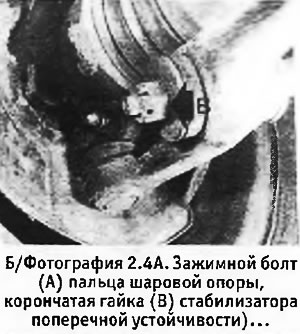
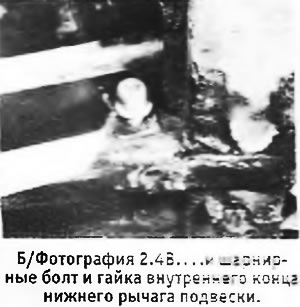
4. Unscrew the ball joint pin clamp nut (above the outer end of the lower suspension arm). Remove the cotter pin and castle nut with washers from the end of the stabilizer bar that extends through the lower control arm. Remove the nut from the pivot bolt at the inner end of the lower control arm. Loosen and remove the rear bolt securing the rigid stop above the pivot bolt of the inner end of the lower control arm (see photos).
 |
 |
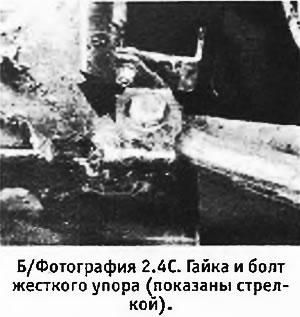
5. Remove the clamp bolt from the outer end of the lower control arm, remove the hard stop from the inner end of the control arm, and unscrew the pivot bolt at the inner end of the control arm.
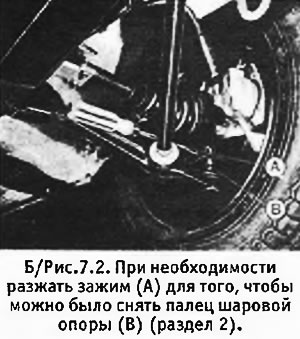
6. Place the jack immediately behind the front wheel arch, jack up the front of the car and support it securely. Pull the inner end of the lower control arm out of its mounting bracket and place a 120 mm thick wooden block under the front wheel. Lower the car onto its wheels and remove the ball joint pin from its clamp. If necessary, you can carefully release the clamp so that the finger can be removed (see B/Figure 7.2).
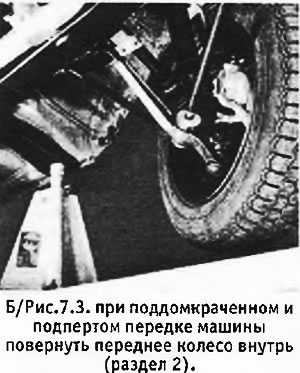
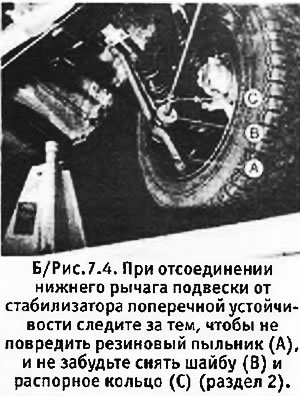
7. Raise and support the front of the car again. Turn the front wheel inward and disconnect the lower control arm from the anti-roll bar. Be careful not to damage the rubber boot of the ball joint. Remove the spacer ring and washer from the anti-roll bar, paying attention to how they were positioned.
 |
 |
8. Carefully rotate the front suspension strut outward while simultaneously pulling the drive shaft splines out of the hub.
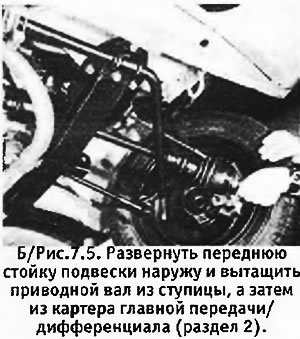
9. Remove the wire that secured the drive shaft and, turning the front wheel all the way outward, pull the drive shaft out of the final drive/differential housing. Be prepared for some oil to spill when doing this.
10. Remove the seals from the final drive/differential housing and from the hub. Both seals must be replaced with new ones.
11. Apply a small amount of grease to the new seal (with two sponges) and carefully hammer it into place into the final drive/differential housing with the spring side facing inward. Fill the space between the seal lips with universal grease. Install a new oil seal into the wheel hub in the same manner, making sure it rests against the bearing retaining ring, and fill the space between the seal lips with universal grease.
12. Before installing the drive shaft, inspect it for any obvious defects. Clean the splines on both ends of the shaft and apply a small amount of Molykote 321 R grease to the splines on the hub side (or similar antifriction lubricant).
13. Carefully insert the shaft into the final drive/differential housing, being careful not to damage the seal. Tie the shaft to the differential with wire so that it does not come out.
14. Insert the shaft into the hub, being careful not to damage the seal. Install the thrust washer and new nut, but do not tighten the nut yet.
15. Install the spacer ring and washer onto the anti-roll bar, making sure they are positioned exactly in their original position (see paragraph 7). Install the lower control arm onto the end of the stabilizer bar, being careful not to damage the rubber boot of the ball joint.
16. Insert the ball joint pin into its clamp on the hub and install the clamp bolt with the head facing backwards. Install the washer and castle nut onto the stabilizer bar without tightening the nuts yet.
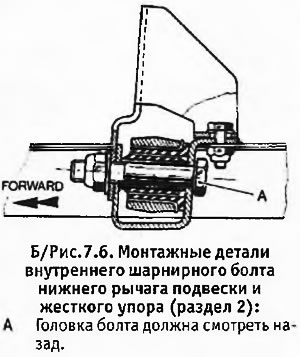
17. Install the rigid stop on its bracket, put a new washer on the bolt and install the bolt in place with the head facing up. Place the second washer on the bolt and install the new Nylstop nut, without tightening it yet.
18. Tighten the ball joint pin clamp bolt nut to the specified torque.
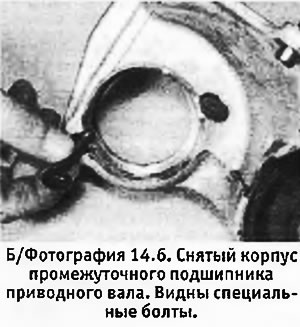 |
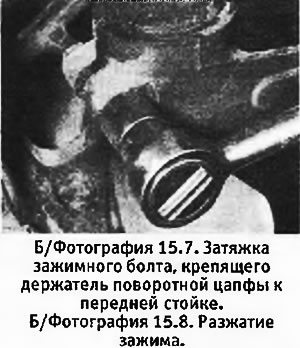 |
19. Lower the car to the ground. Now you need to load the front of the car so that the hole in the rubber bushing on the inner end of the lower suspension arm aligns with the bolt holes in the arm mounting bracket. There is a special Peugeot tool that allows you to pull the car body down so that it presses on the springs when the car is raised with a lift. In principle, you can get by with just a few spring compression devices. If you compress the front springs well, you will get the desired result. Alternatively, you can simply ask several people to sit on the hood, thereby pressing down on the front of the car. Once the hole in the bushing is aligned with the holes in the mounting bracket, insert the inner pivot bolt head-first and install a washer and a new Nylstop nut onto it, do not tighten it yet. Remove the spring compressors or have helpers climb down from the hood and remove the wire securing the drive shaft to the differential.
20. Tighten the hub nut to the required torque and, using a suitable blunt punch, drive the collar of the nut into the groove on the shaft to lock it. Install the hub cap and third wheel nut. Tighten the wheel nuts to the specified torque.
21. Release the handbrake and set the gear shift lever to neutral position. Rock the car back and forth to settle the suspension, then apply the handbrake again.
22. Install spring compressors on the front springs or reload the front end so that there is a 50 mm gap between the drive shafts and the fender edges. To achieve the desired gap, you can use two 50 mm high wooden blocks and insert them between the drive shafts and the fender edges.
23. Tighten the lower control arm inner pivot bolt nut to the specified torque. Tighten the nut and bolt securing the hard stop to the required torque.
24. Tighten the castle nut on the anti-roll bar to the specified torque. If the hole for the cotter pin does not align with the slot in the nut, tighten the nut a little more until the desired position is achieved, being careful not to exceed the maximum tightening torque. Install a new 3mm pin and lock the nut, then remove the spring compressors or remove the load from the hood.
25. Check the front wheel alignment (see chapter 9).
26. Fill the engine with oil and connect the negative cable to the battery.