
English Русский
Български
Беларускі
Український
Српски
Hrvatski
Română
Polski
Slovenský
Magyar
Bookmark Articles Sitemap Contacts
Company Hyundai Company Opel Company Skoda Company Kia Company Mitsubishi Company LADA Company Audi
PeugeotBook.ru


Series 100   Series 200   Series 300   400-500   Series 600   Crossovers   Others
 
Peugeot 106 (1991-2003)

Oil pump — removal, inspection and refitting (Peugeot 106)

  • Main
  • 10X
  • Peugeot 106 (1991-2003)
  • Power unit
  • Petrol engines
  • Oil pump — removal, inspection and refitting
0
Table of contents: Removal 🠇 Inspection 🠇 Refitting 🠇

Removal


1. Remove the sump as described in Section 14.

2. Slacken and remove the three bolts securing the oil pump in position (see illustration). Disengage the pump sprocket from the chain, and remove the oil pump. If the pump locating dowel is a loose fit, remove and store it with the retaining bolts for safekeeping.
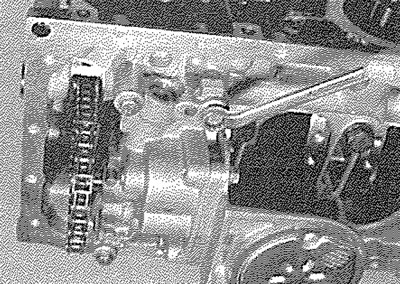
15.2. Oil pump is retained by three bolts

15.2. Oil pump is retained by three bolts


Inspection


3. Examine the oil pump sprocket for signs of damage and wear such as chipped or missing teeth. If the sprocket is worn, the pump assembly must be renewed, as the sprocket is not available separately. It is also recommended that the chain and drive sprocket, fitted to the crankshaft, is renewed at the same time. On aluminium block engines, renewal of the chain and drive sprocket is an involved operation requiring the removal of the main bearing ladder, and therefore cannot be carried out with the engine still fitted to the vehicle. On cast-iron block engines, the oil pump drive sprocket and chain can be removed with the engine in situ, once the crankshaft sprocket has been removed and the crankshaft oil seal housing has been unbolted. Refer to Part C for further information.


4. Slacken and remove the bolts securing the strainer cover to the pump body, then lift off the strainer cover. Remove the relief valve piston and spring (and guide pin - cast-iron block engines only), noting which way round they are fitted.

5. Examine the pump rotors and body for signs of wear ridges and scoring. If worn, the complete pump assembly must be renewed.

6. Examine the relief valve piston for signs of wear or damage, and renew if necessary. The condition of the relief valve spring can only be measured by comparing it with a new one; if there is any doubt about its condition, it should also be renewed. Both the piston and spring are available individually.

7. Thoroughly clean the oil pump strainer with a suitable solvent, and check it for signs of clogging or splitting. If the strainer is damaged, the strainer and cover assembly must be renewed.

8. Locate the relief valve spring, piston and (where fitted) the guide pin in the strainer cover, then refit the cover to the pump body.

Align the relief valve piston with its bore in the pump. Refit the cover retaining bolts, tightening them securely.

(Article based on material from the website: «PeugeotBook.ru»)

Refitting


9. Ensure that the locating dowel is in position, then engage the pump sprocket with its drive chain. Locate the pump on its dowel and refit the pump retaining bolts, tightening them to the specified torque setting.

10. Refit the sump as described in Section 14.
This article is available at russian, bulgarian, belarusian, ukrainian, serbian, croatian, romanian, polish, slovak, hungarian
Article reviewed by editor: Matveev Demid
Share information:
Previous
Peugeot 106: Petrol engines
Next

Sump — removal and refitting
Cylinder head (16-valve engines) — removal and refitting
Cylinder head (8-valve engines) — removal and refitting
Camshaft and followers (16-valve engines) — removal, inspection…
Camshaft and rocker arms (8-valve engines) — removal, inspection…
Crankshaft oil seals — renewal
Oil cooler (1294 cc and some 1360 cc & 1587 cc models) — removal…
Flywheel/driveplate — removal, inspection and refitting
Engine/transmission mountings — inspection and renewal
See similar information for other Peugeot models

➨ Turbocharger Cooling Pump Replacement (EP6DT Engines) Peugeot 207 (2006-2014)
➨ Oil pump — inspection and maintenance Peugeot 305 (1977-1989)
➨ Power steering pump (XU9J4) (10000 km/6 months) Peugeot 405 (1987-1997)
➨ Oil pump — removal Peugeot 605 (1989-2000)
➨ Oil pump — removal and installation Peugeot 806 (1994-2002)
Link to this article in different formats
Comments and feedback from visitors
No comments yet


Add two numbers 45 + 16


Peugeot 106 (1991-2003) 
  • General information
  • Introduction to manual
  • Weekly checks
  • Maintenance (petrol)
  • Maintenance (diesel)
  • Troubleshooting
  • Power unit
  • Petrol engines
  • Diesel engines
  • Engine overhaul
  • Cooling and heating
  • Fuel system (carburetor)
  • Single point injection (petrol)
  • Multipoint injection (petrol)
  • Fuel system (diesel)
  • Emission control system
  • Engine electrical equipment
  • Ignition system
  • Diesel heating
  • Transmission
  • Clutch
  • Manual gearbox
  • Automatic gearbox
  • Drive shafts
  • Chassis, running gear
  • Brake system
  • Car suspension
  • Steering
  • Body and interior
  • Exterior (external elements)
  • Interior (internal elements)
  • Doors, locks and windows
  • Electrical equipment
  • Equipment and devices
  • Electrical diagrams
PeugeotBook.ru © 2018–2026 | Mobile version | Sitemap: EN BG BY UA RS HR RO PL SK HU | Write message | Site search | Add to bookmarks | Peugeot owners
106 (1991-2003) | 206 (1998-2012) | 207 (2006-2014) | 305 (1977-1989) | 306 (1993-2002) | 307 (2001-2008) | 405 (1987-1997) | 406 (1995-2004) | 605 (1989-2000) | Partner-I (1996-2008) | Eurovans-807 (2002-2014) | Eurovans-806 (1994-2002) | J5 (1981-1993) |
Cookies are used to ensure the correct display of pages on the site.