
English Русский
Български
Беларускі
Український
Српски
Hrvatski
Română
Polski
Slovenský
Magyar
Bookmark Articles Sitemap Contacts
Company Hyundai Company Opel Company Skoda Company Kia Company Mitsubishi Company LADA Company Audi
PeugeotBook.ru


Series 100   Series 200   Series 300   400-500   Series 600   Crossovers   Others
 
Peugeot 206 (1998-2012) Peugeot 207 (2006-2014)

Draining, filling and removing air from the hydraulic drive of the brake system (Peugeot 206)

  • Main
  • 20X
  • Peugeot 206 (1998-2012)
  • Chassis, running gear
  • Brake system
  • Draining, filling and removing air from the hydraulic drive of the brake system
0
Drain the brake fluid from the hydraulic drive in the following order:

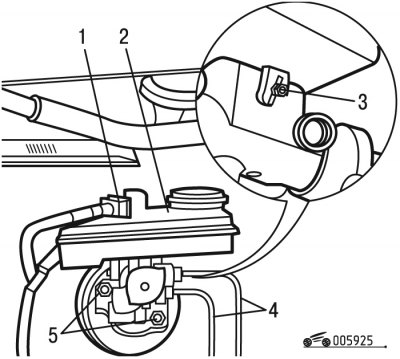
Figure 9.25. Removing the master brake cylinder: 1-pin connector; 2 - feed tank; 3 - cotter pin; 4…

Figure 9.25. Removing the master brake cylinder: 1-pin connector; 2 - feed tank; 3 - cotter pin; 4 - brake pipes; 5 - nuts

  • disconnect pin connector 1 (see figure 9.25) brake fluid level sensor;
  • unscrew the cap of the feed tank 2;
  • pump out the brake fluid from the reservoir using a syringe;
  • open the air bleed valves on all brake mechanisms so that brake fluid comes out of them when you press the brake pedal;
  • press and release the brake pedal until no more brake fluid comes out of each valve.

Fill the hydraulic drive with brake fluid in the following order:

Caution: Use only fresh brake fluid of the recommended brand or DOT4 brake fluid brand.

  • replace the brake fluid by bleeding the hydraulic drive of all brake mechanisms in the sequence indicated below;
  • when bleeding the hydraulic drive, ensure that the required level is maintained in the supply tank and constantly add brake fluid to it.

Remove air from the hydraulic drive in the following order:
  • front left wheel;
  • front right wheel;
  • rear left wheel;
  • rear right wheel.

After carrying out work involving the removal of the brake mechanism, bleed the hydraulic drive in the following order:


  • the brake mechanism that was removed;
  • front left wheel;
  • front right wheel;
  • rear left wheel;
  • rear right wheel.

Note: When removing and installing the master brake cylinder, it is recommended to complete automatic bleeding with manual bleeding.


Vehicles equipped with ABS


Note: Hydraulic blocks are supplied filled with brake fluid.


If manual or automatic bleeding of the hydraulic drive of the brake system with ABS did not give the desired results, bleed using the TEP 92, DIAG 2000 diagnostic device, following the instructions supplied with it.

All cars


  • - connect one end of the transparent tube to the air bleed valve, lower the other end into a transparent container with brake fluid poured into it;
  • press the brake pedal slowly;
  • hold the brake pedal down, while your assistant should unscrew the bleed valve - some of the brake fluid will spill into the container;
  • close the bleed valve after the pedal hits the floor;
  • release the brake pedal;
  • repeat the above operations until clean brake fluid, free of air bubbles, starts to flow out;
  • perform the same operations on the remaining brake mechanisms in the sequence indicated above.
This article is available at russian, bulgarian, belarusian, ukrainian, serbian, croatian, romanian, polish, slovak, hungarian
Article reviewed by editor: Matveev Demid
Share information:
Previous
Peugeot 206: Brake system
Next

Checking the operation and adjusting the parking brake
Removal and installation the pressure regulator
Removal and installation the brake booster
Removal and installation the master brake cylinder
Removal and installation rear drum brake shoes LUCAS
 
See similar information for other Peugeot models

➨ Hydraulic system — bleeding Peugeot 106 (1991-2003)
➨ Draining and filling fluid, removing air from the hydraulic… Peugeot 306 (1993-2002)
➨ Bleeding the hydraulic brake system Peugeot 405 (1987-1997)
➨ Brake system specifications Peugeot 605 (1989-2000)
➨ Brake system — filling fluid and bleeding air Peugeot 807 (2002-2014)
Link to this article in different formats
Comments and feedback from visitors
No comments yet


Add two numbers 43 + 35


Peugeot 207 (2006-2014) 
  • General information
  • Car care
  • Governing bodies
  • Driving and operation
  • Power unit
  • Engine characteristics
  • Engine repair
  • Cooling system
  • Lubrication system
  • Ignition system
  • Control system (gasoline)
  • Fuel system (gasoline)
  • Control system (diesel)
  • Transmission
  • Clutch
  • Mechanical gearbox
  • Automatic gearbox
  • Drive shafts
  • Chassis, running gear
  • Car suspension
  • Steering
  • Brake system
  • Body and interior
  • Exterior (external elements)
  • Interior (internal elements)
  • Heating and air conditioning
  • Electrical equipment
  • Equipment and devices
  • Headlights and lighting
  • Power devices
  • Electrical circuits
Peugeot 206 (1998-2012) 
  • General information
  • User manual
  • Maintenance
  • Power unit
  • Gasoline engines
  • Diesel engines
  • Diesel power system
  • Engine management system
  • Transmission
  • Clutch
  • Mechanical gearbox
  • Automatic gearbox
  • Drive shafts
  • Chassis, running gear
  • Front suspension
  • Rear suspension
  • Steering
  • Brake system
  • Body and interior
  • Body elements
  • Doors, locks and windows
  • Electrical equipment
  • Equipment and devices
  • Electrical circuits
PeugeotBook.ru © 2018–2026 | Mobile version | Sitemap: EN BG BY UA RS HR RO PL SK HU | Write message | Site search | Add to bookmarks | Peugeot owners
106 (1991-2003) | 206 (1998-2012) | 207 (2006-2014) | 305 (1977-1989) | 306 (1993-2002) | 307 (2001-2008) | 405 (1987-1997) | 406 (1995-2004) | 605 (1989-2000) | Partner-I (1996-2008) | Eurovans-807 (2002-2014) | Eurovans-806 (1994-2002) | J5 (1981-1993) |
Cookies are used to ensure the correct display of pages on the site.