
English Русский
Български
Беларускі
Український
Српски
Hrvatski
Română
Polski
Slovenský
Magyar
Bookmark Articles Sitemap Contacts
Company Hyundai Company Opel Company Skoda Company Kia Company Mitsubishi Company LADA Company Audi
PeugeotBook.ru


Series 100   Series 200   Series 300   400-500   Series 600   Crossovers   Others
 
Peugeot 206 (1998-2012) Peugeot 207 (2006-2014)

Draining, filling and bleeding the brake circuit (Peugeot 207)

  • Main
  • 20X
  • Peugeot 207 (2006-2014)
  • Chassis, running gear
  • Brake system
  • Draining, filling and bleeding the brake circuit
0
Table of contents: Fluid replacement 🠇 Filling the brake system 🠇 Pumping with a device 🠇 Pumping without a device 🠇
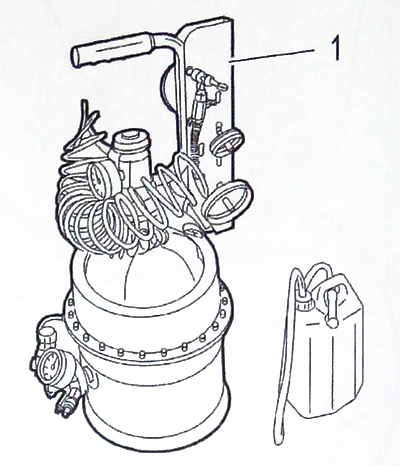
Special device:

Special device:
1 - a device for pumping "Luro" or similar.


Fluid replacement


Empty the brake reservoir (1) as much as possible (if necessary, use a clean syringe).

Disconnect the connector (4).

Disconnect the hose (2).

Unscrew and remove the axle (3).
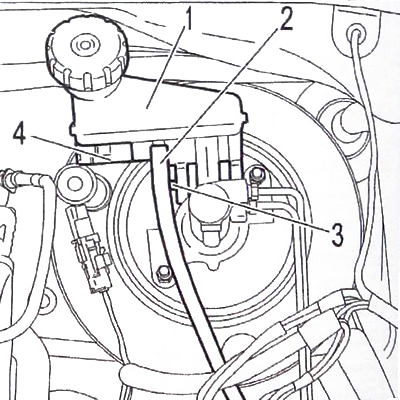
Unscrew and remove the axle (3).


Remove the brake fluid reservoir (1).

Drain the brake fluid from the reservoir and clean it.

Install the parts in reverse order.

Filling the brake system


Fill the brake fluid reservoir (1).

Caution: Before bleeding, check the brake fluid level and top it up if necessary. Use only clean, non-emulsified brake fluid.


During bleeding, the ABS system must be disabled.
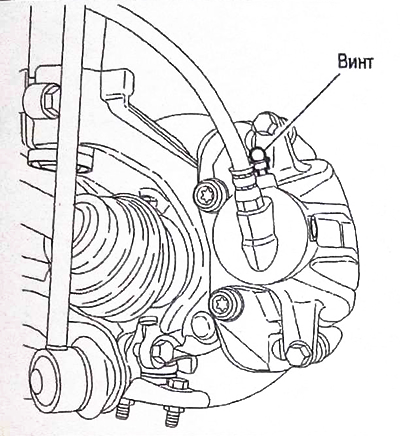
Front Brake Caliper Bleed Screw
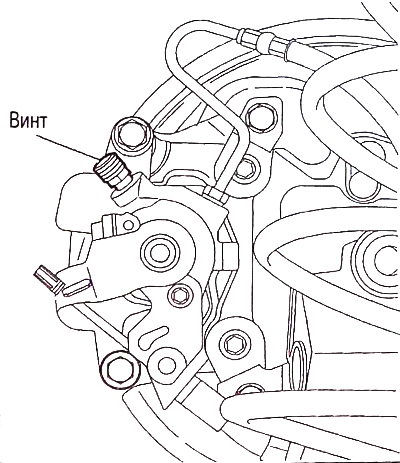
Front Brake Caliper Bleed Screw


Rear Brake Caliper Bleed Screw

Rear Brake Caliper Bleed Screw


When bleeding the brake cylinders, proceed in the following sequence:
  • front left wheel;
  • front right wheel;
  • rear left wheel;
  • rear right wheel.

Pumping with a device


Connect bleeding device 1 to the brake fluid reservoir.
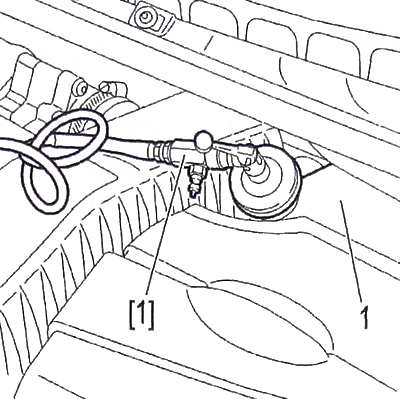
Connect bleeding device 1 to the brake fluid reservoir.


Adjust the pressure of the device to 2 bar.


Attach a transparent tube to the air release nipple, lower the other end of the tube into a clean container. Unscrew the nipple and wait until the liquid starts to flow out without air bubbles.

Close the bleed screw.

Disconnect the bleeding device.

Bleed each brake mechanism in the same manner in the sequence given above.

Make sure that the brake fluid level is normal (between the "MIN" and "MAX" marks).

If necessary, top up with brake fluid recommended and certified by the manufacturer.

Pumping without a device


Note: This procedure usually requires two people. If the procedure is being performed by one mechanic, use a suitable tool, such as a tire iron, to hold the brake pedal in the depressed position.


Press the brake pedal to build up pressure in the system.

Attach a transparent tube to the air release screw, lower the other end of the tube into a clean container. Loosen the drain screw and wait until the liquid starts to flow out without air bubbles.

Close the bleed screw.

Bleed each brake mechanism in the same manner in the sequence given above. Disconnect the bleeding device.
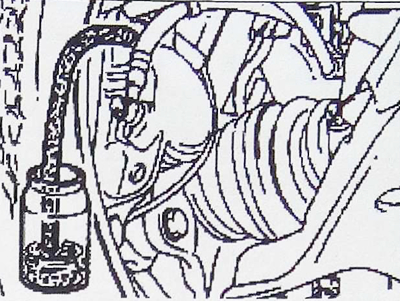
Bleed each brake mechanism in the same manner in the sequence given above. Disconnect the bleeding…


Note: If necessary, repeat the operation.


Make sure the brake fluid level is correct (between the "MIN" and "MAX" marks). If necessary, top up with brake fluid recommended and certified by the manufacturer.

[Original is contained on the portal PEUGEOTBOOK]
This article is available at russian, bulgarian, belarusian, ukrainian, serbian, croatian, romanian, polish, slovak, hungarian
Article reviewed by editor: Matveev Demid
Share information:
Previous
Peugeot 207: Brake system
Next

Checking and adjusting the parking brake
Brake system characteristics
Tightening torques for brake system components
General information about the braking system
Checking the front brake discs
Checking the rear brake discs
Checking the rear brake drum
Replacing the parking brake cables
Replacing the master brake cylinder
See similar information for other Peugeot models

➨ Front brake pad check Peugeot 106 (1991-2003)
➨ Bleeding the brake system Peugeot 305 (1977-1989)
➨ Filling coolant and bleeding air (diesel) Peugeot 405 (1987-1997)
➨ Brake system — bleeding Peugeot 605 (1989-2000)
➨ Power steering — draining and filling fluid, bleeding air Peugeot 806 (1994-2002)
Link to this article in different formats
Comments and feedback from visitors
No comments yet


Add two numbers 35 + 38


Peugeot 207 (2006-2014) 
  • General information
  • Car care
  • Governing bodies
  • Driving and operation
  • Power unit
  • Engine characteristics
  • Engine repair
  • Cooling system
  • Lubrication system
  • Ignition system
  • Control system (gasoline)
  • Fuel system (gasoline)
  • Control system (diesel)
  • Transmission
  • Clutch
  • Mechanical gearbox
  • Automatic gearbox
  • Drive shafts
  • Chassis, running gear
  • Car suspension
  • Steering
  • Brake system
  • Body and interior
  • Exterior (external elements)
  • Interior (internal elements)
  • Heating and air conditioning
  • Electrical equipment
  • Equipment and devices
  • Headlights and lighting
  • Power devices
  • Electrical circuits
Peugeot 206 (1998-2012) 
  • General information
  • User manual
  • Maintenance
  • Power unit
  • Gasoline engines
  • Diesel engines
  • Diesel power system
  • Engine management system
  • Transmission
  • Clutch
  • Mechanical gearbox
  • Automatic gearbox
  • Drive shafts
  • Chassis, running gear
  • Front suspension
  • Rear suspension
  • Steering
  • Brake system
  • Body and interior
  • Body elements
  • Doors, locks and windows
  • Electrical equipment
  • Equipment and devices
  • Electrical circuits
PeugeotBook.ru © 2018–2026 | Mobile version | Sitemap: EN BG BY UA RS HR RO PL SK HU | Write message | Site search | Add to bookmarks | Peugeot owners
106 (1991-2003) | 206 (1998-2012) | 207 (2006-2014) | 305 (1977-1989) | 306 (1993-2002) | 307 (2001-2008) | 405 (1987-1997) | 406 (1995-2004) | 605 (1989-2000) | Partner-I (1996-2008) | Eurovans-807 (2002-2014) | Eurovans-806 (1994-2002) | J5 (1981-1993) |
Cookies are used to ensure the correct display of pages on the site.