
English Русский
Български
Беларускі
Український
Српски
Hrvatski
Română
Polski
Slovenský
Magyar
Bookmark Articles Sitemap Contacts
Company Hyundai Company Opel Company Skoda Company Kia Company Mitsubishi Company LADA Company Audi
PeugeotBook.ru


Series 100   Series 200   Series 300   400-500   Series 600   Crossovers   Others
 
Peugeot 206 (1998-2012) Peugeot 207 (2006-2014)

Checking the electrolyte level (Peugeot 207)

  • Main
  • 20X
  • Peugeot 207 (2006-2014)
  • Electrical equipment
  • Power devices
  • Checking the electrolyte level
0
Table of contents: SAE Cold Cranking Current Values,…🠇 Cold cranking current values…🠇
Note: Check the electrolyte level at each regular service. More frequent checks may be required for vehicles driven in severe conditions or in hot climates. Always check the electrolyte level before and after charging the battery.


Unscrew the battery plugs.

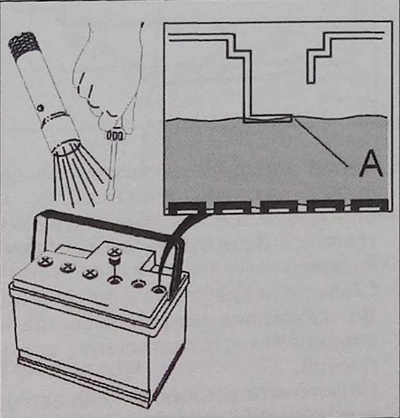
Check the level in all battery cells. Each cell has its own maximum mark (A).

Fill the battery to the maximum mark "A" with distilled or ionized water.

Caution: Do not use ordinary water, it may damage the battery.


SAE Cold Cranking Current Values, Corresponding Capacity and Recommended Continuous Charging Current
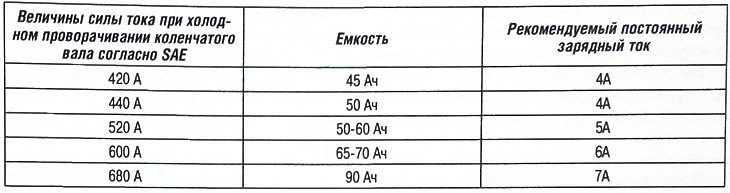


SAE Cold Cranking Current Values, Corresponding Capacity and Recommended Continuous Charging Current

Cold cranking current values according to DIN standard, corresponding capacity and recommended continuous charging current
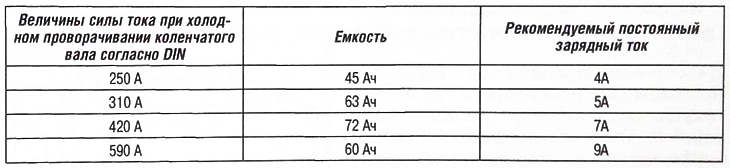

Cold cranking current values according to DIN standard, corresponding capacity and recommended…

Cold cranking current values according to DIN standard, corresponding capacity and recommended…


Caution: Do not fill the battery above the maximum mark. This may cause electrolyte leakage.


Install the plugs.

Caution: Do not replace the grey plugs (with exhaust filter) on black (tightly closed plugs).


Tighten the plugs completely.

Warning: The battery contains a hydrogen-oxygen mixture that is highly explosive. Open fire or smoking near the battery may cause an explosion.


The electrolyte is highly toxic. If it comes into contact with your skin, clothing or vehicle paintwork, rinse the area immediately with plenty of water.

If electrolyte gets into the engine compartment, it can cause corrosion of the engine and vehicle wiring.

[Material copied from the resource: peugeotbook]
This article is available at russian, bulgarian, belarusian, ukrainian, serbian, croatian, romanian, polish, slovak, hungarian
Article reviewed by editor: Matveev Demid
Share information:
Previous
Peugeot 207: Power devices
Next

Battery marking
Battery Testing Methods
Charging batteries
Disconnecting the battery
Checking the power supply system and electricity consumers
Generator — General Information
See similar information for other Peugeot models

➨ Automatic transmission fluid level check Peugeot 106 (1991-2003)
➨ Checking the electrolyte level in the battery Peugeot 307 (2001-2008)
➨ Checking the transmission oil level (10,000 km/6 months) Peugeot 405 (1987-1997)
➨ Engine Oil Level — Checking and Replacing Peugeot 605 (1989-2000)
➨ Engine oil level — checking and replacing Peugeot 806 (1994-2002)
Link to this article in different formats
Comments and feedback from visitors
No comments yet


Add two numbers 33 + 32


Peugeot 207 (2006-2014) 
  • General information
  • Car care
  • Governing bodies
  • Driving and operation
  • Power unit
  • Engine characteristics
  • Engine repair
  • Cooling system
  • Lubrication system
  • Ignition system
  • Control system (gasoline)
  • Fuel system (gasoline)
  • Control system (diesel)
  • Transmission
  • Clutch
  • Mechanical gearbox
  • Automatic gearbox
  • Drive shafts
  • Chassis, running gear
  • Car suspension
  • Steering
  • Brake system
  • Body and interior
  • Exterior (external elements)
  • Interior (internal elements)
  • Heating and air conditioning
  • Electrical equipment
  • Equipment and devices
  • Headlights and lighting
  • Power devices
  • Electrical circuits
Peugeot 206 (1998-2012) 
  • General information
  • User manual
  • Maintenance
  • Power unit
  • Gasoline engines
  • Diesel engines
  • Diesel power system
  • Engine management system
  • Transmission
  • Clutch
  • Mechanical gearbox
  • Automatic gearbox
  • Drive shafts
  • Chassis, running gear
  • Front suspension
  • Rear suspension
  • Steering
  • Brake system
  • Body and interior
  • Body elements
  • Doors, locks and windows
  • Electrical equipment
  • Equipment and devices
  • Electrical circuits
PeugeotBook.ru © 2018–2026 | Mobile version | Sitemap: EN BG BY UA RS HR RO PL SK HU | Write message | Site search | Add to bookmarks | Peugeot owners
106 (1991-2003) | 206 (1998-2012) | 207 (2006-2014) | 305 (1977-1989) | 306 (1993-2002) | 307 (2001-2008) | 405 (1987-1997) | 406 (1995-2004) | 605 (1989-2000) | Partner-I (1996-2008) | Eurovans-807 (2002-2014) | Eurovans-806 (1994-2002) | J5 (1981-1993) |
Cookies are used to ensure the correct display of pages on the site.