



Table of contents: Troubleshooting and testing the…🠇 Measuring current in resting…🠇
Troubleshooting and testing the power supply system
Check battery, starter and alternator terminals and cables for loose, corroded or damaged cable terminals and wiring.
Check the charging current and charging voltage of the generator.
Check that the alternator freewheel pulley is functioning properly. Increase engine speed to 3000 rpm - no additional electrical consumers should be running. Switch off the engine. Check that the alternator clutch continues to rotate longer than the engine. In cold weather, the battery charge lamp in the instrument cluster may come on for a few seconds after starting. This is due to the overrunning clutch needing additional time to heat up the bearing grease. A constantly lit battery charge lamp may indicate that the overrunning clutch is not locking in relation to the alternator rotor shaft. Check the tension of the accessory drive belt. Check the belt for wear (see section "Engine and control systems").
Measure the power consumption at idle voltage.
Measuring current in resting position (by car)
Open the hood.
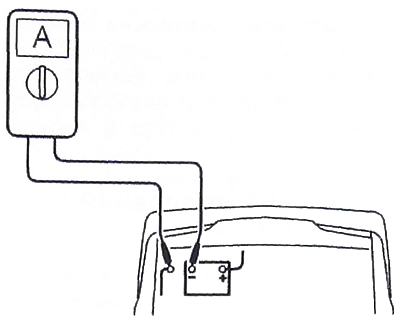
Connect the multimeter between the negative wire in the wiring and the negative terminal of the battery. Start with the 10 A measurement range. Continue in the decreasing direction until a suitable measurement range is found. If the quiescent current is 10 mA higher than the maximum, install a larger battery in the car. If a large battery is already installed, find the main components of the power consumption in the quiescent state. This can be done by measuring the quiescent voltages at the moment when the consumer fuses are removed one by one.
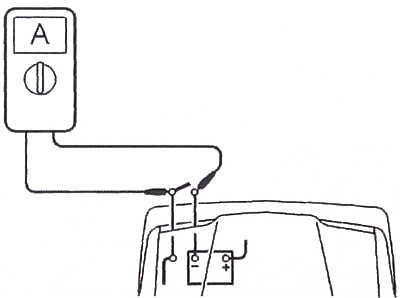
Then measure the quiescent voltage with the car locked and the alarm armed. This will require a length of wiring long enough to measure with the car locked, the hood on, and the alarm armed. The wiring should be connected between the negative cable and the negative terminal of the battery. Connect the multimeter.
Open the circuit after one minute to allow current to flow through the multimeter.
Calculation of the maximum allowable quiescent voltage.
[Data published on the website: PEUGEOTBOOK.ru]
Determine the capacity of the battery in the vehicle to calculate the maximum allowable idle voltage.
Formula: *Ah/504 h/4 = I mA (* = battery capacity, I = quiescent current).
For example: capacity / 3 weeks * 25% = quiescent voltage 65 Ah / 504 h * 0.25 = 32.2 mA.