



Table of contents: Removal 🠇 Installation 🠇
Removal
Disconnect the cable from the negative terminal of the battery.
Remove the right mudguard.
Caution: Use chalk, marker, or paint to mark the direction of rotation of the timing belt. If the timing belt rotates in the opposite direction during installation, it will be damaged.
Remove the accessory drive belt.
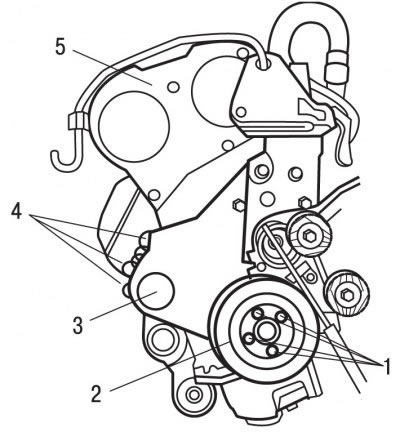
Figure 3.86. Removing the lower and upper timing belt covers: 1, 4 - bolts; 2 - auxiliary drive belt pulley; 3 - lower toothed belt cover; 5 - upper toothed belt cover
Remove bolts 1 (figure 3.86) and remove pulley 2 of the accessory drive belt.
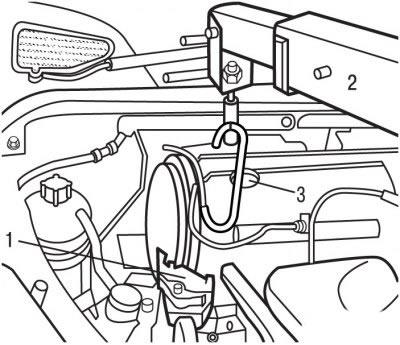
Figure 3.87. Location of the right intermediate engine support (1) and grips (3) of the lifting mechanism (2)
Hook the grips 3 (figure 3.87) lifting mechanism 2 by the engine lifting eye and lift it so that the engine weight is supported by the lifting mechanism.
Remove the right intermediate engine mount 1.
Remove the top cover 5 (see Figure 3.86) toothed belt.
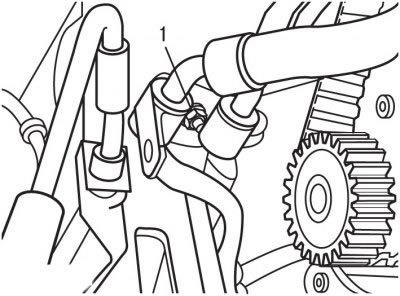
Figure 3.88. Location of the bolt (1) securing the hydraulic power steering hoses
Remove bolt 1 (figure 3.88) hydraulic power steering hose fastenings, move the hoses to the side and secure them in this position.
Remove the lower cover 3 (see Figure 3.86) toothed belt, being careful not to damage it. Do not remove bolts 4.
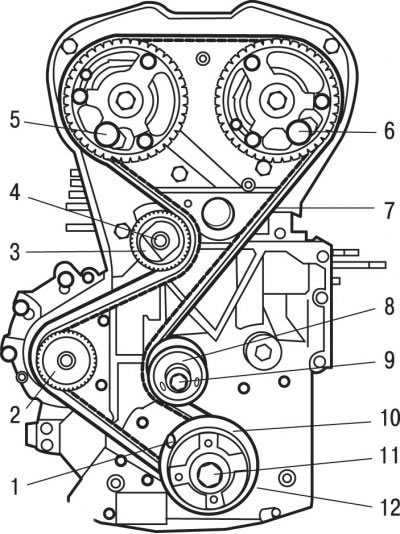
Figure 3.74. Timing drive elements: 1 - a special device for fixing the engine crankshaft from turning; 2 - water pump; 3 - tension roller; 4 - bolt; 5, 6 - special devices for fixing camshafts from turning; 7 - toothed belt; 8 - guide roller; 9 - bolt; 10 - flange; 11 - central bolt; 12 - toothed belt pulley
Special device 1 (see Figure 3.74) fix the engine crankshaft from turning.
Using special tools 5 and 6, secure the camshafts from turning.
Loosen bolt 4 as much as possible and release tension roller bracket 3 from the cylinder block lug to increase its freedom of movement.
Remove toothed belt 7.
Installation
Attention!
- 1. Do not twist or bend the timing belt. Prevent the timing belt from coming into contact with oil, coolant or fuel.
- 2. If the outer surface of the timing belt is significantly worn or delaminated, check the condition of the idler and tension roller races.
- 3. If there are any defects on the timing belt, replace it.
Check that the guide and tension rollers rotate smoothly and evenly.
If the guide roller was replaced, tighten the roller mounting bolt to a torque of 35 N·m.
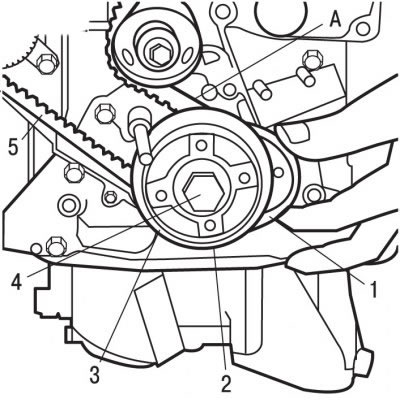
Figure 3.75. Installing the toothed belt on the crankshaft pulley: 1 - a special device for fastening the toothed belt to the crankshaft pulley; 2 - toothed belt pulley; 3 - flange; 4 - central bolt; 5 - toothed belt; A - branch of the toothed belt
Install toothed belt 5 on crankshaft pulley 2 (see Figure 3.75).
Using special tool 1, secure toothed belt 5 to crankshaft pulley 2.
Install the timing belt of the gas distribution mechanism sequentially on the guide roller 8, the camshaft pulley of the intake valves, the camshaft pulley of the exhaust valves, the water pump 2 and the tension roller 3 (see Figure 3.74).
Remove special tool 1 (see Figure 3.75).
Remove special tools 5 and 6 (figure 3.74), locking camshafts from turning.
Operations to adjust the timing belt tension must be performed on a cold engine.
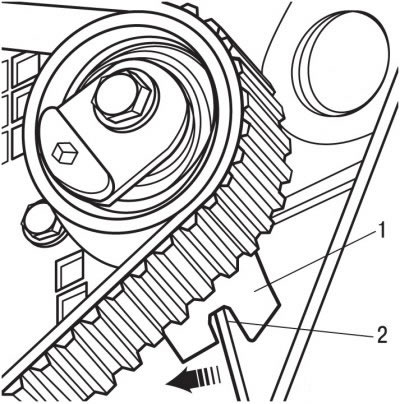
Figure 3.89. Installing the tension roller bracket (1) onto the cylinder block boss (2)
Install the tension roller bracket 1 (figure 3.89) on the tide 2 cylinder blocks.
Remove special tool 1 holding toothed belt 5 on crankshaft pulley 2 (see Figure 3.75).
(Article republished from the website: «www.PeugeotBook.ru»)
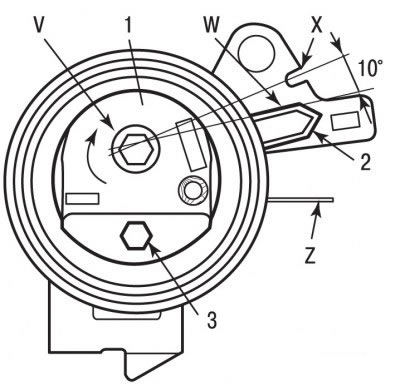
Figure 3.76. Positions of the tension roller when adjusting the toothed belt tension: 1 - tension roller; 2 - pointer; 3 - hex head; V - direction of rotation of the tension roller; W - conditional line of belt pre-tensioning; X - notch for final belt tensioning; Z - connecting plane of the cylinder head
For hex head 3 (see Figure 3.76) turn tension roller 1 to a position in which pointer 2 aligns with the conventional line W, while the tension of the toothed belt will be maximum.
Attention! When combining pointer 2 (see Figure 3.76) with the imaginary line W, it must pass through the notch X at an angle of at least 10°. Otherwise, replace the tension roller or the tension roller and timing belt.
Install calibrated pin 0189-J to lock the dynamic tensioner roller in the specified position.
For hex head 3 (see Figure 3.76) turn the tension roller in the direction opposite to the arrow until the slider contacts the pin. This operation allows you to set the indicator 2 opposite the notch X, i.e. in the position of the nominal tension of the toothed belt.
Caution! Do not turn the tension roller a full turn. The pointer should not move beyond the notch X, otherwise repeat the timing belt tensioning operations.
Tighten the tension roller mounting bolt to 20 Nm.
Caution! The tension roller should not turn when tightening its mounting bolt; otherwise, repeat the timing belt tensioning operations.
The hexagon for turning the tension roller must be located below the connecting plane of the cylinder head Z (see Figure 3.76). Otherwise, replace the tension roller or tension roller and timing belt.
Remove the special devices that secure the camshafts and flywheel from turning.
Turn the engine crankshaft 10 revolutions, while no pressure or external influences should be applied to the timing belt.
Check that pointer 2 (see Figure 3.76) aligned with the notch X. Otherwise, repeat the toothed belt tensioning operations.
Install the lower timing belt cover 3 (see Figure 3.86).
Install the accessory drive belt pulley and secure it with bolts, tightening them to a torque of 20 Nm.
Install the upper cover of the 5 toothed belt.
Install the hydraulic power steering hoses in place and secure them with bolt 1 (see figure 3.88).
Install the right intermediate engine support 1 (see Figure 3.87).
Unhook the clamp 3 of the lifting mechanism 2 from the engine.
Install the accessory drive belt.
Further installation is carried out in the reverse order of removal.
Connect the cable to the negative terminal of the battery.