



Caution! Replace any clamps or clips that are damaged or cut during removal with new ones when installing the cylinder head. When replacing the cylinder head, fill the cooling system with fresh coolant.
Removal
Drain the coolant from the engine cooling system.
Disconnect the exhaust pipe from the exhaust manifold.
Remove the decorative cover from the engine.
Relieve the pressure in the fuel system by connecting special tool 0141-T1 to the SHRADER valve and collecting gasoline in a container.
Disconnect the terminals from the battery.
Disconnect the electrical connectors from the throttle body.
Disconnect the fuel vapor recovery tubes from the fittings.
Disconnect the flexible clutch cable.
Disconnect the exhaust gas recirculation tube from the fitting.
Remove the oil level indicator tube mounting bolt.
Remove the air intake pipe.
Remove the accessory drive belt.
Remove the timing belt.
Remove the timing belt tensioner roller.
Install the right intermediate engine mount.
Remove the cylinder head cover mounting bolts.
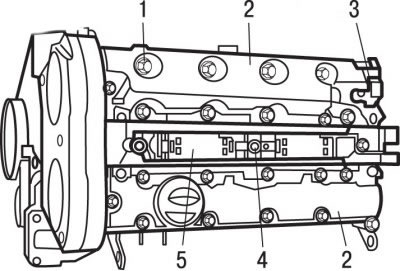
Figure 3.77. Location of bolts (1) for fastening the cylinder head covers (2), the current phase sensor in the cylinder (3) and bolts (4) for fastening the ignition coil unit (5)
Remove the current phase sensor in cylinder 3 (see Figure 3.77).
Remove the cylinder head covers 2.
Unscrew bolts 4 and remove the compact ignition coil block 5.
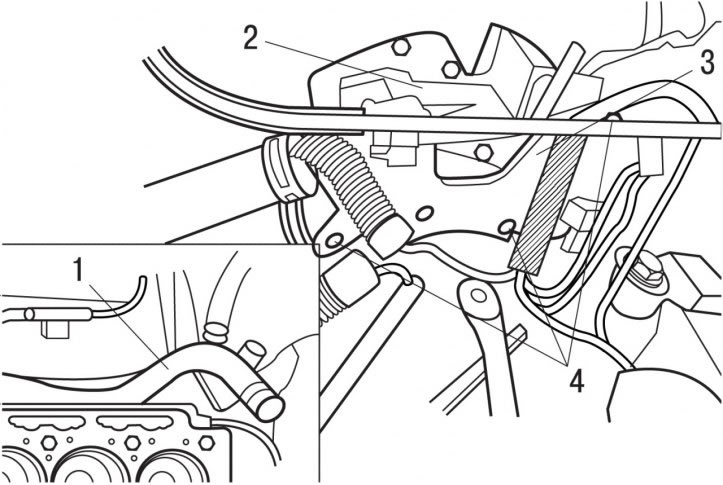
Figure 3.82. Location of the rigid tube (1) connecting the water pump to the coolant outlet block (2), the support (3) of the wiring harness and bolts (4)
On the flywheel side, loosen bolts 4 (figure 3.82).
Move the wire harness support 3 to the side.
Remove the rigid pipe 1 connecting the water pump to the coolant outlet block 2.
Move the coolant outlet block 2 away from the cylinder head.
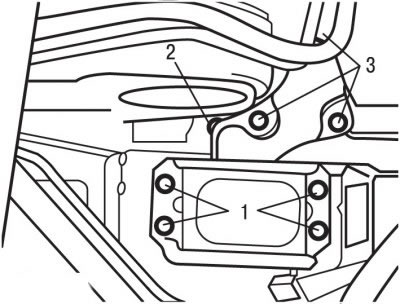
Figure 3.52. Location of bolts (1, 2, 3) for fastening the engine bracket
Loosen bolt 2 as much as possible (see Figure 3.52).
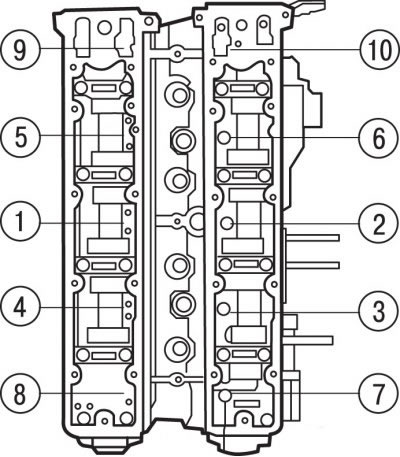
Figure 3.70. Cylinder head bolt tightening sequence
In the reverse order of tightening, gradually loosen and then completely unscrew the cylinder head mounting bolts (see Figure 3.70).
Before removing the cylinder head, make sure all hoses, lines and connectors are disconnected from it.
Using a lifting mechanism, remove the cylinder head together with the exhaust manifold and place it on a soft surface.
Remove the cylinder head gasket.
Preparing the cylinder head for installation
On the camshafts, clean the surfaces that contact the seals.
The mating surfaces of the cylinder head and block must be completely clean. To clean them, use a hard plastic or wooden scraper. When cleaning, be careful as the aluminum alloy is very easy to damage. Make sure that carbon deposits do not get into the lubrication and cooling system channels. This is especially important for the lubrication system, as carbon deposits can block the supply of oil to engine parts. Clean the channels if necessary.
Check the mating surfaces of the cylinder head and block: they should not have any nicks, deep scratches or other damage. Minor defects can be removed by mechanical processing. In case of significant defects, parts are subject to replacement.
Using a metal ruler and feeler gauge, check the mating surfaces for flatness.
If the deviation from flatness exceeds 0.05 mm, regrind the head.
Clean the threads of the cylinder head bolt holes.
Clean the bolt holes in the block. Remember that driving a bolt into an oil filled hole can cause the block to burst due to hydraulic pressure.
Before reusing bolts, measure the length of the bolts to the base of the head, which should be 147.0 mm.
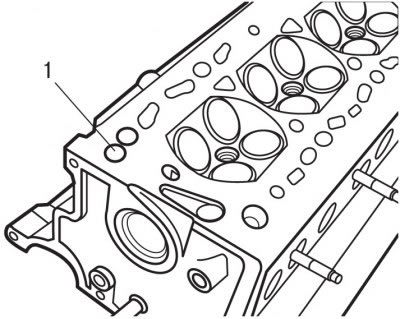
Figure 3.83. Location of the non-return valve (1) in the cylinder head
Replace the non-return valve 1 in the cylinder head (figure 3.83).
Installation
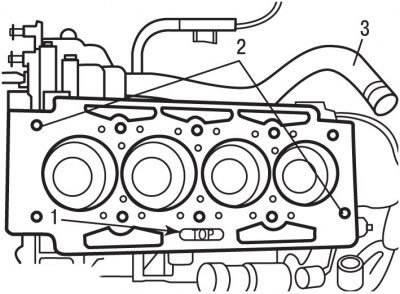
Figure 3.69. Location of centering bushings (1) and the "TOP" inscription (2) on the cylinder head gasket and the rigid pipe (3) of the cooling system
Check for the presence of centering bushings 1 (see figure 3.69) in the cylinder block.
Check the condition of the sealing rings of the rigid tube 3 and install the tube into the water pump.
The new cylinder head gasket must be removed from its packaging immediately before installation.
Install the gasket on the guide bushings 2, with the inscription 1 "TOP" facing the head and located on the side of the oil filter.
Install the coolant outlet block onto the cylinder head.
Install pipe 3 into the coolant outlet block.
Install the cylinder head with the timing belt pulley fixed.
Apply a thin coat of MOLYKOTE RAPID PLUS grease to the threads of the cylinder head bolts, insert the bolts and tighten them by hand.
Consistently (see Figure 3.70), tighten the cylinder head bolts in several stages:
- 1st - tighten to 15 Nm;
- 2nd - tighten to 50 Nm;
- 3rd - unscrew the bolts one turn (360°);
- 4th - tighten to 20 Nm;
- 5th - tighten to an angle of (285±5)°.
[Source can be seen at peugeotbook]
Further installation of the cylinder head is carried out in the reverse order of removal, taking into account the following.
Fill the cavities located under the hydraulic valve lifters with fresh engine oil.
Tighten bolt 2 (see Figure 3.52) torque of 45 Nm.
Install the cylinder head covers.
Install the current phase sensor in cylinder 3 (see Figure 3.77).
Install the ignition coil block 5 and secure it with bolts 4.
Install the mounting bolts and screw them in until the bolt heads contact the cylinder head covers.
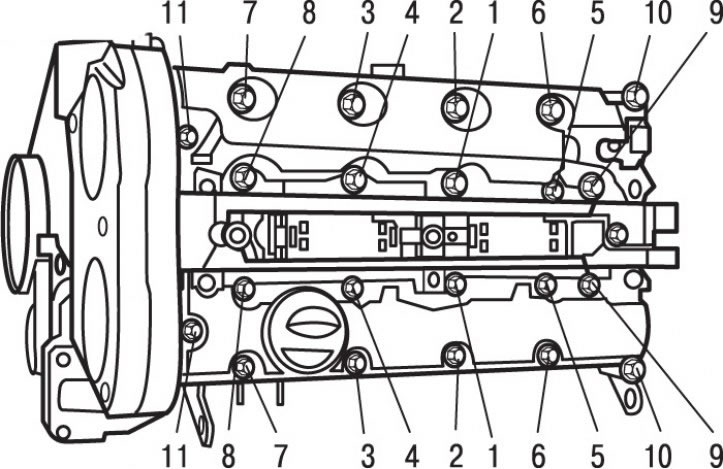
Figure 3.78. Tightening sequence (numbers in circles) cylinder head cover mounting bolts
Consistently (see Figure 3.78), tighten the cylinder head cover bolts in several stages:
- 1st - tighten to 5 Nm;
- 2nd - tighten to 15 Nm.
Remove the right intermediate engine mount.
Install the timing belt and adjust its tension.
Install the accessory drive belt.
Further installation of the cylinder head is carried out in the reverse order of removal.
Fill with coolant and bleed it.