
English Русский
Български
Беларускі
Український
Српски
Hrvatski
Română
Polski
Slovenský
Magyar
Bookmark Articles Sitemap Contacts
Company Hyundai Company Opel Company Skoda Company Kia Company Mitsubishi Company LADA Company Audi
PeugeotBook.ru


Series 100   Series 200   Series 300   400-500   Series 600   Crossovers   Others
 
Partner I (1996-2008) Peugeot 807 (2002-2014) Peugeot 806 (1994-2002) Peugeot J5 (1981-1993)

Radiator — removal and installation (Peugeot Eurovans 806)

  • Main
  • Пежо
  • Peugeot 806 (1994-2002)
  • Power unit
  • Cooling system
  • Radiator — removal and installation
0
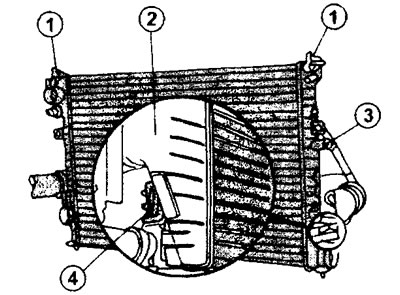
Removal and installation of the radiator is performed after dismantling the front trim of the car. Depending on the car model, the radiator block consists of the following parts: (see illustrations 3.0 and 3.0a).

3.0 Car radiator without air conditioning

3.0 Car radiator without air conditioning
1 - fastening latches
2 - supercharger air radiator (intercooler)
3 - self-tapping screws
4 - fastening of the supercharger radiator
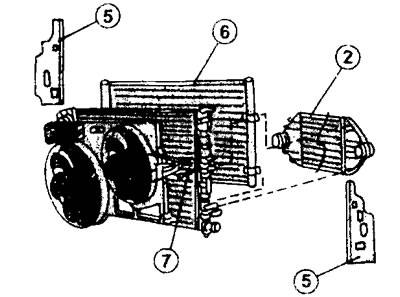

3.0a Car radiator with air conditioning

3.0a Car radiator with air conditioning
5 - radiator guides
6 - evaporator
7 - mounting bolt


A certain pressure is created in the cooling system. The expansion tank cap has a valve that opens when the system pressure reaches a certain value (1.4 bar). To check the condition of the expansion tank cap, a special device (a pump) is required to create the required pressure. The expansion tank cap is screwed onto the pump, which pumps air until the release valve on the cap opens. The valve opening must occur within the nominal values of excess pressure. If the valve operates at other pressure values, the cover must be replaced.


The expansion tank cap valve test pump can be used to test the cooling system for leaks. To do this, the pump is attached to the filler neck of the radiator or expansion tank. The device creates a pressure of approximately 1.0 bar in the system. Monitor the device to ensure the pressure in the system remains at this level for at least 2 minutes. If the pressure drops during this time, the system is not sealed and a leak is occurring. The location of the leak is fairly easy to determine by the liquid escaping under pressure.

(Original is contained on the portal: «PEUGEOTBOOK.ru»)
This article is available at russian, bulgarian, belarusian, ukrainian, serbian, croatian, romanian, polish, slovak, hungarian
Article reviewed by editor: Shirokov Arseny
Share information:
Previous
Peugeot 806: Cooling system
Next

Coolant — draining and filling
General description and precautions
Cooling system specifications
Water pump — removal and installation
Removal the thermostat
Cooling liquid
Checking thermal switches
Radiator blower fan
See similar information for other Peugeot models

➨ Radiator — removal, inspection and refitting Peugeot 106 (1991-2003)
➨ Removal and installation lower radiator hoses with quick-release… Peugeot 207 (2006-2014)
➨ Radiator — removal and installation Peugeot 305 (1977-1989)
➨ Oil radiator — removal and installation Peugeot 405 (1987-1997)
➨ Radiator — removal and installation Peugeot 605 (1989-2000)
Link to this article in different formats
Comments and feedback from visitors
No comments yet


Add two numbers 47 + 50


Partner I (1996-2008) 
  • General information
  • Introduction to the guide
  • Faults en route
  • Weekly checks
  • User manual
  • Maintenance (petrol)
  • Maintenance (diesel)
  • Power unit
  • Petrol engines
  • Diesel engines «XUD»
  • Diesel engines «DW»
  • Overhaul of petrol engines
  • Overhaul of diesel engines
  • Cooling and heating
  • Power and exhaust (petrol)
  • Power and exhaust (XUD diesels)
  • Power and exhaust (DW diesels)
  • Emission reduction
  • Starting and charging system
  • Transmission
  • Clutch
  • Mechanical gearbox
  • Drive shafts
  • Chassis, running gear
  • Brake system
  • Car suspension
  • Steering
  • Body and interior
  • Exterior (external elements)
  • Interior (internal elements)
  • Doors, locks and windows
  • Electrical equipment
  • Equipment and devices
  • Electrical circuits
Peugeot 807 (2002-2014) 
  • General information
  • Operating instructions
  • Maintenance
  • Troubleshooting
  • Power unit
  • Gasoline engines
  • Diesel engines
  • Cooling and heating
  • Fuel injection (petrol)
  • Fuel system (diesel)
  • Fuel system
  • Exhaust system
  • Ignition system
  • Transmission
  • Clutch
  • Manual gearbox
  • Automatic gearbox
  • Chassis, running gear
  • Brake system
  • Car suspension
  • Steering system
  • Body and interior
  • Exterior (external elements)
  • Interior (internal elements)
  • Electrical equipment
  • Power devices
  • Electrical circuits
Peugeot 806 (1994-2002) 
  • General information
  • User manual
  • Maintenance
  • Power unit
  • Petrol engines
  • Diesel engines
  • Lubrication system
  • Cooling system
  • Fuel injection (petrol)
  • Fuel system (diesel)
  • Ignition and exhaust systems
  • ECM Bosch Motronic MP 3.2
  • ECM Magneti-Marelli (MM)
  • Transmission
  • Clutch
  • Mechanical gearbox
  • Chassis, running gear
  • Brake system
  • Car suspension
  • Steering
  • Electrical equipment
  • Equipment and devices
  • Electrical circuits
Peugeot J5 (1981-1993) 
  • General information
  • Introduction to manual
  • Specifications
  • Gasoline engine
  • Engine repair
  • Lubrication system
  • Cooling system
  • Fuel system
  • Ignition system
  • Diesel engine
  • Engine repair (DB9)
  • Lubrication system (DB9)
  • Cooling system (DB9)
  • Fuel injection (DB9)
  • Engine repair (U25)
  • Lubrication system (U25)
  • Cooling system (U25)
  • Fuel injection (U25)
  • Transmission
  • Clutch
  • Gearbox
  • Drive shafts
  • Chassis, running gear
  • Steering system
  • Car suspension
  • Brake system
  • Electrical equipment
  • Power devices
  • Electrical circuits
PeugeotBook.ru © 2018–2026 | Mobile version | Sitemap: EN BG BY UA RS HR RO PL SK HU | Write message | Site search | Add to bookmarks | Peugeot owners
106 (1991-2003) | 206 (1998-2012) | 207 (2006-2014) | 305 (1977-1989) | 306 (1993-2002) | 307 (2001-2008) | 405 (1987-1997) | 406 (1995-2004) | 605 (1989-2000) | Partner-I (1996-2008) | Eurovans-807 (2002-2014) | Eurovans-806 (1994-2002) | J5 (1981-1993) |
Cookies are used to ensure the correct display of pages on the site.