



1. Unscrew the thermostat housing cover mounting bolts and remove the thermostat. The thermostat housing cover has a rubber sealing ring (see illustration).
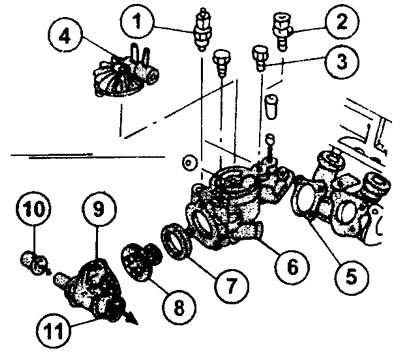
5.1 Thermostat housing for a 1.9 liter diesel engine
1 - coolant temperature indicator lamp thermal switch
2 - thermal switch
3 - cork
4 - fuel heating unit
5 - thermostat housing sealing gasket
6 - thermostat housing
7 - sealing ring
8 - thermostat
9 - thermostat housing cover
10 - oil radiator hose branch
11 - Upper radiator hose branch pipe
The thermostat cannot be repaired and is replaced with a new one in case of defect. Checking the thermostat is quite simple.
2. Attach the thermostat to the wire and lower it into a container of cold water. Similarly, secure the thermometer in the container. The thermostat and thermometer should not touch the walls of the container.
3. Heat the water in the container and watch to see if the thermostat starts to open when the water heats up to the thermostat opening temperature. When the water heats up to a certain temperature, the thermostat should open completely. The thermostat opening temperature is specified in the specifications. The thermostat opening stroke is at least 7.5 mm. If the thermostat fails this test, it must be replaced.
When installing the thermostat, the old sealing gasket is replaced with a new one. To ensure good sealing of surfaces, it is recommended to apply a sealing compound (sealant) to them.
4. Check the clamps that secure the coolant hoses. Replace the clamps if necessary.
5. Fill the system with coolant.
If a new thermostat has been installed, perform a test drive to ensure the thermostat is functioning properly.
The thermostat may not open due to jamming or sticking. This defect manifests itself in the fact that the coolant temperature gauge needle has been "off the scale" for a long time, and the control light is on, but the radiator still remains cold.
6. Turn off the engine and let it cool. After this, disconnect, open the thermostat cover and remove the thermostat. Driving without a thermostat will not affect the engine. Driving with a non-opening thermostat can cause significant engine damage. The cylinder head gasket may burn out, and the head itself may warp or crack.
The thermostat may not close completely due to foreign particles getting into it. In this case, immediately after starting the engine, the radiator heats up, as does the thermostat housing. The interior heating is very slow.
7. Replace the thermostat as soon as possible because it reduces the car's fuel economy and will also cause engine damage.