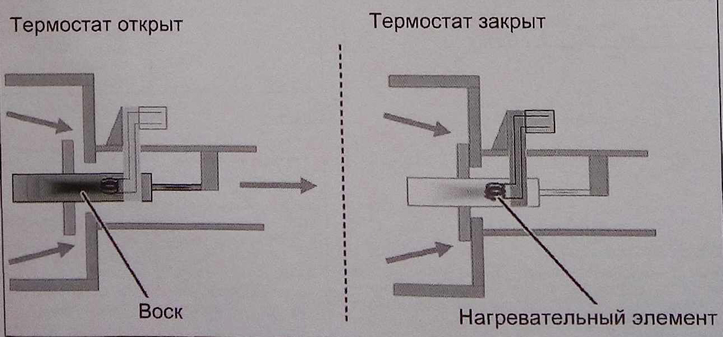
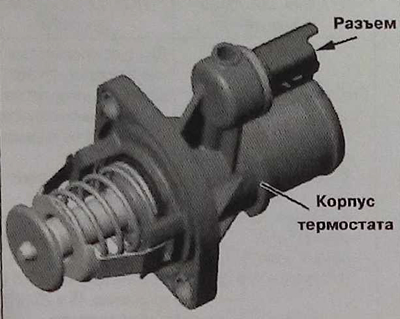
The adjustable thermostat allows the coolant temperature to rise faster for a quicker start of exhaust gas neutralization. In addition, higher engine temperatures reduce friction, allowing for lower fuel consumption.
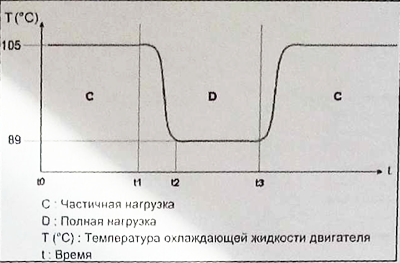
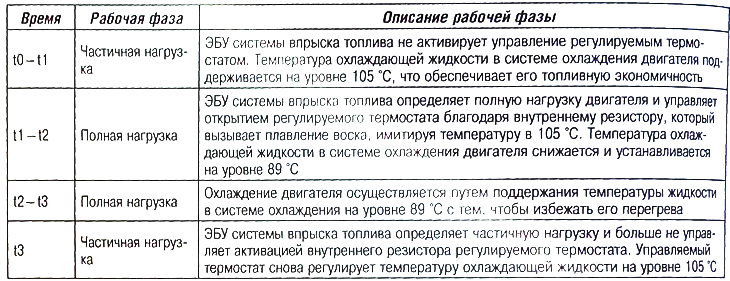
The wax in the thermostat melts at 105°C. Electronics usually do not interfere with the thermostat, it maintains the temperature at this level itself.
For full loads, the fuel injection ECU controls the thermostat regulation at 89°C. The ECU controls the heating resistor (16) of the controlled thermostat to add the 16°C that is missing at 89°C coolant temperature to melt the wax (15).
Thermostat control is also determined based on the following parameters:
- vehicle speed and intake air temperature, ensuring the operation of the cooling system;
- atmospheric air temperature that ensures a good thermal condition in the engine compartment, allowing the engine to cool and not deteriorating in countries with cold climates.
(Source of the article is posted at Peugeotbook.ru)
Controlled thermostat response phases
Note: The automatic transmission cooling requirement takes priority over other cooling requirements. When the automatic transmission commands cooling, the thermostatically controlled temperature is set to 89°C.
Attention. To remove air from the cooling system, a special operating mode of the injection system processor is provided. To send the information entered during the specific cooling system bleeding phase to the fuel injection system ECU, it is necessary to be in the following conditions for 10 seconds: the vehicle speed is zero, the engine speed is higher than 1450 rpm, the engine torque is lower than 50 Nm.