



Before bleeding, clean all bleeding points and the brake fluid reservoir cap from dirt.
If only one wheel cylinder or brake caliper was opened, it is sufficient to bleed air only from the corresponding brake circuit, the routing diagram of which is shown in figure 167.
Otherwise, bleeding should begin with the rear wheels, then move on to the upper valves of the front brake calipers and finish with the lower valves of the front brake calipers.
During the bleeding process, the reservoir must be constantly filled with brake fluid. When the fluid level in the tank drops, air may enter the system.
- Attach a transparent plastic hose to the corresponding air release valve, having first removed the boot from the valve. Place the other end of the hose in a container partially filled with brake fluid.
- Have the assistant press the brake pedal all the way down. Open the valve half a turn. Observe the liquid flowing through the hose.
- As soon as air bubbles are no longer visible in the flowing liquid, the air has been removed from the system. Keep the brake pedal depressed and close the air bleed valve. Slowly release the pedal.
- Perform the same work on all other valves. Figure 189 shows the location of both front brake caliper air bleed valves. Once again, it should be noted that it is necessary to constantly monitor the level of brake fluid in the reservoir. Do not refill the system with fluid under any circumstances. Also, do not add brake fluid that has been open for a long time.
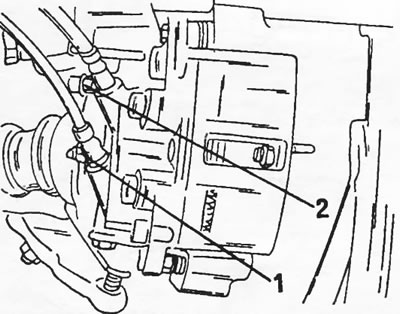
Figure 189. Location of air release valves on the brake caliper. (1) - lower brake circuit valve; (2) — upper brake circuit valve.