



- Insert the valves into their guide bushings. If the valve seats have been machined, they must be installed in the corresponding bushings. The same applies to used valves, which must be installed in their original locations.
- Thoroughly clean the threaded holes for the cylinder head bolts. The holes must be dry and free of grease. If necessary, tap the thread with an M12 x150 tap. Then thoroughly clean the thread.
- Install new valve stem seals on each guide bushing (Figure 257).
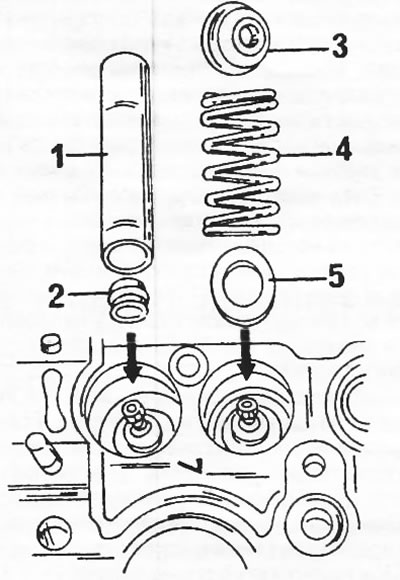
Figure 257. Installing valves. 1. Tube for mounting valve oil-reflecting rings; 2. Oil deflector ring; 3. Valve spring cup; 4. Valve spring; 5. Washer
- Insert valves (well lubricated with motor oil) into the cylinder head from the bottom side and place the parts shown in Figure 257 on top of each valve. Compress the springs with a special spring compressor. With the end of the valve stem protruding from the top side, use tweezers to insert the valve crackers. Slowly release the spring compressor and check that the valve springs are seated properly in the valves.
- Hit the top of the valve stems with a plastic hammer. At the same time, poorly seated crackers pop out. For safety, place a rag on the ends of the springs to prevent the parts from flying apart.
- Generously lubricate the valve lifters and adjusting washers with engine oil and insert the parts into the original holes. When removing the push rod, it must be pulled out completely to check the position of the adjusting washer, which may shift when pulling out the push rod.
- Lubricate the camshaft journals with engine oil and insert the shaft into the cylinder head. Install the three camshaft bearing caps. The lids are numbered. Cover No. 3 is located on the toothed pulley side. Tighten the cap nuts evenly to a torque of 18 Nm.
- Press both camshaft oil seals into the cylinder head with a suitable piece of pipe and, after adjusting the valve clearances, into the camshaft.
(Original publication on the website: PeugeotBook.ru)