



Table of contents: Removal 🠇 Installation 🠇
Removal
1. Fully apply the parking brake. Raise the front of the vehicle and support it securely (see "Lifting and installing the car on supports").
2. Drain the coolant from the cooling system as described in the chapter. Alternatively, clamp the coolant hoses to the oil cooler just above the radiator and be prepared for some coolant to leak out when you disconnect the hoses.
3. Place a suitable container under the oil filter. Unscrew the filter, using a special oil filter removal tool if necessary, and drain the oil into a container. If the oil filter was damaged or deformed when removed, it should be replaced. Given the low cost of a new oil filter compared to the cost of repairs to fix the damage that may occur if a reused filter develops a leak, it is recommended that the filter be replaced on a regular basis.
4. Loosen the hose clamps and disconnect the coolant hoses from the oil cooler.
5. Remove the oil cooler/oil filter mounting bolt from the cylinder block and remove the oil cooler. Note the mounting groove in the radiator flange that mates with the protrusion on the cylinder block (figure 19.5). Discard the oil cooler sealing ring; when installing, you should use a new one.
[Original is located at: PeugeotBook.ru]
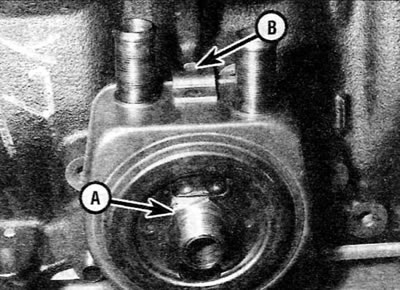
Figure 19.5. Mounting bolt (A) and installation groove (B) of the oil radiator/oil filter
Installation
6. Install the new O-ring into the recess at the rear of the radiator, then position the radiator toward the cylinder block.
7. Make sure that the locating groove in the radiator flange is correctly engaged with the protrusion on the cylinder block, then screw in the corresponding bolt and tighten it securely.
8. Install the oil filter. Lower the car. Bring the engine oil level up to the correct level as described in "Weekly checks".
9. Fill the cooling system or top up the coolant level as described in chapter 1B or "Weekly checks". Start the engine and check the oil cooler for signs of leaks.