
English Русский
Български
Беларускі
Український
Српски
Hrvatski
Română
Polski
Slovenský
Magyar
Bookmark Articles Sitemap Contacts
Company Hyundai Company Opel Company Skoda Company Kia Company Mitsubishi Company LADA Company Audi
PeugeotBook.ru


Series 100   Series 200   Series 300   400-500   Series 600   Crossovers   Others
 
Peugeot 206 (1998-2012) Peugeot 207 (2006-2014)

Removal and installation the exhaust pipe (petrol engine) (Peugeot 207)

  • Main
  • 20X
  • Peugeot 207 (2006-2014)
  • Power unit
  • Fuel system (gasoline)
  • Removal and installation the exhaust pipe (petrol engine)
0
Table of contents: Removal 🠇 Installation 🠇
Note: This chapter describes the procedure for a gasoline engine, but the operations for a diesel engine are the same.


Caution: The exhaust system must never be suspended without support by the flexible pipe.


The flexible pipe must be protected from any external mechanical influences.

The flexible pipe must not be exposed to corrosive substances.

Failure to observe these precautions will result in a reduced service life of the front hose. Disconnecting or removing the exhaust system is a prerequisite for lifting the power plant

Removal


Place the car on a lift.

Next to the rear cross member there is a cut area of the exhaust pipe, which is marked with four ring marks "a".

Draw a "b" on the pipe (from the catalytic converter side) at a distance of "A" = 40 mm; the marking "b" serves for positioning on the sleeve during reinstallation.
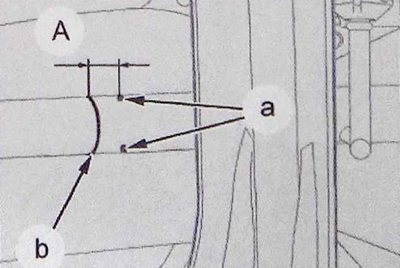
Draw a «b» on the pipe (from the catalytic converter side) at a distance of «A» = 40 mm; the…


Remove the engine guard and clamp (1).

Loosen the nuts of the two exhaust system suspension elements (2) as much as possible.
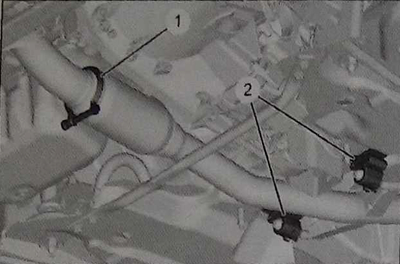
Loosen the nuts of the two exhaust system suspension elements (2) as much as possible.


Loosen the nuts of the three exhaust system suspension elements (3) as much as possible.
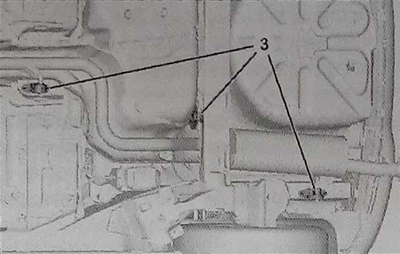


Loosen the nuts of the three exhaust system suspension elements (3) as much as possible.


Set the device [1] to cutting zone "a".

Cut the pipe.

Remove the corresponding exhaust tract element (muffler or resonator).

View the original on the website PEUGEOTBOOK.ru
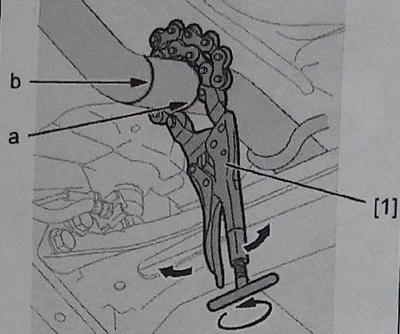
Remove the corresponding exhaust tract element (muffler or resonator).


Installation


Install the intermediate or rear muffler in accordance with the element that was removed.

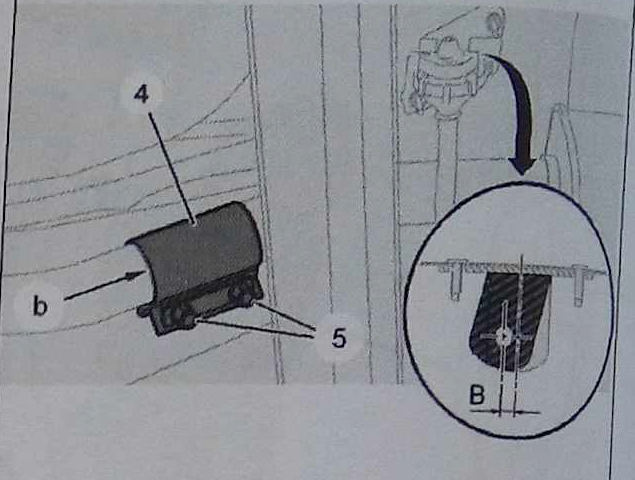
Install the tube (4) corresponding to the diameter of the outlet pipe.

Place the sleeve on the markings "b".

Connect the elements.

Orient the bushing (see picture).

Tighten the exhaust system suspension nuts (2), (3) to a torque of 10 Nm.
Tighten the exhaust system suspension nuts (2), (3) to a torque of 10 Nm.


Attention. To avoid contact with the bottom of the exhaust system during vehicle operation, install the muffler in such a way as to obtain a displacement of the suspension elements by a distance of "B" = 12 mm (towards the front of the car).


Check the tightness of the assembly.
This article is available at russian, bulgarian, belarusian, ukrainian, serbian, croatian, romanian, polish, slovak, hungarian
Article reviewed by editor: Matveev Demid
Share information:
Previous
Peugeot 207: Fuel system (gasoline)
Next

Exhaust system device (petrol engine)
Exhaust system (diesel engine)
Removal the heat exchanger (cars with AL4 automatic transmission)
Removal the intake manifold and throttle valve (EP6DT engines)
Removal the intake manifold and throttle valve (EP3, EP6 engines)
 
See similar information for other Peugeot models

➨ Petrol engine in-car repair procedures — specifications Peugeot 106 (1991-2003)
➨ Engine fault diagnostics Peugeot 305 (1977-1989)
➨ 1.4 liter petrol engine — design description Peugeot 405 (1987-1997)
➨ Engine bay. Cars with 2.0L turbocharged petrol engine Peugeot 605 (1989-2000)
➨ Engine compartment. Cars with a 2.0/2.2 L EW10J4/EW12J4 petrol… Peugeot 807 (2002-2014)
Link to this article in different formats
Comments and feedback from visitors
No comments yet


Add two numbers 41 + 50


Peugeot 207 (2006-2014) 
  • General information
  • Car care
  • Governing bodies
  • Driving and operation
  • Power unit
  • Engine characteristics
  • Engine repair
  • Cooling system
  • Lubrication system
  • Ignition system
  • Control system (gasoline)
  • Fuel system (gasoline)
  • Control system (diesel)
  • Transmission
  • Clutch
  • Mechanical gearbox
  • Automatic gearbox
  • Drive shafts
  • Chassis, running gear
  • Car suspension
  • Steering
  • Brake system
  • Body and interior
  • Exterior (external elements)
  • Interior (internal elements)
  • Heating and air conditioning
  • Electrical equipment
  • Equipment and devices
  • Headlights and lighting
  • Power devices
  • Electrical circuits
Peugeot 206 (1998-2012) 
  • General information
  • User manual
  • Maintenance
  • Power unit
  • Gasoline engines
  • Diesel engines
  • Diesel power system
  • Engine management system
  • Transmission
  • Clutch
  • Mechanical gearbox
  • Automatic gearbox
  • Drive shafts
  • Chassis, running gear
  • Front suspension
  • Rear suspension
  • Steering
  • Brake system
  • Body and interior
  • Body elements
  • Doors, locks and windows
  • Electrical equipment
  • Equipment and devices
  • Electrical circuits
PeugeotBook.ru © 2018–2026 | Mobile version | Sitemap: EN BG BY UA RS HR RO PL SK HU | Write message | Site search | Add to bookmarks | Peugeot owners
106 (1991-2003) | 206 (1998-2012) | 207 (2006-2014) | 305 (1977-1989) | 306 (1993-2002) | 307 (2001-2008) | 405 (1987-1997) | 406 (1995-2004) | 605 (1989-2000) | Partner-I (1996-2008) | Eurovans-807 (2002-2014) | Eurovans-806 (1994-2002) | J5 (1981-1993) |
Cookies are used to ensure the correct display of pages on the site.