
English Русский
Български
Беларускі
Український
Српски
Hrvatski
Română
Polski
Slovenský
Magyar
Bookmark Articles Sitemap Contacts
Company Hyundai Company Opel Company Skoda Company Kia Company Mitsubishi Company LADA Company Audi
PeugeotBook.ru


Series 100   Series 200   Series 300   400-500   Series 600   Crossovers   Others
 
Peugeot 305 (1977-1989) Peugeot 306 (1993-2002) Peugeot 307 (2001-2008)

Turbocharger — description, removal, and installation (Peugeot 307)

  • Main
  • 30X
  • Peugeot 307 (2001-2008)
  • Power unit
  • Diesel engines DV10
  • Turbocharger — description, removal, and installation
0
Table of contents: General information 🠇 Removal 🠇 Installation 🠇

General information


The power an engine can produce depends on the amount of air and fuel that enters the engine cylinders. To increase engine power, it is necessary to increase the supply of air and fuel. Injecting more fuel will have no effect until there is sufficient air available for combustion. Otherwise, excess unburned fuel will form, which will lead to overheating and increased smoke in the engine. To increase the amount of air supplied to the engine, a turbocharger is used, which compresses the air entering the combustion chamber.

The turbocharger consists of a centrifugal compressor wheel and a turbine, connected to each other by a common rigid axle. Both of these elements rotate in the same direction at the same speed. The energy from the exhaust gas flow, which is not used in conventional engines, is converted into torque, which drives the turbocharger. The exhaust gases leaving the engine cylinders have high temperature and pressure. They accelerate to high speed and interact with the turbine blades, which converts kinetic energy into mechanical rotational energy. Energy conversion is accompanied by a decrease in the temperature and pressure of the exhaust gases. The turbocharger draws air through the air filter, compresses it and delivers it into the engine cylinders. By increasing the amount of air, the amount of fuel can also be increased, allowing the engine to develop more power.


To lubricate the turbocharger, engine oil is supplied under pressure through a special pipeline.

Since the turbocharger operates at high speed, care and cleanliness are required. If dirt gets into the turbocharger, it can fail.

Caution: Before disconnecting any components from the turbocharger, thoroughly clean them of any dirt. To protect against contamination, place the removed turbocharger components in a sealed container and close the turbocharger air ducts.


The turbocharger has no regulation system and provides a boost pressure of 0.5 bar at idle speed and 1 bar at full load.

It is located on the exhaust manifold above the catalytic converter and is covered by a heat shield.

Removal


Turn off the ignition and disconnect the ground wire from the battery.

Place the car on a lift.
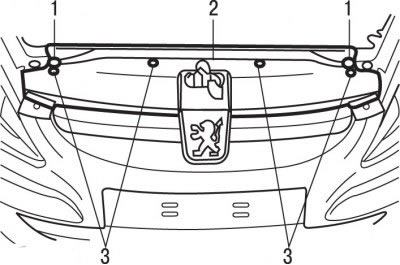
Figure 4.37. Location of bolts (1) for fastening the upper cross panel (2) and clamps (3)

Figure 4.37. Location of bolts (1) for fastening the upper cross panel (2) and clamps (3)


Remove bolts 1 (figure 4.37) fastening the upper cross panel 2.

Remove the 3 radiator grille retaining clips.

Lift and tilt the upper cross panel towards the front of the vehicle.
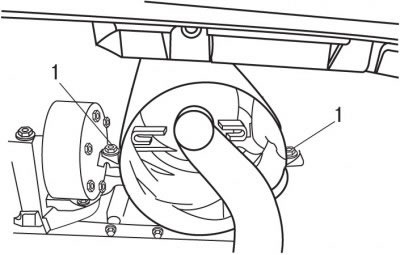
Figure 4.38. Location of bolts (1) for fastening the heat shield

Figure 4.38. Location of bolts (1) for fastening the heat shield


Remove bolts 1 (figure 4.38) heat shield fastenings.

Protect the cooling system radiator and, moving upwards, remove the heat shield.

Remove the air duct and the turbocharger receiver-damper.

Remove the upper exhaust manifold heat shield.
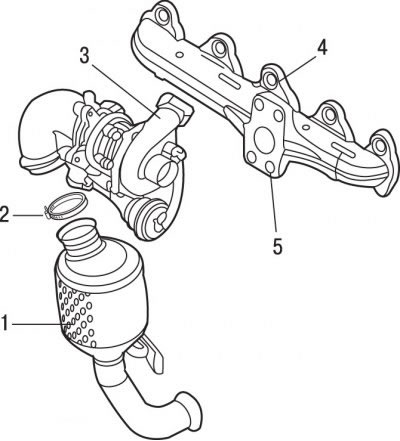
Figure 4.39. Turbocharger: 1 - catalytic converter; 2 - clamp; 3 - turbocharger; 4 - exhaust…

Figure 4.39. Turbocharger: 1 - catalytic converter; 2 - clamp; 3 - turbocharger; 4 - exhaust manifold; 5 - nuts


Loosen clamp 2 (figure 4.39) fastening the catalytic converter 1 to the turbocharger 3.

Remove the hollow bolt to lubricate the turbocharger.

Remove the turbocharger oil return connection.

Unscrew nuts 5 securing the turbocharger to the exhaust manifold 4 and remove the turbocharger.

Installation


Clean the surface of the exhaust manifold.

Install the turbocharger onto the exhaust manifold and secure it with new nuts, tightening them to a torque of 25 Nm.

Replace the leather gasket of the hollow bolt used to lubricate the turbocharger.

Install the oil feed pipe with the hollow bolt.

Tighten the hollow bolt to 30 Nm.

Install the turbocharger oil return connection.

Connect the catalytic converter to the turbocharger and secure it with a clamp.

Install the exhaust manifold upper heat shield and secure with bolts, tightening them to a torque of 10 Nm.


Install the air duct and the turbocharger receiver-damper.

Protect the cooling system radiator and install a heat shield from above. Tighten the heat shield mounting bolts to 5 Nm.

Install the top cross panel.

Install the radiator grille retainers.

Tighten the upper cross panel mounting bolts to 15 Nm.

Connect the cable to the negative terminal of the battery.
This article is available at russian, bulgarian, belarusian, ukrainian, serbian, croatian, romanian, polish, slovak, hungarian
Article reviewed by editor: Sidorov Timofey
Share information:
Previous
Peugeot 307: Diesel engines DV10
Next

Fuel distributor (Common Rail) — removal and installation
Fuel injectors — removal and installation
Integrated air supply system unit
Power supply system — general information
Water pump — removal and installation
Fuel filter — removal and installation
Exhaust gas system
See similar information for other Peugeot models

➨ Turbocharger Cooling Pump Replacement (EP6DT Engines) Peugeot 207 (2006-2014)
➨ Removal and installation a turbocharger Peugeot 405 (1987-1997)
➨ Turbocharger — operating principle Peugeot 605 (1989-2000)
➨ Cooling system. 2.0-liter engine with a turbocharger and one Peugeot 806 (1994-2002)
Link to this article in different formats
Comments and feedback from visitors
No comments yet


Add two numbers 19 + 23


Peugeot 307 (2001-2008) 
  • User manual
  • Keys, doors and alarm
  • Controls and instruments
  • Driving and operation
  • Maintenance
  • Power unit
  • Petrol engines TU3 and TU5
  • Petrol engines EW10
  • Diesel engines DV10
  • Diesel engines DW10
  • Transmission
  • Clutch and drive shafts
  • Mechanical gearbox
  • Automatic gearbox
  • Chassis, running gear
  • Front suspension
  • Rear suspension
  • Steering
  • Brake system
  • Body and interior
  • Exterior (external elements)
  • Interior (internal elements)
  • Doors, locks and windows
  • Heating and air conditioning
  • Electrical equipment
  • Equipment and devices
  • Power devices
  • Airbags
  • Electrical circuits
Peugeot 306 (1993-2002) 
  • General information
  • Introduction to manual
  • Specifications
  • Gasoline engine
  • Engine repair
  • Lubrication system
  • Cooling system
  • Fuel injection
  • Ignition system
  • Diesel engine
  • Engine repair
  • Lubrication system
  • Cooling system
  • Fuel injection
  • Transmission
  • Clutch
  • Gearbox
  • Drive shafts
  • Chassis, running gear
  • Steering system
  • Front suspension
  • Rear suspension
  • Brake system
  • Electrical equipment
  • Power devices
  • Electrical circuits
Peugeot 305 (1977-1989) 
  • General information
  • Maintenance
  • Power unit
  • Gasoline engines
  • Diesel engines
  • Cooling system (gasoline)
  • Cooling system (diesel)
  • Fuel system (gasoline)
  • Fuel system (diesel)
  • Ignition system
  • Transmission
  • Clutch
  • Mechanical gearbox BB8
  • Mechanical gearbox BE1
  • Automatic gearbox ZF4
  • Shafts, hubs and wheels
  • Chassis, running gear
  • Brake system
  • Car suspension
  • Steering
  • Body and interior
  • Exterior (external elements)
  • Interior (internal elements)
  • Electrical equipment
  • Equipment and devices
  • Headlights and lighting
  • Power devices
  • Electrical circuits
  • Wiring diagrams (diesel)
PeugeotBook.ru © 2018–2026 | Mobile version | Sitemap: EN BG BY UA RS HR RO PL SK HU | Write message | Site search | Add to bookmarks | Peugeot owners
106 (1991-2003) | 206 (1998-2012) | 207 (2006-2014) | 305 (1977-1989) | 306 (1993-2002) | 307 (2001-2008) | 405 (1987-1997) | 406 (1995-2004) | 605 (1989-2000) | Partner-I (1996-2008) | Eurovans-807 (2002-2014) | Eurovans-806 (1994-2002) | J5 (1981-1993) |
Cookies are used to ensure the correct display of pages on the site.