



The drained coolant must be collected and disposed of.
Draining the coolant should be done on a cold engine.
Caution: When opening the expansion tank cap on a hot engine, exercise caution as escaping vapors can cause severe burns. To do this, cover the expansion tank cap with a thick layer of cloth and slowly unscrew it until a hissing sound is heard. After the hissing stops, slowly unscrew and remove the cap from the expansion tank.
Remove the expansion tank cap.
Remove the plastic windshield crossbar.
Place a coolant collection pan under the engine.
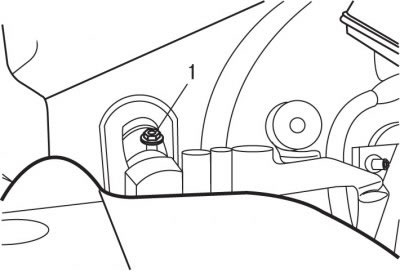
Figure 4.24. Location of the bolt (1) for bleeding air from the cooling system of the DV4TD diesel engine
Unscrew bolt 1 (figure 4.24) to remove air from the cooling system.
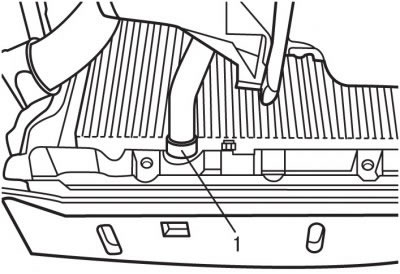
Figure 4.25. Location of hose installation on the lower radiator pipe (1)
Loosen the clamp and remove the hose from the lower radiator hose 1 (figure 4.25), drain the coolant from the radiator and hose.
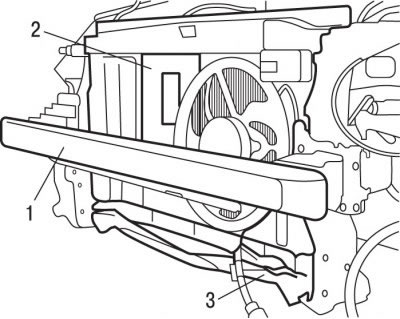
Figure 4.1. Location of the front panel crossbar (1), the cooling cassette assembly (2) together with the radiator and the lower crossbar (3) of the front panel
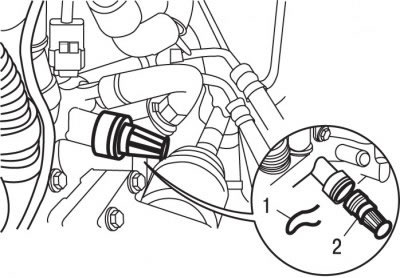
Figure 4.26. Location of the retainer (1) of the coolant drain plug (2)
Remove retainer 1 (figure 4.1 4.26), remove drain plug 2 and drain the coolant from the engine cooling system.
After draining the coolant, reinstall drain plug 1 with a new sealing ring and secure it with a new retainer.
If the coolant is heavily contaminated, flush the cooling system. Since it is impossible to completely drain the coolant from the cooling system, it is recommended to flush the cooling system every time the coolant is drained.
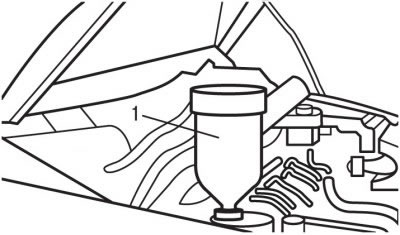
Figure 3.47. Installation of a special container 0173/2 (1) on the expansion tank for filling the coolant
Instead of the expansion tank cap, screw in a special container 1 (see figure 3.47) 0173/2 for filling the coolant. This is necessary in order to completely fill the engine cooling system with coolant and remove air from it. If you don't have a special container, you can make it yourself.
Slowly pour BASF GLYSANTIN G33-23F or GUTIT ESSEX REVKOGEL 2000 coolant into the cooling system.
Pour coolant into the expansion tank until it flows out through the bleed screw hole. Screw on bolt 1 (see Figure 4.24).
For proper bleeding of the cooling system, a special container 1 (see figure 3.47) 0173/2 for filling the coolant must be filled to the 1 l mark.
Start the engine and let it run at 2000 rpm until the second cooling cycle is complete (turning the radiator fan on and off), while maintaining the liquid level at the 1 liter mark.
Stop the engine.
Remove special container 1 (see figure 3.47) 0173/2 to fill the coolant and screw on the expansion tank cap.
Install the plastic windshield crossbar.
Note: If the cooling system was filled with a coolant not recommended by the manufacturer, drain the coolant from the cooling system. Fill the cooling system with clean water, start the engine, and let it idle for 2 minutes. Drain the water from the cooling system and blow out the engine cooling system with compressed air. Fill with fresh coolant, as recommended by the manufacturer.
Check the coolant level and top it up if necessary.
On a hot engine, the coolant level should be at the "Max" mark; on a cold engine, between the "Max" and "Min" marks.