
English Русский
Български
Беларускі
Український
Српски
Hrvatski
Română
Polski
Slovenský
Magyar
Bookmark Articles Sitemap Contacts
Company Hyundai Company Opel Company Skoda Company Kia Company Mitsubishi Company LADA Company Audi
PeugeotBook.ru


Series 100   Series 200   Series 300   400-500   Series 600   Crossovers   Others
 
Peugeot 305 (1977-1989) Peugeot 306 (1993-2002) Peugeot 307 (2001-2008)

Cooling system — design description (Peugeot 307)

  • Main
  • 30X
  • Peugeot 307 (2001-2008)
  • Power unit
  • Diesel engines DV10
  • Cooling system — design description
0
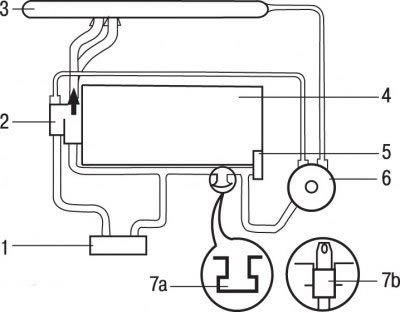
Figure 4.23. Cooling system elements: 1 - heat exchanger; 2 - coolant outlet block with integrated…

Figure 4.23. Cooling system elements: 1 - heat exchanger; 2 - coolant outlet block with integrated thermostatic valve; 3 - cooling radiator; 4 - oil/coolant heat exchanger; 5 - water pump; 6 - expansion tank; 7 - water inlet manifold with drain bolt (for countries with cold climates, a drain tap is installed instead of a drain plug); 7a - installation with drain plug; 7b - installation with heated tap


The cooling system includes a water pump driven by an auxiliary belt from the crankshaft, a radiator fan, a radiator, an expansion tank, a thermostat, a heater core and hoses (figure 4.23). When starting a cold engine, the coolant does not enter the radiator, since the thermostat valve is closed, but circulates through the block jacket and cylinder head, then enters the pump again. This ensures rapid warm-up of a cold engine. When the coolant reaches a certain temperature, the thermostat valve opens and the hot coolant passes through the hose to the radiator and is cooled by the oncoming air flow.

Caution! Avoid contact with coolant on clothing or vehicle paintwork. Otherwise, rinse the surface with plenty of water. Collect and dispose of the drained coolant.


The water pump of the cooling system is connected to the coolant outlet block by a rigid tube, the tightness of which is ensured on the pump side by a cuff, and on the coolant block side by a snap-on fitting on the upper hose and by a sealed tip on the lower hose.

(View the original on the website peugeotbook.ru)

The coolant outlet block is secured to the cylinder head on the flywheel side with 4 bolts.

The coolant does not require replacement throughout its entire service life.
This article is available at russian, bulgarian, belarusian, ukrainian, serbian, croatian, romanian, polish, slovak, hungarian
Article reviewed by editor: Sidorov Timofey
Share information:
Previous
Peugeot 307: Diesel engines DV10
Next

Lubrication system — design description
Timing belt — removal and installation
Accessory drive belt
Cylinder head — removal and installation
Removal and installation the engine
Replacing the coolant
Water pump — removal and installation
Power supply system — general information
Integrated air supply system unit
Fuel injectors — removal and installation
See similar information for other Peugeot models

➨ Cooling system electrical switches — testing, removal and… Peugeot 106 (1991-2003)
➨ Cooling system test data (all engines) Peugeot 207 (2006-2014)
➨ Cooling system — design description Peugeot 405 (1987-1997)
➨ Cooling system — bleeding Peugeot 605 (1989-2000)
➨ Checking the cooling system Peugeot 806 (1994-2002)
Link to this article in different formats
Comments and feedback from visitors
No comments yet


Add two numbers 50 + 16


Peugeot 307 (2001-2008) 
  • User manual
  • Keys, doors and alarm
  • Controls and instruments
  • Driving and operation
  • Maintenance
  • Power unit
  • Petrol engines TU3 and TU5
  • Petrol engines EW10
  • Diesel engines DV10
  • Diesel engines DW10
  • Transmission
  • Clutch and drive shafts
  • Mechanical gearbox
  • Automatic gearbox
  • Chassis, running gear
  • Front suspension
  • Rear suspension
  • Steering
  • Brake system
  • Body and interior
  • Exterior (external elements)
  • Interior (internal elements)
  • Doors, locks and windows
  • Heating and air conditioning
  • Electrical equipment
  • Equipment and devices
  • Power devices
  • Airbags
  • Electrical circuits
Peugeot 306 (1993-2002) 
  • General information
  • Introduction to manual
  • Specifications
  • Gasoline engine
  • Engine repair
  • Lubrication system
  • Cooling system
  • Fuel injection
  • Ignition system
  • Diesel engine
  • Engine repair
  • Lubrication system
  • Cooling system
  • Fuel injection
  • Transmission
  • Clutch
  • Gearbox
  • Drive shafts
  • Chassis, running gear
  • Steering system
  • Front suspension
  • Rear suspension
  • Brake system
  • Electrical equipment
  • Power devices
  • Electrical circuits
Peugeot 305 (1977-1989) 
  • General information
  • Maintenance
  • Power unit
  • Gasoline engines
  • Diesel engines
  • Cooling system (gasoline)
  • Cooling system (diesel)
  • Fuel system (gasoline)
  • Fuel system (diesel)
  • Ignition system
  • Transmission
  • Clutch
  • Mechanical gearbox BB8
  • Mechanical gearbox BE1
  • Automatic gearbox ZF4
  • Shafts, hubs and wheels
  • Chassis, running gear
  • Brake system
  • Car suspension
  • Steering
  • Body and interior
  • Exterior (external elements)
  • Interior (internal elements)
  • Electrical equipment
  • Equipment and devices
  • Headlights and lighting
  • Power devices
  • Electrical circuits
  • Wiring diagrams (diesel)
PeugeotBook.ru © 2018–2026 | Mobile version | Sitemap: EN BG BY UA RS HR RO PL SK HU | Write message | Site search | Add to bookmarks | Peugeot owners
106 (1991-2003) | 206 (1998-2012) | 207 (2006-2014) | 305 (1977-1989) | 306 (1993-2002) | 307 (2001-2008) | 405 (1987-1997) | 406 (1995-2004) | 605 (1989-2000) | Partner-I (1996-2008) | Eurovans-807 (2002-2014) | Eurovans-806 (1994-2002) | J5 (1981-1993) |
Cookies are used to ensure the correct display of pages on the site.