



The injectors are mounted using brackets.
The cylinder head cover is made of plastic with a built-in oil filler neck and a neck for supplying the crankcase ventilation system.
Cylinder head gaskets with stainless steel bezels are available in five thicknesses.
Remove the cylinder head on a cold engine.
Caution! Replace any clamps or clips that are damaged or cut during removal with new ones when installing the cylinder head. When replacing the cylinder head, fill the cooling system with fresh coolant.
Removal
Turn off the ignition and disconnect the cable from the negative battery terminal.
Drain the coolant.
Remove the accessory drive belt.
Remove the timing belt.
Remove the decorative cover from the engine.
Remove the plastic windshield crossbar and sound insulation plates.
Disconnect the connector from the air flow meter.
At the outlet of the turbocharger, disconnect and remove the bent pipe.
Remove the integrated air supply system unit.
Using a special protective kit, close the air ducts and camshaft bed covers.
Remove the heat shield and catalytic converter.
Disconnect the EGR valve pressure relief pipe.
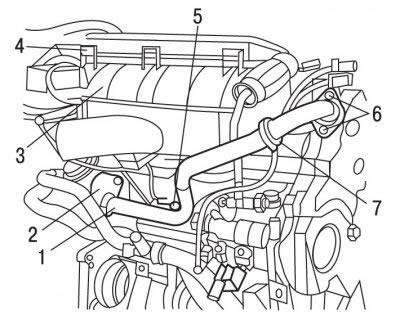
Figure 4.2. Exhaust gas recirculation tube and valve: 1 - clamp; 2 - bolts; 3 - air filter housing; 4 - air filter cover; 5 - bolt; 6 - bolts; 7 - tube
Remove bolts 2, 5 and 6 (figure 4.2), loosen clamps 1 and remove the exhaust gas recirculation tube.
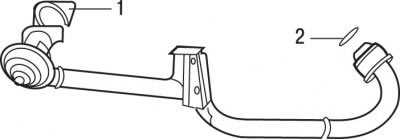
Figure 4.3. Exhaust gas recirculation tube: 1 - metal seal; 2 - sealing ring
Remove and then install the metal seal 1 (figure 4.3) exhaust gas recirculation system valves and O-ring 2.
Remove the jumper wires connecting the glow plugs.
Remove the glow plugs.
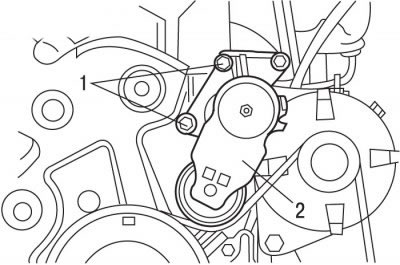
Figure 4.4. Location of bolts (1) for fastening the tension roller (2) of the accessory drive belt
Remove bolts 1 (figure 4.4) and remove tension roller 2 of the accessory drive belt.
Disconnect the contact connectors from the generator.
Remove the mounting bolts and remove the generator from the engine.
Remove the bolts and the upper generator support.
Remove the upper high pressure fuel pump support mounting bolts.
Clean the fuel supply lines from dirt.
Disconnect from the injectors and fuel distribution line (Common Rail) high pressure pipelines. To prevent dirt from entering, close the pipes and fittings on the fuel distribution pipe with suitable plugs.
Unscrew the bolts, remove the injector mounting brackets 5 and, being careful, remove the injectors from the cylinder head.
Close the injector sockets and injector nozzles with suitable plugs.
Remove the coolant outlet block and set it aside.
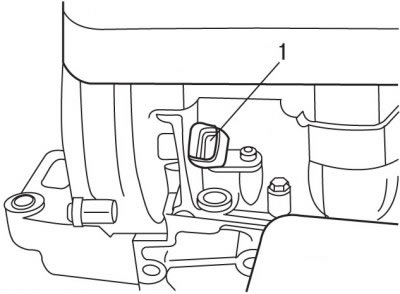
Figure 4.5. Location of the camshaft position sensor (1)
Remove camshaft position sensor 1 (figure 4.5).
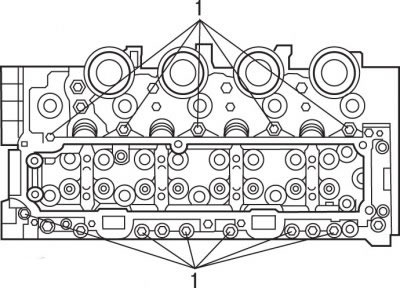
Figure 4.6. Location of bolts (1) for fastening the camshaft bearing caps
Remove bolts 1 (figure 4.6) fastenings of camshaft bed covers.
Disconnect the vacuum pump pressure relief tube.
Remove the camshaft bearing cap.
In the reverse order of tightening, gradually loosen and then completely unscrew the cylinder head mounting bolts.
Install curved levers into the cylinder head holes and, pressing on them, separate the head from the cylinder block.
Remove the cylinder head and place it on a soft surface.
Preparing the cylinder head for installation
The mating surfaces of the cylinder head and block must be completely clean. To clean them, use a hard plastic or wooden scraper. When cleaning, be careful as the aluminum alloy is very easy to damage. Make sure that carbon deposits do not get into the lubrication and cooling system channels. This is especially important for the lubrication system, as carbon deposits can block the supply of oil to engine parts. Clean the channels if necessary.
Check the mating surfaces of the cylinder head and block: they should not have any nicks, deep scratches or other damage. Minor defects can be removed by mechanical processing. In case of significant defects, parts are subject to replacement.
Using a metal ruler and feeler gauge, check the mating surfaces for flatness.
If the deviation from flatness exceeds 0.05 mm, the head must be re-ground.
Clean the threads of the cylinder head bolt holes.
Clean the bolt holes in the block. Driving a bolt into an oil filled hole can cause the block to burst due to hydraulic pressure.
Before reusing bolts, measure the length of the bolts to the base of the head, which should be no more than 149.0 mm.
Installation
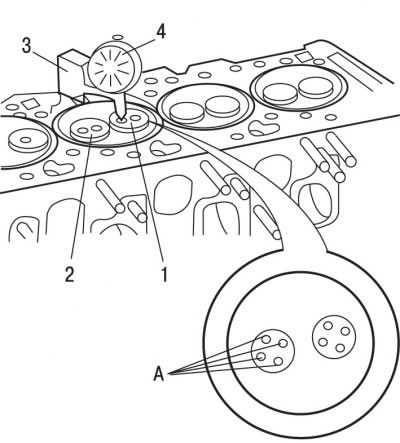
Figure 4.7. Measuring the valve protrusion: 1 - exhaust valve; 2 - inlet valve; 3 - stand; 4 - hour indicator; A - measurement points
Check the valve protrusion in relation to the cylinder head plane at points A (figure 4.7), which should be equal to 1.25 mm. The protrusion value must be calculated as an average based on four measurements.
Remove the device that prevents the crankshaft from turning.
It is necessary to measure the protrusion of the pistons from the cylinder block and, in accordance with this value, select the thickness of the new cylinder head gasket.
Note: The maximum difference between piston protrusions should be less than 0.10 mm.
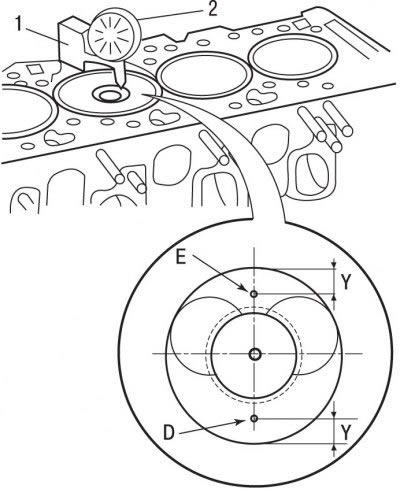
Figure 4.8. Measuring the piston protrusion from the cylinder block: 1 - stand; 2 - hour indicator; D, E - measurement points; Y = 10.0 mm
Install a dial indicator 2 on the cylinder block (figure 4.8) on stand 1.
Place the indicator tip on the top surface of the cylinder block and set the indicator arrow to 0.
Place the indicator measuring tip on one of the control points.
Turn the crankshaft until one of the pistons reaches TDC, but do not go past it. Read the piston protrusion value on the indicator.
The amount of protrusion must be calculated as an average based on measurements at two points.
Measure the protrusion of the remaining pistons in the same manner.
The greatest average piston protrusion determines the thickness of the cylinder head gasket.
Use a special device to prevent the flywheel from turning.
Check for the presence of centering bushings in the cylinder block.
The new cylinder head gasket must be removed from its packaging immediately before installation.
Install a new cylinder head gasket of the specified thickness.
Install the cylinder head.
Apply a thin coat of MOLYKOTE G RAPID PLUS grease to the threads of the cylinder head bolts, insert the bolts and tighten them by hand.
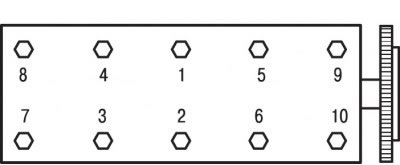
Figure 4.9. Cylinder head bolt tightening sequence
In the sequence shown in the figure 4.9, tighten the cylinder head bolts in several stages:
- Step 1 - Tighten to 20 Nm;
- Step 2: Tighten to 40 Nm;
- Step 3: Turn to an angle of 230.
Install the coolant drainage block with a new sealing gasket and secure with bolts, tightening them to a torque of 10 Nm.
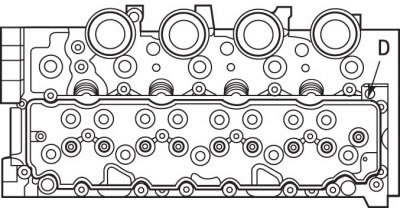
Figure 4.10. Place (D) of application of SILICONE CATEGORIE 2 sealant to the mating surface of the cylinder head
Apply SILICONE CATEGORIE 2 sealant around the entire perimeter of the mating surface (figure 4.10).
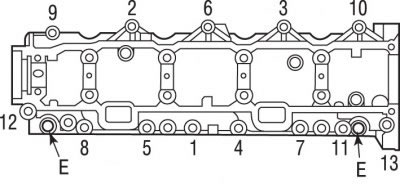
Figure 4.11. Sequence of tightening the camshaft bearing cover bolts: E - holes for installing special devices
Install into holes E (figure 4.11) camshaft bearing caps using special tools and install the cap in place.
In the sequence shown in the figure 4.11, tighten and then tighten the camshaft bearing cover mounting bolts to a torque of 10 N·m.
Remove the special tools from the holes E.
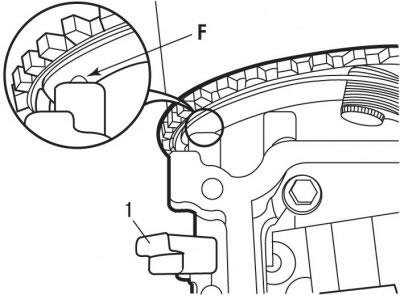
Figure 4.12. Installing the camshaft position sensor (1): F - sensor head
Install camshaft position sensor 1 (figure 4.12).
Adjust the gap between the pulley and the sensor to 1.2 mm. If installing a new sensor, move the F-head to adjust the air gap (figure 4.12) sensor until it touches one of the three protrusions on the camshaft pulley.
Connect the vacuum tube to the vacuum pump.
Install the injectors and connect the high pressure lines.
Install the fuel pump support onto the cylinder head and secure with bolts, tightening them to a torque of 20 Nm.
Install the upper generator support and secure with bolts, tightening them to a torque of 20 Nm.
Install the generator and secure it with bolts, tightening them to a torque of 40 Nm.
Install the tension roller and secure it with the bolt, tightening it to a torque of 20 Nm.
Screw in the glow plugs and tighten to 9 Nm.
Install jumper wires connecting the glow plugs.
Reinstall the EGR valve and pipe and secure them with bolts and clamps.
Install the catalytic converter and heat shield.
Install the integrated air supply unit.
Install the accessory drive belt.
Fill with coolant and bleed it.
Connect the cable to the negative terminal of the battery.