



Removal
Caution! All clamps and clips that are damaged or cut during removal must be replaced with new ones when installing the cylinder head. When replacing the cylinder head, fill the cooling system with fresh coolant.
Turn off the ignition and disconnect the cable from the negative battery terminal.
Drain the coolant.
Remove the front wheels.
Remove the front mudguards.
Remove the decorative cover from the engine and the cover on the right side of the engine compartment.
Remove the air filter.
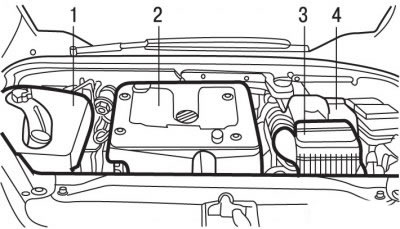
Figure 4.44. Location of parts and assemblies in the engine compartment with the DW10TD engine: 1, 2 - decorative covers; 3 - air filter; 4 - battery
Remove the battery 4 (see figure 4.44) and its bracket. Access to one of the bracket mounting bolts is possible through the left wheel arch.
Remove the front guard cross member.
Remove the sound-insulating mats from the engine compartment bulkhead.
Remove, set aside and secure the brake fluid reservoir.
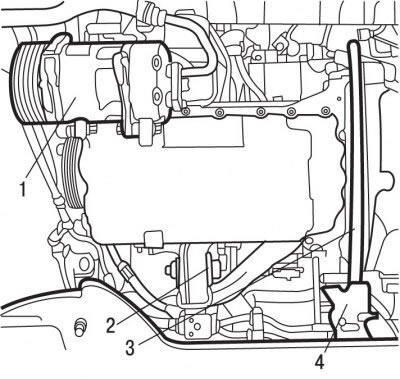
Figure 4.42. Location of the air conditioning compressor in the engine compartment of the DW10TD engine: 1 - air conditioning compressor; 2 - jet bracket; 3 - shockproof reinforcement of the sub-engine frame; 4 - bump stop
Unscrew the nut, remove the bolt and remove the reaction bracket 2 (see Figure 4.42) engine mounts
Remove the engine subframe shock absorber 3.
Remove the exhaust system.
Caution! The connecting element in the front exhaust pipe must be protected from any mechanical damage. The connecting element in the front exhaust pipe must not be bent at an angle of more than 20° or displaced by 20 mm in the axial direction and 25 mm in the radial direction, otherwise it will be damaged.
Remove the accessory drive belt.
Remove the timing belt.
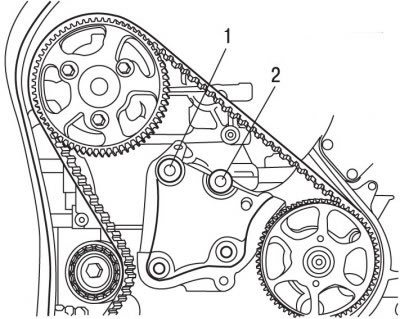
Figure 4.50. Location of bracket mounting bolts: 1 - bolt, 20 Nm; 2 - bolt, 45 Nm
Remove bolts 1 and 2 (figure 4.50) bracket fastenings.
Install the right engine mount bracket and secure with bolts, tightening them by hand.
Remove the 0911-AY engine support crossmember that was installed when the timing belt was removed.
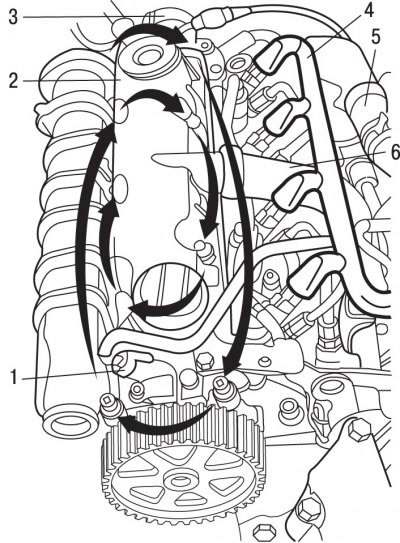
Figure 4.51. Sequence for unscrewing the cylinder head cover mounting bolts: 1-pin connector; 2 - cylinder head cover; 3 - rubber bulb for filling the system with fuel; 4 - electrical wiring harness; 5 - cooling system pipe; 6 - hose for returning condensed oil vapors to the unit
Disconnect pin 1 (figure 4.51).
Disconnect the electrical wiring harness 4, the cooling system pipe 5, the brake booster hose and the rubber bulb for filling the fuel system 3 from the engine.
Disconnect the electrical connectors from the glow plugs of the pre-heating system.
Disconnect the hose 6 for returning condensed oil vapors to the cylinder block, the wiring harnesses, tubes and hoses of the heater radiator from the cylinder head and move it aside.
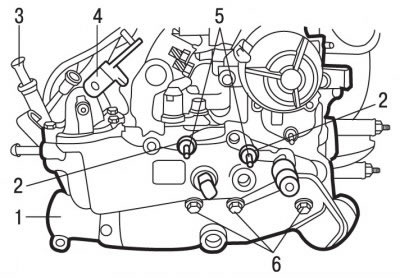
Figure 4.52. Fastening the block for the coolant outlet: 1 - block for coolant outlet; 2 - nuts, 20 Nm; 3 - oil level indicator (dipstick) tube; 4 - support; 5 - studs, 25 Nm; 6 - bolts, 20 Nm
Remove support 4 (figure 4.52).
Unscrew the bolt and remove the tube 3 of the oil level indicator (dipstick).
Unscrew the bolts 6 securing the coolant outlet block.
Unscrew nuts 2 and studs.
On DW10ATED engines, remove the cylinder current phase sensor.
In a spiral, starting from the outer one, unscrew the bolts and remove the cylinder head cover.
Move the coolant outlet block away from the cylinder head.
Remove the oil filter tube mounting bolt.
Use SODIMAC 35 to clean the high-pressure fuel pipe union nuts and the areas around the nuts.
Loosen the connecting nuts securing the high-pressure fuel line connecting the high-pressure fuel pump and the fuel distributor (Common Rail) and remove the fuel line.
Remove the glow plugs.
Unscrew the bolts and remove the injector mounting brackets.
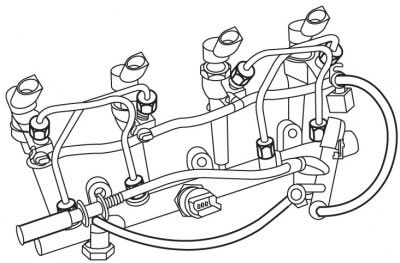
Figure 4.53. Injectors, high-pressure pipes and fuel distributor assembly
Carefully remove the injectors from the cylinder head and at the same time remove the high-pressure pipes and the fuel distributor assembly (figure 4.53).
Remove the steering gear heat shield.
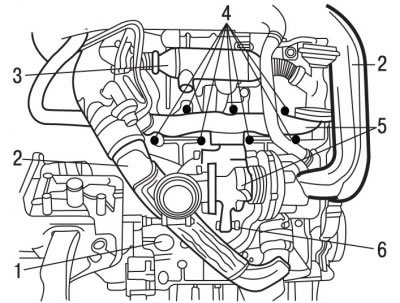
Figure 4.54. Location of engine components: 1 - oil return pipe; 2 - air supply pipe to the turbocharger; 3 - exhaust gas recirculation system unit; 4 - turbocharger and exhaust manifold mounting nuts; 5 - exhaust manifold; 6 - lower turbocharger mounting bracket
Remove pipes 2 (figure 4.54) supply air to the turbocharger.
Disconnect oil return pipe 1 from the cylinder block.
Remove the exhaust gas recirculation system unit 3.
Remove the lower turbocharger mounting bracket 6.
Unscrew the 4 nuts securing the exhaust manifold.
Remove and set aside the exhaust manifold 5 together with the turbocharger.
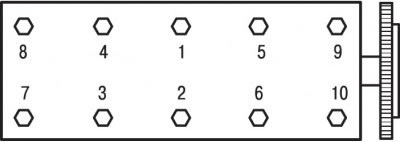
Figure 4.55. Tightening sequence of cylinder head bolts on the DW10TD engine
In the reverse order of tightening, gradually loosen and then completely unscrew the cylinder head mounting bolts (figure 4.55).
Install curved levers into the cylinder head holes and, pressing on them, separate the head from the cylinder block.
Remove the cylinder head and place it on a soft surface.
Preparing the head for installation
The mating surfaces of the cylinder head and block must be completely clean. To clean them, use a hard plastic or wooden scraper. When cleaning, be careful as the aluminum alloy is very easy to damage. Make sure that carbon deposits do not get into the lubrication and cooling system channels. This is especially important for the lubrication system, as carbon deposits can block the supply of oil to engine parts. Clean the channels if necessary.
Check the mating surfaces of the cylinder head and block: they should not have any nicks, deep scratches or other damage. Minor defects can be removed by mechanical processing. In case of significant defects, parts are subject to replacement.
Using a metal ruler and feeler gauge, check the flatness of the mating surfaces.
If the deviation from flatness exceeds 0.05 mm, the head must be re-ground.
Clean the threads of the cylinder head bolt holes.
Clean the bolt holes in the block. Driving a bolt into an oil filled hole can cause the block to burst due to hydraulic pressure.
Before reusing bolts, measure the length of the bolts to the base of the head, which should be 133.4 mm for the DW10TD engine and 134 mm for the DW10ATED engine.
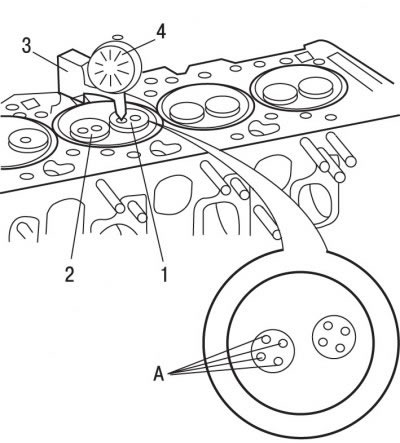
Figure 4.7. Measuring the valve protrusion: 1 - exhaust valve; 2 - inlet valve; 3 - stand; 4 - hour indicator; A - measurement points
Check the valve protrusion in relation to the cylinder head plane at points A (see Figure 4.7), which should be equal to 0.2 mm. The protrusion value must be calculated as an average based on four measurements.
Remove the device that prevents the crankshaft from turning.
Measure the piston protrusion from the cylinder block and select the thickness of the new cylinder head gasket according to this value.
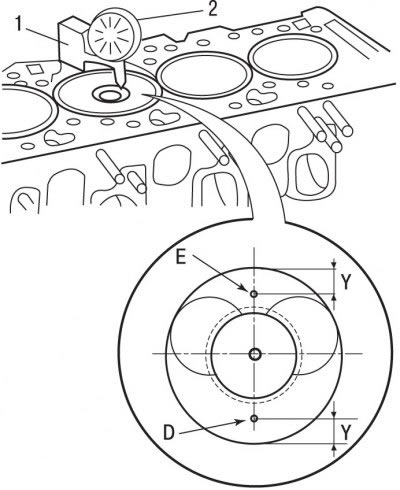
Figure 4.8. Measuring the piston protrusion from the cylinder block: 1 - stand; 2 - hour indicator; D, E - measurement points; Y = 10.0 mm
Install a dial indicator on a stand on the cylinder block (see Figure 4.8).
Place the dial indicator tip on the top surface of the cylinder block and set the dial indicator to 0.
Place the indicator measuring tip on one of the control points.
Turn the crankshaft until one of the pistons reaches TDC, but do not go past it. Read the piston protrusion value on the indicator.
The amount of protrusion must be calculated as an average based on measurements at two points.
Measure the protrusion of the remaining pistons in the same manner.
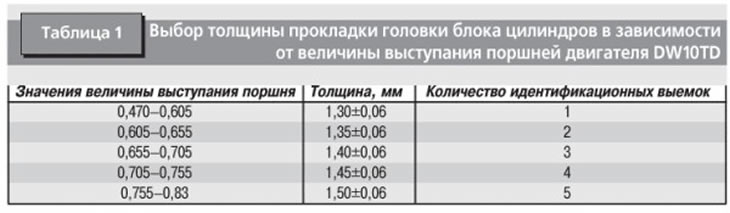
The largest average piston protrusion value determines the thickness of the cylinder head gasket (Table 1).
Installation
Turn the engine crankshaft to a position where the piston of the 1st cylinder is set to the TDC position.
Use special tool 0188-Y to prevent the flywheel from turning.
Check for the presence of centering bushings in the cylinder block.
The new cylinder head gasket must be removed from its packaging immediately before installation.
Install a new cylinder head gasket of the specified thickness.
Check that the camshaft is secured against turning with a special device.
Install the cylinder head.
Apply a thin coat of G10 grease to the threads of the cylinder head bolts, insert the bolts and tighten them by hand.
In the sequence shown in the figure 4.55, tighten the cylinder head mounting bolts:
(Source of the article is posted at: peugeotbook.ru)
- Step 1 - Tighten to 20 Nm;
- Step 2: Tighten to 60 Nm;
- Step 3: Turn to an angle of 220.
Note: After the engine has warmed up, additional tightening of the cylinder head mounting bolts is not required.
Install the injectors, high pressure pipes and fuel distributor assembly.
Screw in the glow plugs.
Install the cylinder head cover with a new gasket.
Insert and, in the reverse order of removal, tighten the cylinder head cover mounting bolts to a torque of 10 N·m (see Figure 4.51).
With the bottom of the engine moved forward, install the exhaust manifold with the turbocharger and secure with bolts.
Install the turbocharger mounting bracket.
Install the exhaust gas recirculation system assembly.
Connect the air conditioning system radiator hose.
Install block 1 (see Figure 4.52) to release the coolant with a new gasket.
Apply LOCTITE FREIN FILET to the threads of the studs 5 to prevent them from loosening (blocking fluid), screw in and tighten to 25 Nm.
Screw nuts 2 onto the studs and tighten them to a torque of 20 Nm.
Screw in the 6 bolts securing the coolant outlet block and tighten them to a torque of 20 Nm.
Install the 0911-AY crossbar to support the engine and tighten the clamps of the fixture so that the weight of the engine is supported by the fixture.
Remove the right engine mount.
Apply to the threads of bolt 2 (see Figure 4.50) the block fastening is secured with LOCTITE FREIN FILET, which prevents it from loosening (blocking fluid), screw in and tighten to 45 Nm. Tighten bolt 1 to 20 Nm.
Install support 4 and tube 3 (see Figure 4.52) oil level indicator (dipstick).
Install the timing belt.
On DW10ATED engines, adjust the position of the current cylinder phase sensor.
Install the accessory drive belt.
Further installation is carried out in the reverse order of removal, taking into account the following.
Fill with coolant and bleed it.
Connect the cable to the negative terminal of the battery.
Perform programming of the engine control computer.
Start the engine.
Check the tightness of the connections.
Increase engine speed to 3500 min⁻¹.
Check the tightness of the connections.