
English Русский
Български
Беларускі
Український
Српски
Hrvatski
Română
Polski
Slovenský
Magyar
Bookmark Articles Sitemap Contacts
Company Hyundai Company Opel Company Skoda Company Kia Company Mitsubishi Company LADA Company Audi
PeugeotBook.ru


Series 100   Series 200   Series 300   400-500   Series 600   Crossovers   Others
 
Peugeot 305 (1977-1989) Peugeot 306 (1993-2002) Peugeot 307 (2001-2008)

Fuel system — safety precautions (Peugeot 307)

  • Main
  • 30X
  • Peugeot 307 (2001-2008)
  • Power unit
  • Diesel engines DW10
  • Fuel system — safety precautions
0
Table of contents: Conditions for working with the…🠇 Security measures 🠇
Diesel engines are equipped with a high-pressure direct injection system (HDI system). In this system, the injection timing is controlled by a processor unit, which receives signals from a system of sensors. The fuel pump is designed only to create the required fuel pressure. The injectors are equipped with high-speed electromagnetic valves.

Diesel engines are equipped with a fuel heating system.

Conditions for working with the SIEMENS power supply system


Caution! Additives such as fuel system cleaner are prohibited from being added to diesel fuel.


Security measures


All work on the fuel injection system must be carried out in accordance with established requirements and regulations that ensure the prevention of accidents and protection of the environment.

Work must be carried out by specially trained personnel who are aware of safety recommendations and measures to be taken.

Considering the very high pressures (1500 bar) that are created in the fuel system, follow these recommendations:
  • smoking is prohibited in the immediate vicinity of the high-pressure hydraulic circuit during work;
  • it is prohibited to work near open flames or sparking objects;
  • it is prohibited to carry out work on the high-pressure hydraulic fuel circuit while the engine is running;
  • before starting any work on the fuel system, wait 30 seconds after the engine has stopped.

With the engine running:
  • always stay out of the reach of any fuel jet that may accidentally escape from the nozzle, as this could cause serious injury;
  • keep hands away from high pressure fuel line leaks.

The work area must be clean and away from other vehicles. Parts removed during repairs must be stored in places protected from dust.


Caution! Do not disconnect the connectors from the injectors or the computer, as this may damage the engine.


Before working on the fuel system, clean the following components of the fuel system:
  • fuel filter;
  • high-pressure fuel pump;
  • fuel distributor (Common Rail);
  • high-pressure fuel lines;
  • injectors.

Immediately after removal, plug the high-pressure pipes to prevent dirt from entering the high-pressure circuit.
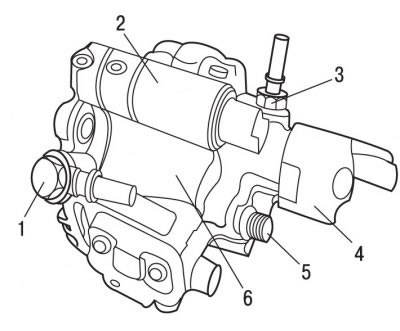
Figure 4.67. Elements of the SIEMENS high-pressure fuel pump: 1 - fuel pump feed pipe fitting; 2 -…

Figure 4.67. Elements of the SIEMENS high-pressure fuel pump: 1 - fuel pump feed pipe fitting; 2 - electromagnetic volume control valve; 3 - fuel return screw; 4 - electromagnetic pressure control valve; 5 - high pressure fuel outlet nipple; 6 - high pressure fuel pump


Do not disconnect or remove from fuel pump 6 (see Figure 4.67) high pressure the following elements:
  • electromagnetic pressure control valve 4;
  • volume control solenoid valve 2;
  • high pressure fuel outlet nipple 5;
  • fuel pump feed pipe nipple 1;
  • fuel return screw 3.

It is prohibited to disconnect the high pressure sensor from the end of the fuel distributor.

Caution! Before performing any work on the engine, read the memory of the injection system control unit.


It is prohibited to disconnect or remove the following components from the injector:
  • spray;
  • solenoid valve winding;
  • turn or loosen hex nuts.

When replacing the fuel system control unit, it is necessary to initialize the engine blocking system.

To carry out initialization, the following conditions must be met:
  • have an access code to the analog module (recorded on the client's confidential card);
  • have a new fuel system control unit and diagnostic tool;

Caution! Do not clean carbon deposits from the injector nozzle tip, nor do you use diesel fuel or ultrasound to clean it. All work with high-pressure fuel lines must always be accompanied by their mandatory replacement.

  • initialize the engine control unit;
  • carry out telecoding of the engine control unit.

Telecoding is carried out using diagnostic devices.

Updating the computer software is done by downloading from DIAG 2000.

Caution! Swapping fuel injection computers on two vehicles will prevent the engine from starting.


To unlock the fuel injection system computer:
  • turn on the ignition;
  • wait until the engine start indicator goes out;
  • disconnect the injection system computer;
  • turn off the ignition.
This article is available at russian, bulgarian, belarusian, ukrainian, serbian, croatian, romanian, polish, slovak, hungarian
Article reviewed by editor: Sidorov Timofey
Share information:
Previous
Peugeot 307: Diesel engines DW10
Next

Water pump — removal and installation
Replacing the coolant
Lubrication system — general information and pressure testing
Timing belt — removal, inspection and installation
Accessory drive belt
Fuel distributor (Common Rail) — removal and installation
Fuel injectors — removal and installation
Fuel filter — removal and installation
Siemens high-pressure fuel pump
Turbocharger — description, removal, and installation
See similar information for other Peugeot models

➨ Air conditioning system — general information and precautions Peugeot 106 (1991-2003)
➨ Fuel system Peugeot 207 (2006-2014)
➨ Removal air from the fuel system Peugeot 405 (1987-1997)
➨ Precautions when working on the fuel system of a diesel engine Peugeot 605 (1989-2000)
➨ Precautions when working on the fuel system of a diesel engine Peugeot 806 (1994-2002)
Link to this article in different formats
Comments and feedback from visitors
No comments yet


Add two numbers 26 + 20


Peugeot 307 (2001-2008) 
  • User manual
  • Keys, doors and alarm
  • Controls and instruments
  • Driving and operation
  • Maintenance
  • Power unit
  • Petrol engines TU3 and TU5
  • Petrol engines EW10
  • Diesel engines DV10
  • Diesel engines DW10
  • Transmission
  • Clutch and drive shafts
  • Mechanical gearbox
  • Automatic gearbox
  • Chassis, running gear
  • Front suspension
  • Rear suspension
  • Steering
  • Brake system
  • Body and interior
  • Exterior (external elements)
  • Interior (internal elements)
  • Doors, locks and windows
  • Heating and air conditioning
  • Electrical equipment
  • Equipment and devices
  • Power devices
  • Airbags
  • Electrical circuits
Peugeot 306 (1993-2002) 
  • General information
  • Introduction to manual
  • Specifications
  • Gasoline engine
  • Engine repair
  • Lubrication system
  • Cooling system
  • Fuel injection
  • Ignition system
  • Diesel engine
  • Engine repair
  • Lubrication system
  • Cooling system
  • Fuel injection
  • Transmission
  • Clutch
  • Gearbox
  • Drive shafts
  • Chassis, running gear
  • Steering system
  • Front suspension
  • Rear suspension
  • Brake system
  • Electrical equipment
  • Power devices
  • Electrical circuits
Peugeot 305 (1977-1989) 
  • General information
  • Maintenance
  • Power unit
  • Gasoline engines
  • Diesel engines
  • Cooling system (gasoline)
  • Cooling system (diesel)
  • Fuel system (gasoline)
  • Fuel system (diesel)
  • Ignition system
  • Transmission
  • Clutch
  • Mechanical gearbox BB8
  • Mechanical gearbox BE1
  • Automatic gearbox ZF4
  • Shafts, hubs and wheels
  • Chassis, running gear
  • Brake system
  • Car suspension
  • Steering
  • Body and interior
  • Exterior (external elements)
  • Interior (internal elements)
  • Electrical equipment
  • Equipment and devices
  • Headlights and lighting
  • Power devices
  • Electrical circuits
  • Wiring diagrams (diesel)
PeugeotBook.ru © 2018–2026 | Mobile version | Sitemap: EN BG BY UA RS HR RO PL SK HU | Write message | Site search | Add to bookmarks | Peugeot owners
106 (1991-2003) | 206 (1998-2012) | 207 (2006-2014) | 305 (1977-1989) | 306 (1993-2002) | 307 (2001-2008) | 405 (1987-1997) | 406 (1995-2004) | 605 (1989-2000) | Partner-I (1996-2008) | Eurovans-807 (2002-2014) | Eurovans-806 (1994-2002) | J5 (1981-1993) |
Cookies are used to ensure the correct display of pages on the site.