



General information
The power an engine can produce depends on the amount of air and fuel that enters the engine cylinders. To increase engine power, it is necessary to increase the supply of air and fuel. Injecting more fuel will have no effect until there is sufficient air available for combustion. To increase the amount of air supplied to the engine, a turbocharger is used, which forces air into the combustion chamber.
The turbocharger consists of a centrifugal compressor wheel and a turbine, connected to each other by a common rigid axle. The exhaust gases leaving the engine cylinders have high temperature and pressure. They accelerate to high speed and interact with the turbine blades, which converts kinetic energy into mechanical rotational energy. Energy conversion is accompanied by a decrease in the temperature and pressure of the exhaust gases. The turbocharger draws air through the air filter, compresses it and delivers it into the engine cylinders. The amount of fuel that is mixed with air can be increased, allowing the engine to produce more power.
To lubricate the turbocharger, engine oil is supplied under pressure through a special pipeline.
Since the turbocharger operates at high speed, care and cleanliness must be taken: dirt entering the turbocharger can cause it to fail.
Caution: Before disconnecting any components from the turbocharger, thoroughly clean them of any dirt. To protect against contamination, place the removed turbocharger components in a sealed container and close the turbocharger air ducts.
Removal
Turn off the ignition and disconnect the cable from the negative battery terminal.
Caution! The connecting element in the front exhaust pipe must be protected from any mechanical damage. The connecting element in the intake pipe must not be bent at an angle of more than 20° or displaced by 20 mm in the axial direction and by 25 mm in the radial direction, otherwise it will be damaged.
Remove the lower engine compartment protection.
Remove the exhaust system.
Remove the front tunnel and steering rack heat shields.
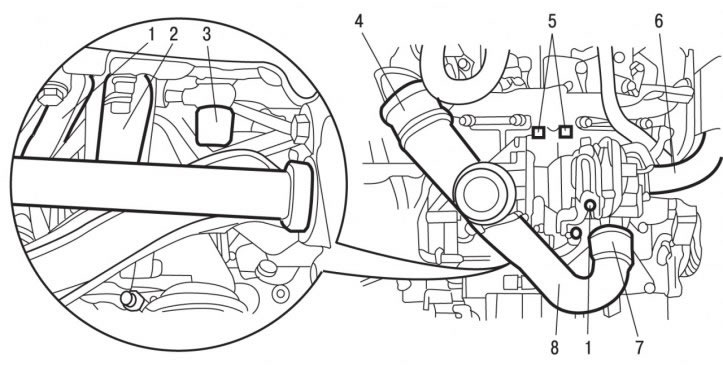
Figure 4.79. Turbocharger fastening and connection elements: 1 - turbocharger oil return pipe; 2 - lower turbocharger support; 3 - hollow bolt for supplying oil to the turbocharger; 4 - bushing; 5 - nuts; 6 - connecting element; 7 - bushing; 8 - air supply pipe to the turbocharger
Remove pipe 8 (figure 4.79) air supply to the turbocharger together with bushings 4 and 7.
Remove the lower turbocharger support 2.
Disconnect the oil return pipe 1 from the turbocharger.
Unscrew the hollow bolt 3 on the cylinder block for supplying oil to the turbocharger.
Disconnect and move aside the connecting element 6 at the turbocharger inlet.
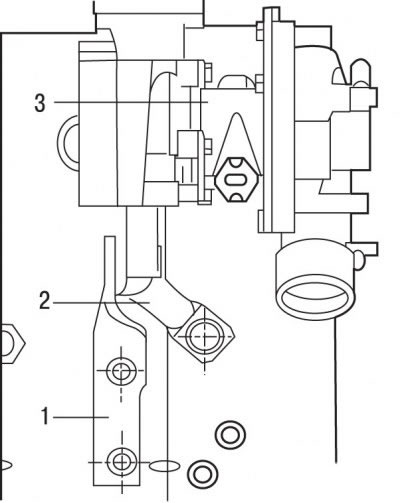
Figure 4.80. Location of bracket (2) and support (1) of turbocharger (3)
Remove bracket 2 (figure 4.80) turbocharger.
Unscrew nuts 5 (see Figure 4.79) and extract them through the exhaust tunnel.
Remove turbocharger 3 (see Figure 4.80).
Installation
Caution! When installing the turbocharger, you must use new bolts 10 (figure 4.81), nuts 5, leather gaskets 14 and 19 and sealing cuff 9.
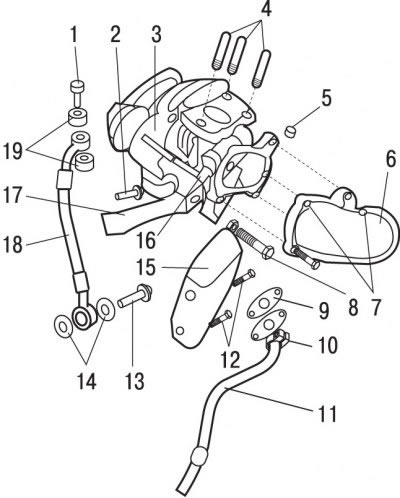
Figure 4.81. Turbocharger mounting elements: 1 - hollow bolt, 30 Nm; 2 - bolt, 25 Nm; 3 - turbocharger; 4 - studs, 10 Nm; 5 - nuts, 25 Nm; 6 - exhaust pipe connecting element; 7 - bolts; 8 - bolt; 9 - sealing cuff; 10 - bolts, 10 Nm; 11 - oil return pipe; 12 - bolts, 25 Nm; 13 - hollow bolt, 55 Nm; 14 - leather pads; 15 - support; 16 - nut, 30 Nm; 17 - support; 18 - oil supply pipe; 19 - leather pads
Install tube 18 (see Figure 4.81) oil supply with new leather gaskets 19 and secure with hollow bolt 1, tightening it to a torque of 30 Nm.
Install the intermediate connecting element 6 of the exhaust pipe and secure with bolts 7.
Tighten studs 4 on the exhaust manifold to a torque of 10 Nm.
Install turbocharger 3 and secure with nuts 5, tightening them to a torque of 25 Nm.
Install a new sealing cuff 9.
Install oil return pipe 11 and secure with new bolts 10, tightening them to a torque of 10 Nm.
Install hollow bolt 13 with new leather washers 14 and tighten it to 55 Nm.
Install support 17 and secure with bolt 2, tightening it by hand.
Install support 15 and secure with bolts 12, tightening them by hand.
Screw on nut 16 and tighten it to a torque of 30 Nm.
Tighten bolt 2 to 25 Nm.
Tighten bolt 12 to 25 Nm.
Further installation is carried out in the reverse order of removal.