
English Русский
Български
Беларускі
Український
Српски
Hrvatski
Română
Polski
Slovenský
Magyar
Bookmark Articles Sitemap Contacts
Company Hyundai Company Opel Company Skoda Company Kia Company Mitsubishi Company LADA Company Audi
PeugeotBook.ru


Series 100   Series 200   Series 300   400-500   Series 600   Crossovers   Others
 
Peugeot 305 (1977-1989) Peugeot 306 (1993-2002) Peugeot 307 (2001-2008)

Exhaust gas system (Peugeot 307)

  • Main
  • 30X
  • Peugeot 307 (2001-2008)
  • Power unit
  • Diesel engines DW10
  • Exhaust gas system
0
The exhaust system is used to remove exhaust gases into the atmosphere, preventing them from entering the vehicle interior even in minimal quantities, and reducing engine noise. For the exhaust system to function properly, it must be in good working order. The condition of the exhaust system also affects engine power and fuel consumption.

In vehicles with diesel engines, a non-adjustable oxidation catalytic converter is used to reduce the toxicity of exhaust gases.

Reducing the content of nitrogen oxides in the exhaust gases of a diesel engine is achieved by installing an exhaust gas recirculation (EGR) system on the vehicle.

Through the EGR valve on a warm engine, part of the exhaust gases are directed into the engine combustion chambers, resulting in a decrease in combustion temperature and a reduction in the content of nitrogen oxides in the exhaust gases.
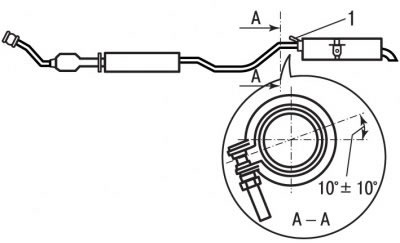
Figure 4.83. Exhaust system on vehicles with DW10TD engines: 1 - clamp, 25 Nm

Figure 4.83. Exhaust system on vehicles with DW10TD engines: 1 - clamp, 25 Nm


The exhaust system components are connected with clamps, the mounting bolts of which must be tightened to a torque of 25 Nm (figure 4.83).

After servicing and repairing the exhaust system, check that the system is installed freely, without tension, with sufficient clearance relative to the body elements.


Caution! When removing the exhaust system, protect the connecting element in the exhaust pipe from any mechanical damage and contact with any corrosive products. The connecting element in the exhaust inlet pipe must not be bent at an angle greater than 20° or displaced by 20 mm in the axial direction and 25 mm in the radial direction, otherwise it will be damaged.


(Text taken from the website: PeugeotBook)

Before reinstalling the exhaust system components, clean the joints with sandpaper to remove any remaining sealant and rust.
This article is available at russian, bulgarian, belarusian, ukrainian, serbian, croatian, romanian, polish, slovak, hungarian
Article reviewed by editor: Sidorov Timofey
Share information:
Previous
Peugeot 307: Diesel engines DW10
Next

Exhaust gas recirculation (EGR) valve
Turbocharger — description, removal, and installation
Siemens high-pressure fuel pump
Fuel filter — removal and installation
Fuel injectors — removal and installation
 
See similar information for other Peugeot models

➨ Exhaust system — general information and component renewal Peugeot 106 (1991-2003)
➨ Exhaust system (diesel engine) Peugeot 207 (2006-2014)
➨ Exhaust system (diesel) Peugeot 405 (1987-1997)
➨ Exhaust system — leak test Peugeot 605 (1989-2000)
➨ Exhaust system — removal and installation Peugeot 806 (1994-2002)
Link to this article in different formats
Comments and feedback from visitors
No comments yet


Add two numbers 15 + 18


Peugeot 307 (2001-2008) 
  • User manual
  • Keys, doors and alarm
  • Controls and instruments
  • Driving and operation
  • Maintenance
  • Power unit
  • Petrol engines TU3 and TU5
  • Petrol engines EW10
  • Diesel engines DV10
  • Diesel engines DW10
  • Transmission
  • Clutch and drive shafts
  • Mechanical gearbox
  • Automatic gearbox
  • Chassis, running gear
  • Front suspension
  • Rear suspension
  • Steering
  • Brake system
  • Body and interior
  • Exterior (external elements)
  • Interior (internal elements)
  • Doors, locks and windows
  • Heating and air conditioning
  • Electrical equipment
  • Equipment and devices
  • Power devices
  • Airbags
  • Electrical circuits
Peugeot 306 (1993-2002) 
  • General information
  • Introduction to manual
  • Specifications
  • Gasoline engine
  • Engine repair
  • Lubrication system
  • Cooling system
  • Fuel injection
  • Ignition system
  • Diesel engine
  • Engine repair
  • Lubrication system
  • Cooling system
  • Fuel injection
  • Transmission
  • Clutch
  • Gearbox
  • Drive shafts
  • Chassis, running gear
  • Steering system
  • Front suspension
  • Rear suspension
  • Brake system
  • Electrical equipment
  • Power devices
  • Electrical circuits
Peugeot 305 (1977-1989) 
  • General information
  • Maintenance
  • Power unit
  • Gasoline engines
  • Diesel engines
  • Cooling system (gasoline)
  • Cooling system (diesel)
  • Fuel system (gasoline)
  • Fuel system (diesel)
  • Ignition system
  • Transmission
  • Clutch
  • Mechanical gearbox BB8
  • Mechanical gearbox BE1
  • Automatic gearbox ZF4
  • Shafts, hubs and wheels
  • Chassis, running gear
  • Brake system
  • Car suspension
  • Steering
  • Body and interior
  • Exterior (external elements)
  • Interior (internal elements)
  • Electrical equipment
  • Equipment and devices
  • Headlights and lighting
  • Power devices
  • Electrical circuits
  • Wiring diagrams (diesel)
PeugeotBook.ru © 2018–2026 | Mobile version | Sitemap: EN BG BY UA RS HR RO PL SK HU | Write message | Site search | Add to bookmarks | Peugeot owners
106 (1991-2003) | 206 (1998-2012) | 207 (2006-2014) | 305 (1977-1989) | 306 (1993-2002) | 307 (2001-2008) | 405 (1987-1997) | 406 (1995-2004) | 605 (1989-2000) | Partner-I (1996-2008) | Eurovans-807 (2002-2014) | Eurovans-806 (1994-2002) | J5 (1981-1993) |
Cookies are used to ensure the correct display of pages on the site.