



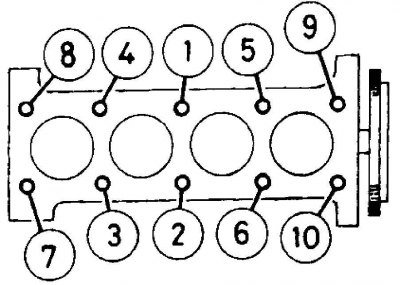
Cylinder Head Bolt Tightening Sequence
Removal
1. Disconnect the negative terminal from the battery.
2. Drain the coolant.
3. Install the timing mechanism drive until the mounting holes are aligned and lock it in this position with rods.
1.6 liter engine models
4. Remove the cylinder head cover.
5. Remove the air filter housing.
6. The following is a description of how to remove the cylinder head from the engine without removing the intake and exhaust manifolds from the head. Disconnect the exhaust pipe from the exhaust manifold. If there is a lambda probe, remove the electrical connector from it.
7. Follow these steps:
- depressurize the fuel system and remove the fuel supply and return hoses. Plug the ends of the hoses with plugs;
- remove the accelerator cable;
- disconnect the electrical connectors from the throttle body;
- remove the electrical connectors from the fuel injectors and release the wire harness from the manifold.
8. Loosen the clamps and remove the coolant supply hoses from the thermostat housing (on the left front side of the cylinder head).
9. Release the mounting brackets and remove the electrical connectors from the sensors that are screwed into the thermostat housing or on the left side of the cylinder head.
10. Unscrew the bolt securing the dipstick tube for measuring the engine oil level from the left front side of the head and remove the tube.
11. Remove the connector from the ignition coil. If the head is removed for major repairs, remove the ignition coil and high-tension wires. If necessary, mark the high-tension wires for correct reinstallation.
12. Release the timing belt tensioner and remove the timing belt from the camshaft pulley.
Engine models 1.8 and 2.0 liters
13. Remove the air cleaner assembly and intake manifold system.
14. Remove the cylinder head cover.
15. Remove the intake manifold.
16. Remove the exhaust pipe from the exhaust manifold. If there is a lambda probe, remove the electrical connector from it.
17. Remove the radiator hose.
18. Remove all remaining hoses and electrical connectors from the cylinder head.
19. Release the timing belt tensioner and remove the timing belt from the camshaft pulleys.
All models
20. Loosen the cylinder head bolts gradually and evenly in the reverse order to that shown in the figure Cylinder Head Bolt Tightening Sequence. Remove the bolts, noting the correct location of the gasket, which is oriented to the front left bolt on 1.6 litre models.
21. After removing the cylinder head bolts, it is necessary to separate the cylinder head from the engine. In this case, the head gasket may be damaged. On engines with removable cylinder liners, the cylinder liner may be pulled out by the gasket, as a result of which the tightness of the liner installation may be violated and coolant will leak through this leak.
22. To remove the cylinder head, use two metal rods with the ends bent at right angles, which are installed in the holes for the cylinder head mounting bolts and gently swing the head towards the front of the car. Do not turn the head in any other direction, because the rear of the head is mounted on guide pins.
23. After the gasket has failed or the head has separated from the gasket, remove the cylinder head. Remove the head gasket from the engine block. If the guide pins are loosely installed in the block, remove them and store them with the head.
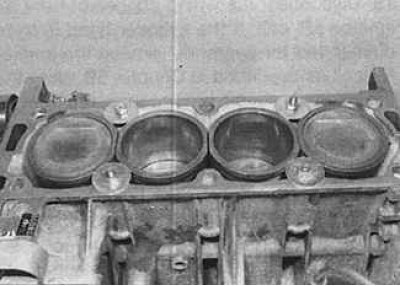
24. On engines with replaceable cylinder liners, the crankshaft must not be turned with the head removed, otherwise the cylinder liners may be pushed up out of their sockets. If it is necessary to turn the crankshaft (for cleaning pistons) the cylinder liners must be fixed in their original position. If there are no special liner clamps, the liners can be fixed by screwing bolts with large washers into the cylinder block, as shown in the figure.
25. If the cylinder head is removed for major repair, remove the camshaft.
Preparing for installation
1. The mating surfaces of the engine head and cylinder block must be thoroughly cleaned of gasket residue and carbon deposits using a plastic or wooden scraper. It is also necessary to clean the upper parts of the pistons. When cleaning, eliminate the possibility of cleaning products getting into the oil channels of the cooling system. Thoroughly clean the inner surfaces of the cylinders.
2. Check the mating surfaces of the engine head and cylinder block for defects. Minor damage can be repaired by mechanical treatment. Also, using a metal ruler and feeler gauge, check the flatness of the mating surfaces.
3. On engines with separate cylinder liners, check the amount of liners protruding from the engine block.
4. When installing a new gasket, it is important to select the correct thickness of gasket. Some models only use one thickness of head gasket. However, other models have two different thicknesses of gaskets - a standard gasket that is installed at the factory and a thicker gasket (+0.2 mm) that is used with a reground cylinder head. If the head is reground, it will be marked with an "R" stamped near the third intake port. The gasket should also have an "R" stamped on the top side of the gasket opposite the third cylinder. Gaskets can also be identified by marks on the left front side of the gasket.
5. A standard 1.2mm thick gasket is identified by one hole punched on the left front end of the gasket, while a heavy duty gasket (1.4mm) is identified by two or three holes punched in the same location.
6. Check the condition of the cylinder head bolts and especially their threads. Measure the length of each bolt (excluding the washer) from the underside of the bolt head to the end of the bolt. If the length of the bolts is less than 176.5 mm (on 1.6 liter engine models) or less than 60 mm (on 1.8 liter engines) or less than 112 mm (on 2.0 liter engines), they can be reused. However, if any bolt exceeds the specified length, all bolts in the set must be replaced.
Installation
1. Clean the mating surfaces of the cylinder head and block and install the two guide rods into the engine block. If used, remove the cylinder liner retaining clamps.
2. Install the new gasket onto the cylinder block so that the identification marks are located at the left end of the gasket.
1.6 liter engine models
3. Check that the crankshaft and camshaft pulleys are secured with the dowel rods. Install the head on the cylinder block using the guide pins.
4. Lubricate the threaded portion of the bolts and the bottom of the bolt head with Molykote G Rapid Plus.
5. Install the bolts with washers into the cylinder head and tighten the bolts evenly and gradually in a certain sequence (see figure Cylinder Head Bolt Tightening Sequence).
6. After tightening the bolts, loosen them in the reverse order of tightening and re-tighten them in the specified sequence to the required torque.
7. Tighten all bolts by 300° in a specific sequence.
8. Connect the ignition coil.
9. Install the timing belt onto the camshaft pulley. Install the engine mount to the cylinder head.
10. Adjust the belt tension.
11. Perform the remaining cylinder head installation operations in the reverse order of removal, observing the following points:
- correctly connect the removed electrical connectors;
- connect the coolant hoses correctly and tighten them securely with clamps;
- check that the vacuum and ventilation hoses are connected correctly;
- install the cylinder head cover;
- connect the exhaust pipe to the manifold, install the air filter and accelerator cable;
- fill the cooling system with coolant and connect the negative ground cable to the battery.
Engine models 1.8 and 2.0 liters
12. Check that the crankshaft and camshaft pulleys are secured with the mounting rods. Install the head on the cylinder block using the guide pins. Lubricate the threaded portion of the bolts and the bottom of the bolt head with Molykote G Rapid Plus. Install the bolts with washers in the cylinder head and tighten them evenly and gradually in a certain sequence (see figure Cylinder Head Bolt Tightening Sequence).
13. After tightening the bolts, loosen them in the reverse order of tightening and re-tighten them in the specified sequence to the required torque. Tighten all bolts to an angle of 300° (1.8 liter engines) or at an angle of 160° (2.0 liter engines) in a certain sequence.
14. Install the timing belt on the camshaft pulley and adjust its tension.
15. Perform the remaining operations in the reverse order of removal, taking into account the recommendations for 1.6 liter engines.