



- Measure the piston ring clearances by height in the piston grooves by successively inserting the rings into the corresponding groove on the piston (Figure 76). The gap is determined by a feeler gauge inserted into the gap between the ring surface and the piston groove surface. There are no official exact values, but it is believed that 0.10 mm is the wear limit value at which the piston should be replaced.
- After this, sequentially insert all piston rings from the top side into the working cylinder liner. Using an inverted piston, push the ring down to a distance of 15 mm from the bottom edge of the hole. To do this, place the cylinder block on its side. To measure the joint gap, insert a feeler gauge into the ring joint. On figure 77 shows how to correctly measure the piston ring joint gap. The joint clearances are not adjustable and if the joint clearances are increased, the piston rings must be replaced. The data is provided in the tables of sizes and adjustments.
- Measure the piston diameter with a micrometer at a right angle to the piston pin along the lower edge of the piston jacket. To check the piston clearance, measure the bore diameter. The holes are measured in the longitudinal and transverse directions and at three levels along the height of the working cylinder liner. In this way the maximum and minimum diameter are determined. Record the results.
- After this, subtract the piston diameter value from the hole diameter values. The difference is the piston clearance value. Only a service station can give an exact value. For example, when AEF pistons are installed, the clearance is 0.10–0.12 mm. For PDC pistons, this dimension is 0.098–0.12 mm. At location (1) in Figure 350, a letter is stamped, either "N" for AEF pistons or "U" for PDC pistons. This designation can be used to determine the type of piston installed.
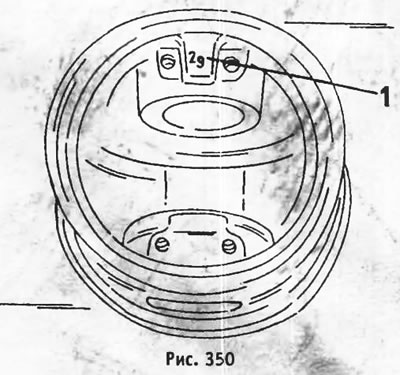
Figure 350.
If the clearance exceeds the specified value, the piston set must be replaced. Kits are supplied complete with piston rings and piston pins.
- Check the piston pins and piston bores for wear and damage. The piston pin must enter the piston hole with suction (lubricated).