



Table of contents: Rear drum brake models 🠇 Rear disc brake models 🠇
Rear drum brake models
Note: The bearing is intended to last the vehicle's entire service life without maintenance or attention. Never overtighten the hub nut beyond the specified torque wrench setting, in an attempt to "adjust" the bearings.
1. Remove the rear brake drum as described in Chapter 9.
2. Using circlip pliers, extract the bearing retaining circlip from the centre of the brake drum (see illustration).
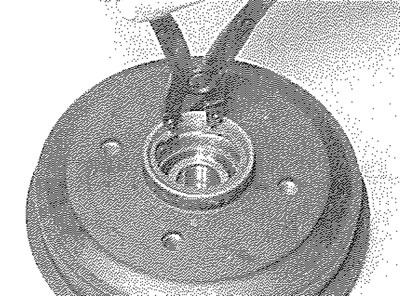
7.2. Extracting the rear wheel bearing circlip
3. Prise the oil seal seating ring from the rear of the hub (see illustration).
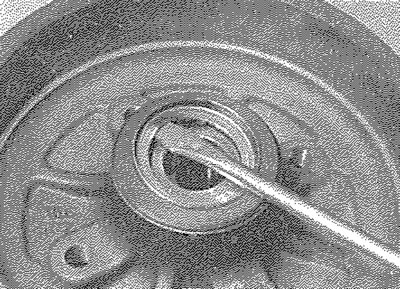
7.3. Prising the oil seal seating ring from the rear hub
4. Securely support the drum hub, then press or drive the bearing out of position, using a tubular drift which bears on the bearing inner race. Alternatively, the bearing can be removed using an improvised tool made up from a suitable socket or tube, washers, nut and a suitable long bolt or threaded rod (see illustration).
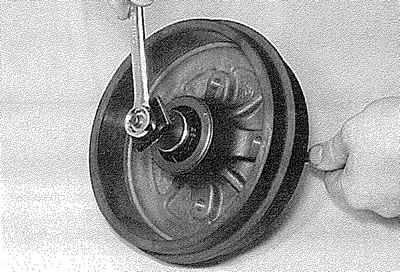
7.4. Drawing the hub bearing from the hub using improvised tools
5. Thoroughly clean the hub, removing all traces of dirt and grease and polish away any burrs or raised edges which might hinder reassembly. Check the hub for cracks or any other signs of wear or damage and renew them if necessary. The bearing and its circlip must be renewed whenever they are disturbed. Obtain a new bearing kit from a Peugeot dealer (see illustration).
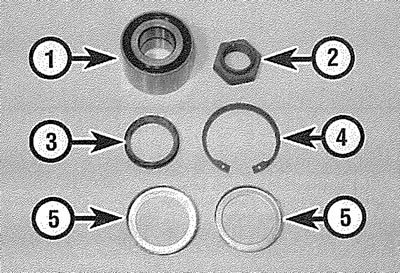
7.5. Rear hub bearing kit 1. Bearing; 2. Hub nut; 3. Oil seal; 4. Circlip; 5. Oil seal seating rings (alternative sizes)
6. Carefully prise the oil seal from the stub axle and fit the new seal supplied in the bearing kit. Note the spacer fitted behind the oil seal (see illustration).
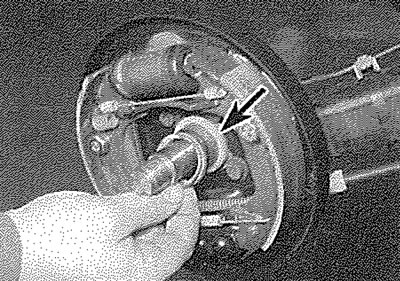
7.6. Fitting a new oil seal to the stub axle. Note spacer (arrowed)
7. Examine the stub axle shaft for signs of wear or damage. The shaft is an integral part of the trailing arm and if worn or damaged, the complete trailing arm must be renewed. Refer to Section 9 for further details.
8. On reassembly, apply a light film of clean engine oil to the bearing outer race, to aid installation of the bearing.
9. Securely support the drum and locate the bearing in the hub. Press the bearing fully into position, ensuring that it enters the hub squarely, using a tubular spacer which bears only on the bearing outer race. Alternatively, the bearing can be drawn into position with the improvised tool used previously, but note that a different socket or tube will be required, to bear on the bearing outer race (see illustrations).
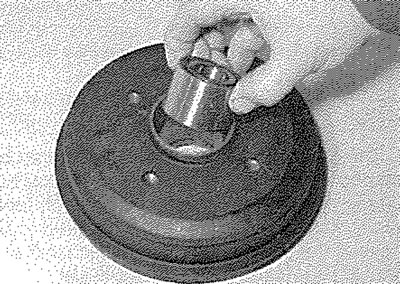
7.9a. Locate the bearing in the hub...
[Source available here: PeugeotBook]
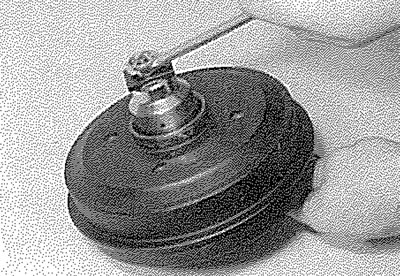
7.9b.... then draw the bearing into position
10. Ensure that the bearing is correctly seated against the hub shoulder and secure it in position with the new circlip. Ensure that the circlip is correctly seated in its hub groove.
11. Tap the new oil seal seating ring into position in the rear of the hub, taking care not to damage the oil seal seating surface (see illustrations). Note that two different-size oil seal seating rings may be supplied in the bearing kit - ensure that the correct ring is used.
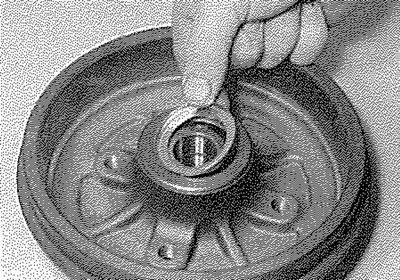
7.11a. Fit the new oil seal seating ring...
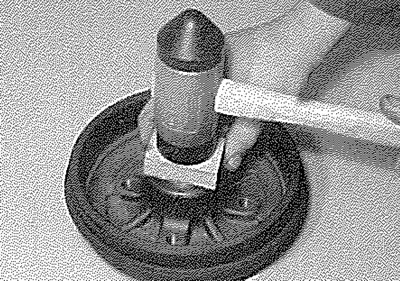
7.11b.... and tap it into position
12. Refit the brake drum as described in Chapter 9.
Rear disc brake models
13. On models with rear disc brakes, it is not possible to renew the rear hub bearing separately. If the bearing is worn, the complete rear hub assembly must be renewed. Refer to Section 6 for hub removal and refitting procedures.