



Table of contents: Every 250 miles (400 km) or weekly 🠇 Every 6000 miles (10 000 km) or 12…🠇 Every 12 000 miles (20 000 km) 🠇 Every 24 000 miles (40 000 km) 🠇 Every 36 000 miles (60 000 km) or 4…🠇 Every 72 000 miles (120 000 km) 🠇 Every 2 years (regardless of mileage) 🠇
Note: This maintenance schedule is a guide recommended for servicing your own vehicle. For the manufacturer's maintenance schedule, check with your local dealer.
The maintenance intervals in this manual are provided with the assumption that you, not the dealer, will be carrying out the work. These are the minimum maintenance intervals based on the schedule recommended by us for vehicles driven daily. If you wish to keep your vehicle in peak condition at all times, you may wish to perform some of these procedures more often. We encourage frequent maintenance, because it enhances the efficiency, performance and resale value of your vehicle.
If the vehicle is driven in dusty areas, used to tow a trailer, or driven frequently at slow speeds (idling in traffic) or on short journeys, more frequent maintenance intervals are recommended. Peugeot actually recommend that the service intervals are halved for vehicles which are used under these conditions.
When the vehicle is new, it should be serviced by a factory-authorised dealer service department, in order to preserve the factory warranty.
During 1994, Peugeot introduced extended maintenance intervals on their petrol models. "Normal servicing" (as described below for 6000 miles/10 000 km or 12 months), for these models has been extended to 9000 miles (15 000 km) or 12 months. However, our own recommendations would be as shown below, due to the benefits as described in paragraph 1.
In addition to the items shown below, where applicable, the ECU should be checked for any fault codes (refer to Chapter 4C for details).
Every 250 miles (400 km) or weekly
- Refer to "Weekly checks'".
Every 6000 miles (10 000 km) or 12 months - whichever comes first
- Renew the engine oil and filter (Section 3).
- Check all underbonnet components for fluid leaks (Section 4).
- Check the steering and suspension components (Section 5).
- Check the condition of the driveshaft rubber gaiters (Section 6).
- Check the automatic transmission fluid level (Section 7).
Every 12 000 miles (20 000 km)
In addition to all the items listed above, carry out the following:
- Check the air conditioning system refrigerant - where applicable (Section 8).
- Renew the spark plugs - at 18,000 miles for 1994-on models (Section 9).
- Renew the fuel filter - carburettor models (Section 10).
- Clean the fuel pick-up filter - fuel-injected models (Section 11).
- Renew the automatic transmission fluid - at 18,000 miles for 1994-on models (Section 12).
- Check the ignition system and ignition timing (Section 13).
- Check the idle speed and mixture adjustment (Section 14).
- Check the emission control system hoses and components (Section 15).
- Check the auxiliary drivebelt, and renew if necessary (Section 16).
- Check the clutch adjustment (Section 17).
- Lubricate the clutch control mechanism (Section 17).
- Check the front brake pads, and renew if necessary (Section 18).
- Check the operation of the handbrake (Section 19).
- Lubricate all hinges and locks (Section 20).
- Carry out a road test (Section 21).
Every 24 000 miles (40 000 km)
In addition to all the items listed above, carry out the following:
- Renew the air filter - at 36,000 miles for 1994-on models (Section 22).
Every 36 000 miles (60 000 km) or 4 years - whichever comes first
In addition to all the items listed above, carry out the following:
- Check the condition of the rear drum brake shoes (Section 23).
- Check the condition of the rear disc brake pads (Section 24).
- Check the manual transmission oil level (Section 25).
- Renew the fuel filter - fuel injection models (Section 26).
- Renew the timing belt (Chapter 2A).
* Note: Although the normal interval for timing belt renewal is 72 000 miles (120 000 km), it is strongly recommended that the interval is halved to 36 000 miles (60 000 km) on vehicles which are subjected to intensive use, ie. mainly short journeys or a lot of stop-start driving. The actual belt renewal interval Is therefore very much up to the individual owner, but bear in mind that severe engine damage will result if the belt breaks.
Every 72 000 miles (120 000 km)
In addition to all the items listed above, cany out the following:
- Renew the timing belt (Chapter 2A).*
*This is the interval recommended by Peugeot, but we recommend that the belt is changed more frequently, at 36 000 miles - see above.
Every 2 years (regardless of mileage)
- Renew the coolant (Section 28).*
- Renew the brake fluid (Section 29).
*The manufacturer has extended the coolant renewal interval for later.models, provided their specified antifreeze is used. Consult your,dealer for more information.
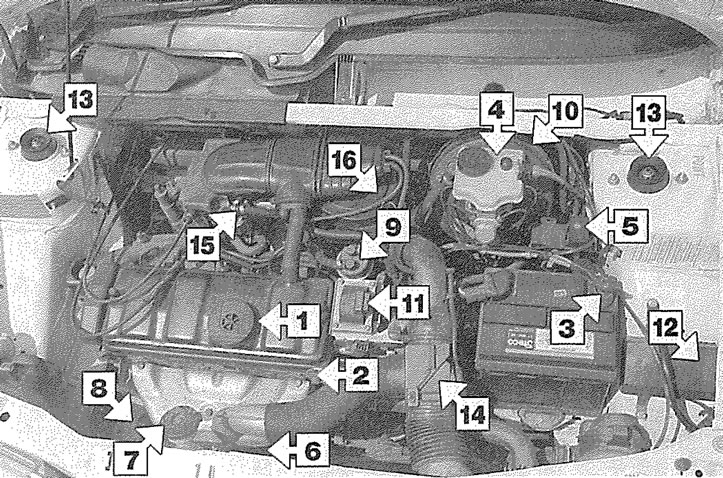
Underbonnet view of an 1124 co (TU1 engine) carburettor model 1. Engine oil filler cap; 2. Engine oil dipstick; 3. Battery earth (negative) terminal; 4. Master cylinder/brake fluid reservoir; 5. Auxiliary fusebox; 6. Engine oil filter; 7. Radiator filler cap; 8. Alternator; 9. Fuel pump; 10. Braking system vacuum servo unit; 11. Ignition HT coil; 12. Relay box; 13. Suspension strut upper mounting; 14. Air cleaner air temperature control valve; 15. Carburettor; 16. Air cleaner housing
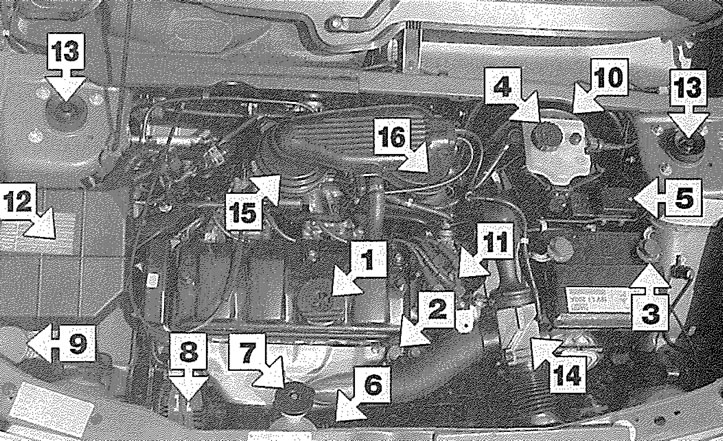
Underbonnet view of a 1360 cc (TU3 engine) fuel-injected model 1. Engine oil filler cap; 2. Engine oil dipstick; 3. Battery earth (negative) terminal; 4. Master cylinder/brake fluid reservoir; 5. Auxiliary fusebox; 6. Engine oil filter; 7. Radiator filler cap; 8. Alternator; 9. Washer fluid reservoir filler cap; 10. Braking system vacuum servo unit; 11. Ignition HT coil; 12. Plastic box containing the fuel injection ECU, relay unit and injector resistor; 13. Suspension strut upper mounting; 14. Air cleaner air temperature control valve; 15. Throttle body assembly; 16. Air cleaner housing
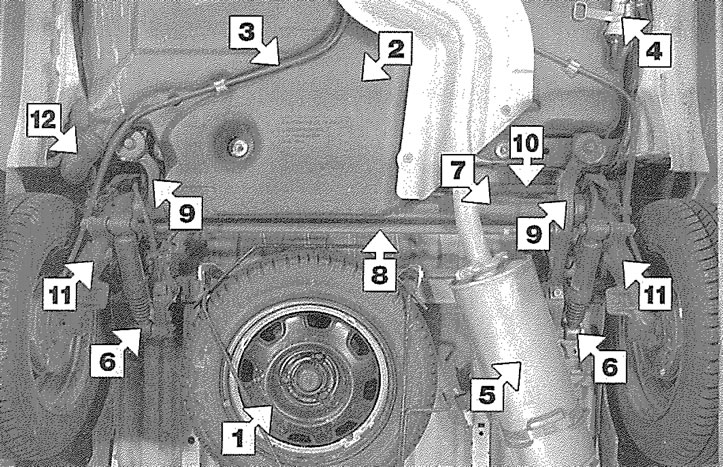
Rear underbody view 1. Spare wheel; 2. Fuel tank; 3. Handbrake cable; 4. Fuel filter; 5. Tailpipe; 6. Rear shock absorber; 7. Rear suspension tubular crossmember; 8. Torsion bar; 9. Rear axle mounting bracket; 10. Torsion bar; 11. Trailing arm; 12. Fuel tank filler hose
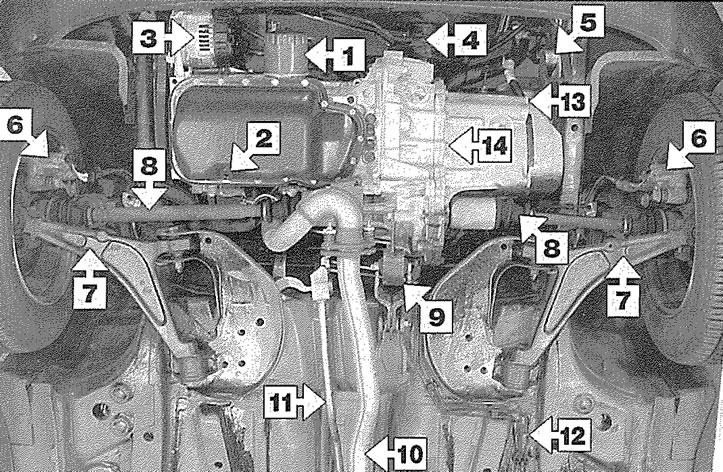
Front underbody view - diesel model shown (petrol models similar) 1. Oil filter; 2. Sump drain plug; 3. Alternator; 4. Radiator cooling fan; 5. Horn; 6. Brake caliper; 7. Lower arm; 8. Driveshaft; 9. Engine/transmission rear mounting; 10. Exhaust system; 11. Gearchange linkage selector rod; 12. Brake pipes; 13. Transmission filler/level plug; 14. Transmission drain plug