
English Русский
Български
Беларускі
Український
Српски
Hrvatski
Română
Polski
Slovenský
Magyar
Bookmark Articles Sitemap Contacts
Company Hyundai Company Opel Company Skoda Company Kia Company Mitsubishi Company LADA Company Audi
PeugeotBook.ru


Series 100   Series 200   Series 300   400-500   Series 600   Crossovers   Others
 
Peugeot 106 (1991-2003)

Automatic transmission fluid renewal (Peugeot 106)

  • Main
  • 10X
  • Peugeot 106 (1991-2003)
  • General information
  • Maintenance (petrol)
  • Automatic transmission fluid renewal
0
1. Take the vehicle on a short run, to warm the transmission up to operating temperature.

2. Park the car on level ground, then switch off the ignition and apply the handbrake firmly. Chock the rear wheels then jack up the front of the car and support it on axle stands (see "Jacking and vehicle support"). Note that, when refilling and checking the fluid level, the car must be lowered to the ground, and level, to ensure accuracy.

3. Remove the dipstick, then position a suitable container under the transmission. The transmission has two drain plugs: one on the sump, and another on the bottom of the differential housing (see illustration).
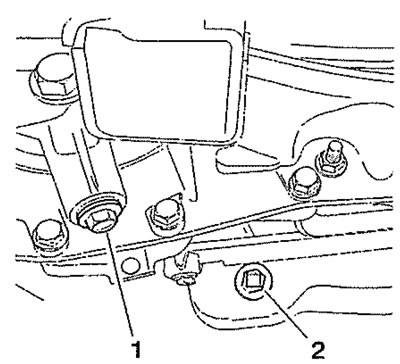
12.3. Automatic transmission fluid drain plugs (1 and 2)

12.3. Automatic transmission fluid drain plugs (1 and 2)


Warning: If the fluid is hot, take precautions against scalding.


4. Unscrew both drain plugs, and allow the fluid to drain completely into the container. Clean the drain plugs, being especially careful to wipe any metallic particles off the magnetic insert. Discard the original sealing washers; these should be renewed whenever they are disturbed.

5. When the fluid has finished draining, clean the drain plug threads and those of the transmission casing. Fit a new sealing washer to each drain plug, and refit the plugs to the transmission, tightening each securely. If the car was raised for the draining operation, now lower it to the ground. Make sure that the car is level (front-to-rear and side-to-side).


6. Refilling the transmission is an awkward operation, adding the specified type of fluid to the transmission a little at a time via the dipstick tube. Use a funnel with a fine-mesh gauze, to avoid spillage, and to ensure that no foreign matter enters the transmission. Allow plenty of time for the fluid level to settle properly. Fill the transmission until the level reaches the upper mark on the dipstick.

Original text is located at peugeotbook.ru

7. Once the level is up to the upper mark on the dipstick, refit the dipstick. Start the engine, and allow it to idle for a few minutes. Switch the engine off, then recheck the level, topping-up if necessary. Take the car on a moderate journey to fully distribute the new fluid around the transmission, then recheck the fluid level as described in Section 7.
This article is available at russian, bulgarian, belarusian, ukrainian, serbian, croatian, romanian, polish, slovak, hungarian
Article reviewed by editor: Matveev Demid
Share information:
Previous
Peugeot 106: Maintenance (petrol)
Next

Fuel pick-up filter cleaning — fuel-injected models
Fuel filter renewal — carburetor models
Spark plug renewal
Air conditioning system refrigerant check
Automatic transmission fluid level check
Ignition system check
Idle speed and mixture check and adjustment
Emission control systems check
Auxiliary drivebelt check and renewal
Clutch adjustment check and control mechanism lubrication
See similar information for other Peugeot models

➨ Automatic transmission Peugeot 207 (2006-2014)
➨ General description of the ZF4 HP14 automatic transmission Peugeot 305 (1977-1989)
➨ Automatic transmission Peugeot 405 (1987-1997)
➨ Automatic transmission Peugeot 605 (1989-2000)
➨ Checking the transmission fluid level in the gearbox Peugeot 806 (1994-2002)
Link to this article in different formats
Comments and feedback from visitors
No comments yet


Add two numbers 17 + 29


Peugeot 106 (1991-2003) 
  • General information
  • Introduction to manual
  • Weekly checks
  • Maintenance (petrol)
  • Maintenance (diesel)
  • Troubleshooting
  • Power unit
  • Petrol engines
  • Diesel engines
  • Engine overhaul
  • Cooling and heating
  • Fuel system (carburetor)
  • Single point injection (petrol)
  • Multipoint injection (petrol)
  • Fuel system (diesel)
  • Emission control system
  • Engine electrical equipment
  • Ignition system
  • Diesel heating
  • Transmission
  • Clutch
  • Manual gearbox
  • Automatic gearbox
  • Drive shafts
  • Chassis, running gear
  • Brake system
  • Car suspension
  • Steering
  • Body and interior
  • Exterior (external elements)
  • Interior (internal elements)
  • Doors, locks and windows
  • Electrical equipment
  • Equipment and devices
  • Electrical diagrams
PeugeotBook.ru © 2018–2026 | Mobile version | Sitemap: EN BG BY UA RS HR RO PL SK HU | Write message | Site search | Add to bookmarks | Peugeot owners
106 (1991-2003) | 206 (1998-2012) | 207 (2006-2014) | 305 (1977-1989) | 306 (1993-2002) | 307 (2001-2008) | 405 (1987-1997) | 406 (1995-2004) | 605 (1989-2000) | Partner-I (1996-2008) | Eurovans-807 (2002-2014) | Eurovans-806 (1994-2002) | J5 (1981-1993) |
Cookies are used to ensure the correct display of pages on the site.