



Table of contents: Recommendations for using a manual…🠇 Recommendations for using an…🠇 General recommendations for using…🠇
Many car models are equipped with an air conditioning system with manual or automatic control. With the help of the air conditioning system, the temperature in the car can be lower than the ambient temperature and maintained automatically according to the set parameters.
The air conditioning compressor is equipped with a wedge drive from the engine pulley. When the air conditioning system is turned on, the compressor consumes only 40% of its power, which ensures stable engine operation in idle mode.
Recommendations for using a manual air conditioner
Turning on the air conditioner
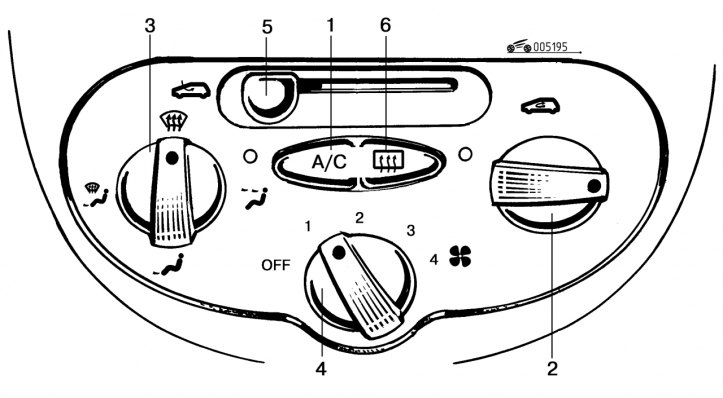
Figure 1.95. Air conditioner controls
 Key 1 (figure 1.95) is designed to turn on the air conditioner, and the indicator lights up.
Warnings!
- 1. The air conditioner operates only when the air intake speed regulator is in the "OFF" position.
- 2. The operation of the air conditioner is accompanied by the release of water flowing under the car, which is not a malfunction.
Air temperature regulation
By changing the position of regulator 2 (see figure 1.95) the desired air temperature in the cabin is set. When the control handle is moved to the right (red zone) the temperature increases, and when shifted to the left, it decreases.
Adjusting the air distribution in the cabin
 When setting switch 3 (see figure 1.95) in this position, the air flow is directed to the windshield and side windows, which ensures the removal of condensation and frost. To quickly remove frost and condensation from the windshield and side windows, set the maximum temperature and air flow in the following order:
- set the outside air intake regulator to the extreme left position - "Outside air";
- set the temperature and incoming air speed regulator to the maximum supply position;
- close the central and side ventilation grilles;
- turn on the air conditioner.
 Direction of air flow to the windshield and side windows, as well as to the passengers' feet.
 Direction of air flow towards the passengers' feet. Recommended at low ambient temperatures.
 Direction of air flow to central and side ventilation grilles. Recommended at elevated ambient temperatures.
Adjusting the air flow rate
 Regulator 4 (see figure 1.95) sets the fan operating mode and has positions "OFF", "1", "2", "3", "4", from off to maximum supply.
Regulator 5 (see figure 1.95) air intake mode
 The intake of outside air corresponds to the normal ventilation operation mode.
 The outside air supply is stopped, the recirculation mode is turned on, which ensures rapid heating of the passenger compartment. This mode should be short-term, as it causes fogging of the glass.
Note: Air conditioning is more efficient with the vents open.
Recommendations for using an electronically controlled air conditioner
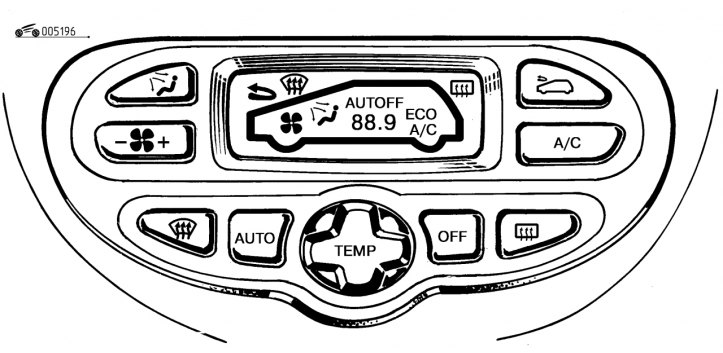
Figure 1.96. Automatic air conditioner controls
Some model 206 vehicles are equipped with electronically controlled air conditioners (figure 1.96). This allows maintaining comfortable conditions in the cabin regardless of the outside air temperature. At the same time, the distribution and amount of air entering the cabin does not depend on the speed of the car and is regulated automatically taking into account the outside air temperature and the air in the cabin. Any malfunctions that arise are recorded by the automatic unit and can be read at the service station.
Temperature control
 The cabin temperature is set by pressing the upper or lower projection of the switch key, its value is automatically displayed on the display. It is recommended to set the temperature in the range of 20-220 C.
Automatic comfort program
 By pressing the "AUTO" button, the system of automatic maintenance of the set air parameters in the cabin is activated. In this case, the system regulates the temperature, flow, distribution of incoming air, as well as the operation of the air conditioner itself.
Automatic glass transparency program
 In case of intensive fogging and icing of the glass, you can manually set the glass transparency mode by pressing a button. You can change the settings of the modes set by the automatic system at your own discretion. In this case, the remaining parameters will be adjusted automatically.
To return to fully automatic operation, press the "AUTO" button.
Air conditioner switch
 To turn off the air conditioner, press the "A/C" button. The "ECO" symbol will appear on the display. To return to the fully automatic mode of operation of the system, press the "A/C" button again. The "A/C" symbol will appear on the display.
Air distribution in the cabin
 Pressing this button in sequence allows you to direct the air flow:
- to the windshield (heating and defrosting);
- windshield and passengers' feet;
- passengers' feet;
- central and side ventilation grilles and to the passengers' feet;
- central and side ventilation grilles.
Outside air intake
 Pressing the "+" button increases the fan speed.
Pressing the "—" button reduces the fan speed.
Air recirculation
 Pressing this button activates the air recirculation mode in the passenger compartment. The indicated symbol lights up on the display. The recirculation mode allows you to isolate the passenger compartment from unpleasant odors, dust and smoke from the outside.
Do not turn on the air recirculation mode in the cabin for a long time. To turn it off, press the button again - this will return to the automatic operation mode of the system with an inflow of outside air.
Complete system shutdown
 The "OFF" button is used to turn off the entire air conditioning system.
Removal condensation from the rear window
 Pressing the button turns on the rear window and outside rearview mirrors. The heater turns off automatically. It can also be turned off before it turns off automatically by pressing the button again.
General recommendations for using the air conditioner
To ensure trouble-free operation of the air conditioner over a long period of operation, turn it on for at least 7-10 minutes at least once or twice a month.
Before turning on the air conditioner, you must open the ventilation grilles.
If you have any comments regarding the operation of the air conditioner, stop using it immediately and contact a service station.
All maintenance and repair work on the air conditioner should be carried out at a service station using highly qualified specialists and equipment for servicing refrigeration units.