



An automatic transmission malfunction can occur both in the control electronics and in the box itself. At the same time, the possibility of transferring the selector lever to any of the positions remains, however, when the forward gears are engaged, the car will only move in 4th or 5th gear. Contact the service station immediately.
Downshift device (Kick-Down)
The Kick-Down mode is used to engage a lower gear when the accelerator pedal is pressed all the way down. In this case, the point of increased resistance must be passed. This mode provides maximum vehicle acceleration when downshifting.
When the accelerator pedal is pressed all the way down, depending on the speed and engine speed, a sequential downshift occurs.
Possible control lever positions
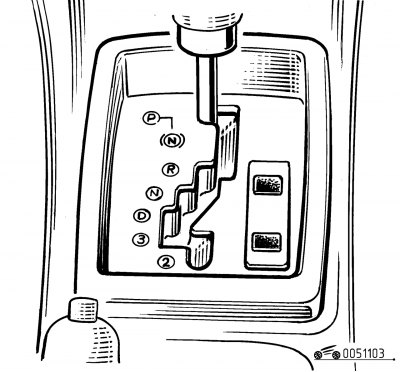
Pic. 1.103. AKP selector lever
The gear selector lever can be in the following six positions (pic. 1.103):
- «R» — parking position;
- «R» - reverse gear;
- «N» - neutral position;
- «D» - auto mode;
- «3» - position for driving on rough terrain, in the city or on a winding road;
- «2» — position for driving on mountainous terrain.

Pic. 1.104. Selector lever position indication
Each of the above positions of the automatic transmission selector lever corresponds to a lit indicator on the display of the instrument cluster (pic. 1.104).
The engine can only be started when the automatic transmission control lever is set to the position «P» or «N».
Attention! When the vehicle is parked with the engine running, the control lever must be in the «P» or «N», and the parking brake must be on.
After moving the selector lever to the position corresponding to forward or reverse, wait until the gear is engaged, feel a slight push, and only then take your foot off the brake pedal and press the accelerator pedal.
Note. Before leaving the vehicle interior, set the automatic transmission control lever to position «P» or» N» and apply the parking brake.
If the control lever is incorrectly moved to the position «N» when driving at high engine speeds, immediately reset «gas». Wait until the speed drops to the value corresponding to the idle mode, and only then engage the desired gear.
The movement begins with the choice of the driving mode, when the selector lever is moved to one of the positions («D», «R», «3» or «2»). Wait for the transmission mechanism to operate, then a slight push will follow, then lower the parking brake lever, release the brake pedal and only then press the accelerator pedal - the car will immediately start moving.
When stopping the car for a short time, it is enough to stop the car by pressing the brake pedal; the engine must be running at idle.
To park the car on a flat area, simply set the control lever to the position «R», thereby blocking the transmission.
On a sloping road, apply the parking brake first and then lock the transmission - the transmission lock mechanism receives less stress and is easier to release.
AKP has three control programs:
- «normal» («economical», or adaptive);
- «sports»;
- «winter» (driving on snow).
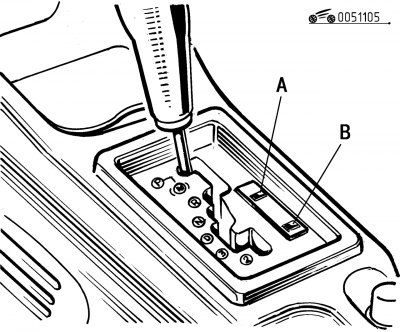
Pic. 1.105. Selecting an automatic transmission control program
The choice of the program is provided by pressing buttons A («S») and B («*»), located to the right of the automatic transmission control selector lever (pic. 1.105). Press button A once to select a program «sports» and the confirmation on the control panel indicator is lit «S». Press button B once to select a program «winter» and the confirmation on the control panel indicator is lit «*». When these buttons are pressed again, the control program switches to the position «normal» (or «economical»).
«Normal» the control program provides gear shifting automatically depending on the following parameters:
- driving style;
- road profile;
- car loading.
Automatic transmission control continuously selects from the programs stored in the memory the one that most fully corresponds to the driving conditions at the moment.
«Sports» the control program automatically provides the possibility of using a sporty driving style and more intense acceleration.
«Winter» the control program is activated when the selector lever is in position «D» and automatically provides a smooth ride on snow and slippery roads. At the same time, road grip and handling are improved. The movement of the car begins with 2nd gear and switching to lower gears occurs at low engine speeds.
Features of the automatic transmission.
During prolonged braking, the automatic transmission automatically shifts to a lower gear for more effective engine braking.
On sudden release «gas» no upshifts.
At the beginning of the movement, while the engine is cold, the optimal engine warm-up program is activated to reduce the emission of toxic components of exhaust gases into the atmosphere.
Warnings!
- 1. Any malfunctions in the automatic transmission control system are accompanied by the blinking of the indicator «sports management program» And «snow riding». The malfunction is manifested by shock loads when moving from the position «P» into position «R» and when moving from the position «N» into position «R».
- 2. When the indicators flash, the speed should not exceed 100 km/h.
- 3. In the event of a malfunction of the automatic transmission, immediately contact the service station.
- 4. If the engine speed is increased at idle, the vehicle may start moving without depressing the accelerator pedal. Hold the car by depressing the brake pedal.
- 5. Do not touch the accelerator pedal while shifting the selector lever if the vehicle is stationary.
- 6. When shifting gears while the vehicle is stationary, do not press the accelerator pedal. Hold the car by pressing the brake pedal.
- 7. When the brake pedal is depressed, do not press the accelerator pedal.
- 8. For any work in the engine compartment with the engine running, set the selector lever to the position «R» and apply the parking brake.
- 9. Move the selector lever to position «N», «P» And «R» only with the vehicle at a complete stop.
- 10. Do not leave children unattended in the car with the engine running and the ignition keys left.