English Русский
Български
Беларускі
Український
Српски
Hrvatski
Română
Polski
Slovenský
Magyar
Bookmark Articles Sitemap Contacts
Company Hyundai Company Opel Company Skoda Company Kia Company Mitsubishi Company LADA Company Audi
PeugeotBook.ru


Series 100   Series 200   Series 300   400-500   Series 600   Crossovers   Others
 
Peugeot 305 (1977-1989) Peugeot 306 (1993-2002) Peugeot 307 (2001-2008)

Disc brake pads — inspection and replacement (Peugeot 305)

  • Main
  • 30X
  • Peugeot 305 (1977-1989)
  • Chassis, running gear
  • Brake system
  • Disc brake pads — inspection and replacement
0
Table of contents: Teves brakes 🠇 DBA brakes 🠇 All front brakes 🠇
1. Before disassembling any part of the brake system, its components must be thoroughly cleaned. Brush off any dirt with a stiff brush and then clean the parts with hot water and a mild detergent (dishwashing liquid will also work). Do not use kerosene, gasoline or other solvents that may damage the friction material of the pads or piston seals.

2. Place the front of the vehicle on repair ramps or jack up and support its front. Apply the handbrake to prevent the car from moving.

3. To inspect the front brake pads, it is necessary to remove the front wheels, behind which the brake calipers are located. In the case of Teves brand calipers, it is also necessary to remove the damper spring, which covers the grooves on the pads that indicate their wear. Remove the wheels and, in the case of Teves brakes, knock out the lower pin that holds the brake pads. Remove the leaf damper spring. Each pad has a special groove that allows you to judge the thickness of the remaining layer of friction material. If this groove is not visible, the pad is worn beyond the permissible limit and should be replaced. If at least one pad is worn out, all 4 must be replaced.

4. To replace the pads, you must remove the front wheels (if it hasn't already been done) and then use a clean syringe to remove some fluid from the brake reservoir. When installing new pads, the pistons must be moved further into the cylinders to accommodate the new, thicker pads. In this case, some of the brake fluid will flow back into the reservoir, and if measures are not taken in advance, it may spill out. The liquid removed from the tank cannot be reused.


5. Figure 8.2 shows the two types of front brake calipers used on the Peugeot 305. Although they are interchangeable in principle, it is important that both front calipers on the car are the same type.
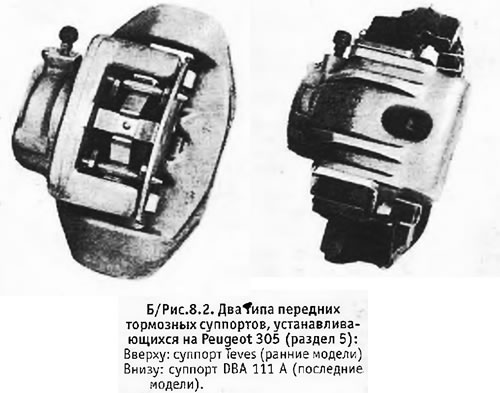
5. Figure 8.2 shows the two types of front brake calipers used on the Peugeot 305. Although they…


Teves brakes


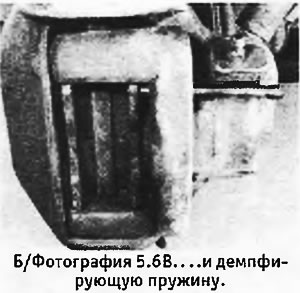
6. To remove the brake pads, knock out the two pins holding the pads, using a 3 mm diameter punch if necessary. Remove the retaining spring (see photos).
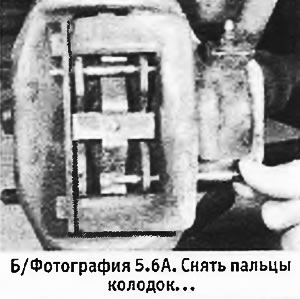
6. To remove the brake pads, knock out the two pins holding the pads, using a 3 mm diameter punch…

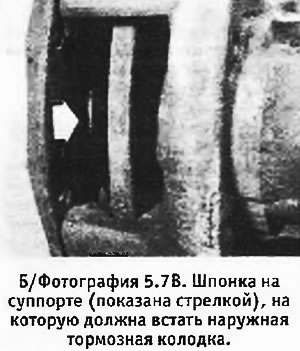
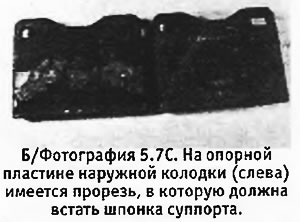
7. Press the caliper towards the center of the car and remove the inner pad (see photo). After this, press the caliper back and remove the outer pad. Please note that the outer pad has a recess on the support plate into which the caliper key fits (see photos).
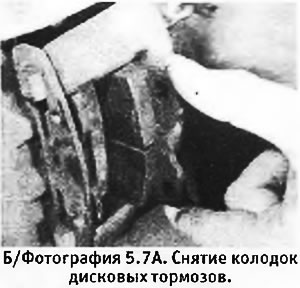


7. Press the caliper towards the center of the car and remove the inner pad (see photo). After…

7. Press the caliper towards the center of the car and remove the inner pad (see photo). After…


8. Inspect the friction surface of the disc. If it is heavily worn or has scratches or cracks, the disc should be replaced. Removing the disc from the suspension strut must be done by a specialist (see chapter 9, section 7). If the wear of the discs does not exceed the permissible limits, the discs can be reground in a specialized workshop.


9. If the pads are not very worn, but have a black shiny surface, they should be treated with sandpaper before installing them in place. Be careful not to remove too much material. The pads must be installed in their original positions.

10. Before installing the pads, inspect the caliper, brake disc and cylinders for wear and signs of leaks. Remove all traces of corrosion. If the brake pad pins and spring are worn or corroded, they should be replaced.

11. If you are going to replace the pads (all 4) you should first remove some of the fluid from the brake reservoir (see paragraph 4). Using a wooden block or blunt tool, push the piston into the caliper cylinder (see photo). Compare the new pads with the old ones to ensure they are identical.
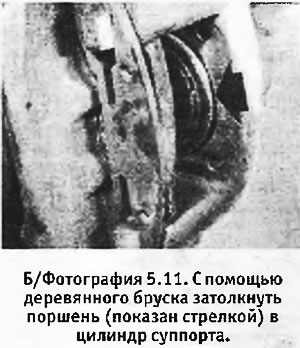
11. If you are going to replace the pads (all 4) you should first remove some of the fluid from the…


12. Spray the brake pad backing plates with a special Penatex sound-damping compound (Peugeot part number 9730.61). Make sure that the compound does not come into contact with the friction material of the pads. Let it dry and check that there are no traces of oil or grease on the disc and pad. Oily brake pads must not be installed. An oily disc must be cleaned with methyl alcohol and wiped with a clean cloth.


13. Installation of the pads is carried out in reverse order. Install the outer shoe first, making sure the key fits into the slot on the shoe support plate, then the inner shoe, spring and pins.

DBA brakes


14. Using long-nose pliers, remove the clamps from the keys and pull the keys out of the mounting slots.
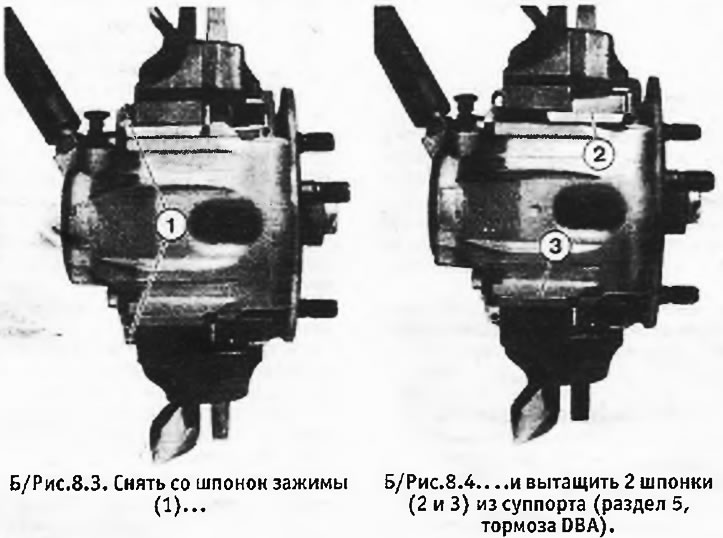
14. Using long-nose pliers, remove the clamps from the keys and pull the keys out of the mounting…


15. After removing the keys, you can remove the wheel cylinder from the caliper and, without disconnecting the brake hose from it, turn the cylinder to the side so that it does not interfere. Make sure that the hose is not stretched.
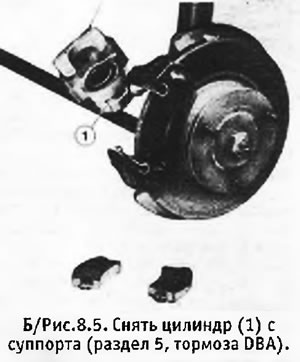
15. After removing the keys, you can remove the wheel cylinder from the caliper and, without…


16. Remove the old pads from the caliper, paying attention to the springs attached to the upper ends of the pads (how they are secured and installed).

17. Perform the operations specified in paragraphs 8-12. Inspect the slots into which the keys fit and remove all unevenness and burrs with sandpaper, carefully removing all traces of abrasive material afterwards.


18. Secure the springs to the pads exactly in their original position (see paragraph 16). The spring coil must pass over the recess in the shoe (see B/Figure 8.6).
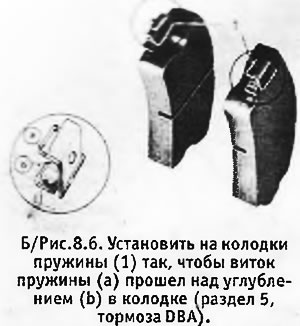
18. Secure the springs to the pads exactly in their original position (see paragraph 16). The…


19. Apply a thin layer of Molykote 321 R grease (or any other dry antifriction lubricant) onto the pad keys and let it dry.

20. Place the pads with their front surfaces facing each other and, after checking that the springs are installed correctly, install the pads in the caliper with the springs facing up.
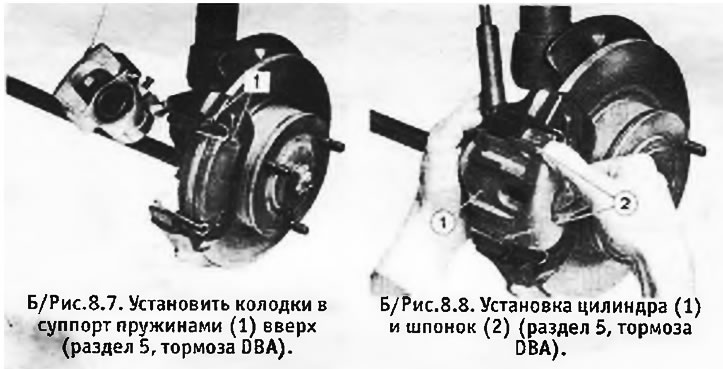
20. Place the pads with their front surfaces facing each other and, after checking that the springs…


21. Install the caliper cylinder and push the keys into place. Make sure the wire springs pass under the sliders on the cylinder and not between the sliders and keys.
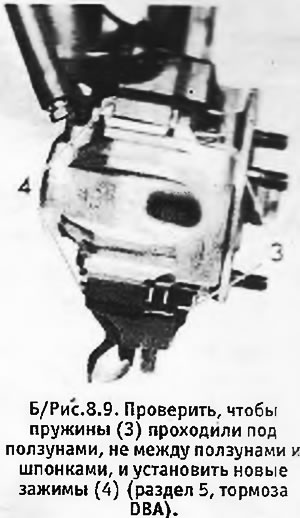
21. Install the caliper cylinder and push the keys into place. Make sure the wire springs pass…


22. Install new clamps to secure the keys in the sliders.


All front brakes


23. Repeat the entire procedure on the second front brake, reinstall the wheels and tighten the wheel nuts to the required torque.

24. Add fresh fluid to the brake reservoir and, with the engine running, press the brake pedal several times to seat the pistons. Once completed, add fluid to the reservoir again (as needed).

25. Remember that new brake pads need to be broken in, so at first you should drive carefully and avoid braking at high speed.

(Data published on the website: www.PeugeotBook.ru)
This article is available at russian, bulgarian, belarusian, ukrainian, serbian, croatian, romanian, polish, slovak, hungarian
Article reviewed by editor: Ostrovsky Fedor
Share information:
Previous
Peugeot 305: Brake system
Next

Brake adjustment
Bleeding brakes (all latest models)
Bleeding the brake system
Routine maintenance
General description of the braking system
Removal and installation front disc brake pads on models…
Disc Brake Calipers — removal, overhaul, and installation
Rear brake drums — removal and installation
Rear brake pads — removal, inspection and installation
Rear wheel cylinders — removal, overhaul and installation
See similar information for other Peugeot models

➨ Front brake pads — renewal (solid disc) Peugeot 106 (1991-2003)
➨ Removal and installation rear disc brake pads BOSCH Peugeot 206 (1998-2012)
➨ Replacing rear brake pads on disc brakes Peugeot 405 (1987-1997)
➨ Brake disc — removal Peugeot 605 (1989-2000)
➨ Front disc brakes — replacing brake pads Peugeot 806 (1994-2002)
Link to this article in different formats
Comments and feedback from visitors
No comments yet


Add two numbers 14 + 27


Peugeot 307 (2001-2008) 
  • User manual
  • Keys, doors and alarm
  • Controls and instruments
  • Driving and operation
  • Maintenance
  • Power unit
  • Petrol engines TU3 and TU5
  • Petrol engines EW10
  • Diesel engines DV10
  • Diesel engines DW10
  • Transmission
  • Clutch and drive shafts
  • Mechanical gearbox
  • Automatic gearbox
  • Chassis, running gear
  • Front suspension
  • Rear suspension
  • Steering
  • Brake system
  • Body and interior
  • Exterior (external elements)
  • Interior (internal elements)
  • Doors, locks and windows
  • Heating and air conditioning
  • Electrical equipment
  • Equipment and devices
  • Power devices
  • Airbags
  • Electrical circuits
Peugeot 306 (1993-2002) 
  • General information
  • Introduction to manual
  • Specifications
  • Gasoline engine
  • Engine repair
  • Lubrication system
  • Cooling system
  • Fuel injection
  • Ignition system
  • Diesel engine
  • Engine repair
  • Lubrication system
  • Cooling system
  • Fuel injection
  • Transmission
  • Clutch
  • Gearbox
  • Drive shafts
  • Chassis, running gear
  • Steering system
  • Front suspension
  • Rear suspension
  • Brake system
  • Electrical equipment
  • Power devices
  • Electrical circuits
Peugeot 305 (1977-1989) 
  • General information
  • Maintenance
  • Power unit
  • Gasoline engines
  • Diesel engines
  • Cooling system (gasoline)
  • Cooling system (diesel)
  • Fuel system (gasoline)
  • Fuel system (diesel)
  • Ignition system
  • Transmission
  • Clutch
  • Mechanical gearbox BB8
  • Mechanical gearbox BE1
  • Automatic gearbox ZF4
  • Shafts, hubs and wheels
  • Chassis, running gear
  • Brake system
  • Car suspension
  • Steering
  • Body and interior
  • Exterior (external elements)
  • Interior (internal elements)
  • Electrical equipment
  • Equipment and devices
  • Headlights and lighting
  • Power devices
  • Electrical circuits
  • Wiring diagrams (diesel)
PeugeotBook.ru © 2018–2026 | Mobile version | Sitemap: EN BG BY UA RS HR RO PL SK HU | Write message | Site search | Add to bookmarks | Peugeot owners
106 (1991-2003) | 206 (1998-2012) | 207 (2006-2014) | 305 (1977-1989) | 306 (1993-2002) | 307 (2001-2008) | 405 (1987-1997) | 406 (1995-2004) | 605 (1989-2000) | Partner-I (1996-2008) | Eurovans-807 (2002-2014) | Eurovans-806 (1994-2002) | J5 (1981-1993) |
Cookies are used to ensure the correct display of pages on the site.