English Русский
Български
Беларускі
Український
Српски
Hrvatski
Română
Polski
Slovenský
Magyar
Bookmark Articles Sitemap Contacts
Company Hyundai Company Opel Company Skoda Company Kia Company Mitsubishi Company LADA Company Audi
PeugeotBook.ru


Series 100   Series 200   Series 300   400-500   Series 600   Crossovers   Others
 
Peugeot 305 (1977-1989) Peugeot 306 (1993-2002) Peugeot 307 (2001-2008)

Spark plugs and high-tension wires — common part (Peugeot 305)

  • Main
  • 30X
  • Peugeot 305 (1977-1989)
  • Power unit
  • Ignition system
  • Spark plugs and high-tension wires — common part
0
1. Proper spark plug operation is critical to efficient engine operation. You must use only spark plugs approved for your engine (see Specifications). Then, provided the engine is in good condition, you do not need to deal with the spark plugs more often than their current maintenance requires. Cleaning spark plugs is rarely necessary, and it's best to avoid it unless you have the proper equipment, as it can easily damage the spark plug electrodes.

2. Spark plugs must be replaced at the intervals specified in the section "Routine maintenance" at the beginning of this Guide. A thorough inspection of spark plugs can tell you a lot about the condition of your engine.

3. If the spark plug's heat cone is clean and white, without any dark deposits, this is a sign of a too-lean mixture or a spark plug that is too hot (a hot spark plug transfers heat from the electrode slowly, while a cold spark plug does so quickly).

4. If the top and heat cone of the spark plug are covered with a thick black coating, this is a sign of an overly rich mixture. If the spark plugs are covered with a black oily coating, this indicates that the engine is very worn and the mixture is most likely too rich.

5. If the heat cone is covered with a coating from light brown to gray-brown in color, this means that the mixture has the correct composition, and the engine is most likely in good condition.

6. The size of the spark gap is of great importance. If it is too big or too small, the spark plug's performance will be greatly reduced. For the correct spark gap value see. in the Specifications at the beginning of this chapter.


7. The spark gap size is adjusted by bending the side electrode. Do not attempt to bend the central electrode under any circumstances, as this may damage the insulator.

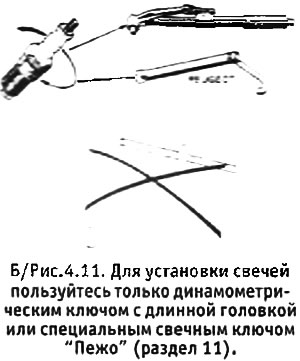
8. Recommended types of candles are indicated in Specifications. The spark plugs must have a conical body and be installed without washers. Since the head is made of light alloy, be careful not to overtighten the spark plugs. It is best to use a torque wrench with a long spark plug socket to tighten them. Check that the spark plug bodies and spark plug hole walls are clean. Check that the ignition wires are connected in the correct order (see B/Figure 4.5).
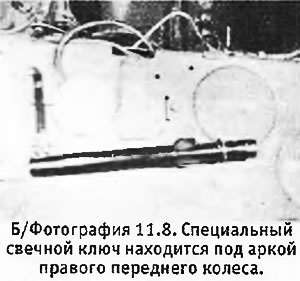
8. Recommended types of candles are indicated in Specifications. The spark plugs must have a…

9. Ignition wires do not require routine maintenance. It is enough to keep them clean and wipe them regularly. When removing spark plugs for servicing or replacement, disconnect the wires one at a time to avoid mixing them up. Before connecting the wires, clean their ends from traces of corrosion and thoroughly wipe the terminals under the wires on the distributor cap.

10. High tension wires slowly lose their performance over time, so it is recommended to replace them regardless of condition during normal engine maintenance. It's better not to throw away old wires, but to leave them in the car just in case.
This article is available at russian, bulgarian, belarusian, ukrainian, serbian, croatian, romanian, polish, slovak, hungarian
Article reviewed by editor: Ostrovsky Fedor
Share information:
Previous
Peugeot 305: Ignition system
Next

Ignition timing — regulation
Setting scale — checking and adjustment
Distributor — bulkhead
Distributor — removal and installation
Distributor — lubricant
Diagnostic socket
TDC sensor — removal, installation and adjustment
Ignition system troubleshooting
Electronic (contactless) ignition system
See similar information for other Peugeot models

➨ Spark plug renewal Peugeot 106 (1991-2003)
➨ Spark plugs Peugeot 207 (2006-2014)
➨ Replacement of spark plugs (20,000 km/12 months) Peugeot 405 (1987-1997)
➨ Spark plugs — general information Peugeot 605 (1989-2000)
➨ Spark plugs Peugeot 806 (1994-2002)
Link to this article in different formats
Comments and feedback from visitors
No comments yet


Add two numbers 20 + 11


Peugeot 307 (2001-2008) 
  • User manual
  • Keys, doors and alarm
  • Controls and instruments
  • Driving and operation
  • Maintenance
  • Power unit
  • Petrol engines TU3 and TU5
  • Petrol engines EW10
  • Diesel engines DV10
  • Diesel engines DW10
  • Transmission
  • Clutch and drive shafts
  • Mechanical gearbox
  • Automatic gearbox
  • Chassis, running gear
  • Front suspension
  • Rear suspension
  • Steering
  • Brake system
  • Body and interior
  • Exterior (external elements)
  • Interior (internal elements)
  • Doors, locks and windows
  • Heating and air conditioning
  • Electrical equipment
  • Equipment and devices
  • Power devices
  • Airbags
  • Electrical circuits
Peugeot 306 (1993-2002) 
  • General information
  • Introduction to manual
  • Specifications
  • Gasoline engine
  • Engine repair
  • Lubrication system
  • Cooling system
  • Fuel injection
  • Ignition system
  • Diesel engine
  • Engine repair
  • Lubrication system
  • Cooling system
  • Fuel injection
  • Transmission
  • Clutch
  • Gearbox
  • Drive shafts
  • Chassis, running gear
  • Steering system
  • Front suspension
  • Rear suspension
  • Brake system
  • Electrical equipment
  • Power devices
  • Electrical circuits
Peugeot 305 (1977-1989) 
  • General information
  • Maintenance
  • Power unit
  • Gasoline engines
  • Diesel engines
  • Cooling system (gasoline)
  • Cooling system (diesel)
  • Fuel system (gasoline)
  • Fuel system (diesel)
  • Ignition system
  • Transmission
  • Clutch
  • Mechanical gearbox BB8
  • Mechanical gearbox BE1
  • Automatic gearbox ZF4
  • Shafts, hubs and wheels
  • Chassis, running gear
  • Brake system
  • Car suspension
  • Steering
  • Body and interior
  • Exterior (external elements)
  • Interior (internal elements)
  • Electrical equipment
  • Equipment and devices
  • Headlights and lighting
  • Power devices
  • Electrical circuits
  • Wiring diagrams (diesel)
PeugeotBook.ru © 2018–2026 | Mobile version | Sitemap: EN BG BY UA RS HR RO PL SK HU | Write message | Site search | Add to bookmarks | Peugeot owners
106 (1991-2003) | 206 (1998-2012) | 207 (2006-2014) | 305 (1977-1989) | 306 (1993-2002) | 307 (2001-2008) | 405 (1987-1997) | 406 (1995-2004) | 605 (1989-2000) | Partner-I (1996-2008) | Eurovans-807 (2002-2014) | Eurovans-806 (1994-2002) | J5 (1981-1993) |
Cookies are used to ensure the correct display of pages on the site.