



Static regulation
2. Connect a 12-volt test lamp between the low-voltage wire of the distributor and ground. Remove the distributor cap or the high-voltage wire of the coil to prevent the engine from starting.
3. Turn on the ignition and, using a wrench placed on the crankshaft pulley bolt, turn the crankshaft in the normal direction of its rotation. The lamp should light every time one of the notches on the pulley passes the first notch on the setting scale.
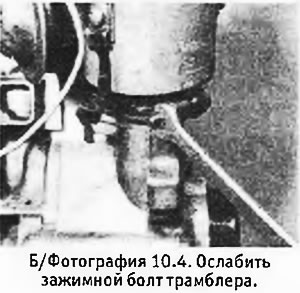
4. If the lamp lights up too early or too late, align one of the notches on the pulley with the first notch on the setting scale and loosen the distributor clamp bolt (see photo). Turn the distributor slightly until the lamp just lights up. Tighten the clamp bolt, turn the crankshaft again and repeat the check for the second mark on the pulley.
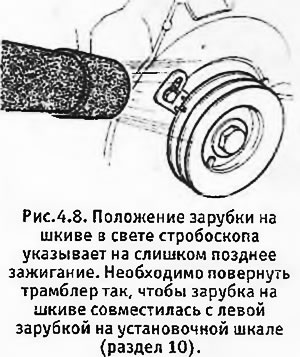
5. After ensuring that the ignition timing is adjusted correctly, turn off the ignition, disconnect the tester lamp and replace the distributor cap or the high tension wire of the coil.
Dynamic regulation
6. Clean the timing scale and the crankshaft pulley rim and mark both notches on the pulley and the first notch on the timing scale with quick-drying paint.
Original published on the portal: peugeotbook
7. Disconnect and plug the distributor vacuum tube. Connect the strobe light to the high voltage wire connecting the coil to the distributor, strictly following the manufacturer's instructions.
8. Start the engine and reduce idle speed to 800 rpm (at high speeds the centrifugal ignition regulator will start to operate). Direct the strobe light onto the setting scale. If the ignition timing is adjusted correctly and the distributor is in good condition, both notches on the pulley will appear as one in the light of the lamp, constantly aligned with the first notch on the setting scale.
9. If this is not the case, loosen the distributor clamp bolt and carefully turn the distributor so that the notches appear aligned in the light of the lamp. Tighten the clamp bolt and repeat the check again.
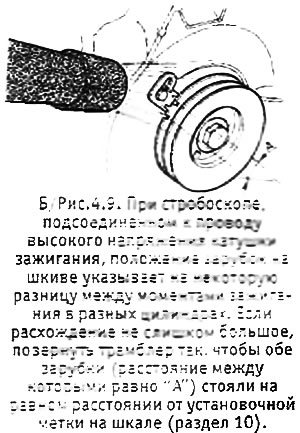
10. If, in the light of the lamp, the two notches on the pulley do not merge into one, or merge poorly, so that the notch looks too wide, then this is a sign of wear of the distributor or cam. Minor wear can be compensated for by turning the distributor so that the first notch on the adjustment scale is exactly in the middle between the two notches on the pulley (See B/Figure 4.9).
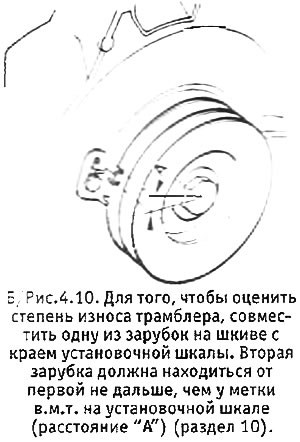
11. To determine the degree of wear, turn the distributor so that the right notch on the pulley aligns with the right edge of the adjustment scale. The second notch should not be located further from the first than the notch for TDC on the setting scale. If it is removed more than this distance, the distributor must be replaced. After checking, adjust the ignition timing correctly again.
12. You will not be able to accurately check the operation of the centrifugal and vacuum ignition regulators on your own. However, keep in mind that under the strobe light, the marks on the pulley should advance as the engine speed increases to a fast idle, and the timing should advance even further when the vacuum line is connected.
13. When finished, tighten the distributor clamp bolt, disconnect the strobe light and raise the idle speed to normal.
Setting a completely misaligned ignition timing
14. If, as a result of engine overhaul or careless movement of the distributor, the correct ignition timing is completely lost, remove the valve cover and turn the crankshaft so that piston No. 2 begins to rise on the compression stroke (both valves of cylinder N 2 are closed, i.e. both rockers do not touch the ends of the rods) and the installation marks are aligned. Loosen the distributor clamp bolt, remove the distributor cover and turn the distributor so that the runner is opposite electrode No. 2 in the cover (see B/Figure 4.5). After this, you can proceed to static ignition regulation, as indicated above.