



Table of contents: Removal 🠇 Installation 🠇
Removal
Caution: Use chalk, marker, or paint to mark the direction of rotation of the timing belt. If the timing belt rotates in the opposite direction during installation, it will be damaged.
TU3JP engine
Disconnect the cable from the negative battery terminal.
Remove the accessory drive belt.
Support the engine with a jack through a wooden spacer so that the weight of the engine is supported by the jack.
Remove the right upper engine mount.
Remove the accessory drive pulley from the crankshaft.
Remove the timing belt covers.
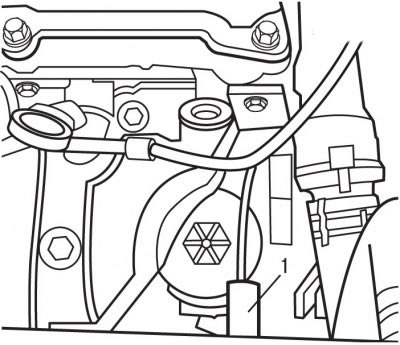
Figure 3.35. Using a special device (1) to prevent the engine flywheel from turning
Turning the engine crankshaft in the direction of working rotation, set the piston of the 1st cylinder to TDC using special tool 1 (figure 3.35), fixing the engine flywheel from turning.
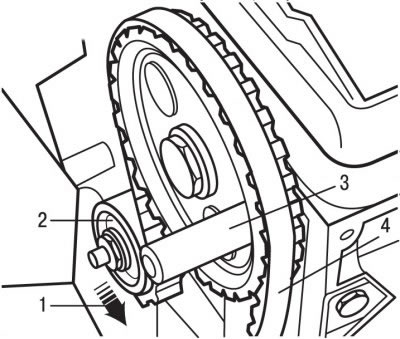
Figure 3.36. Timing belt fixing and tensioning elements: 1 - nut; 2 - tension roller; 3 - special pin; 4 - toothed belt
Secure the camshaft using a special pin 3 (figure 3.36).
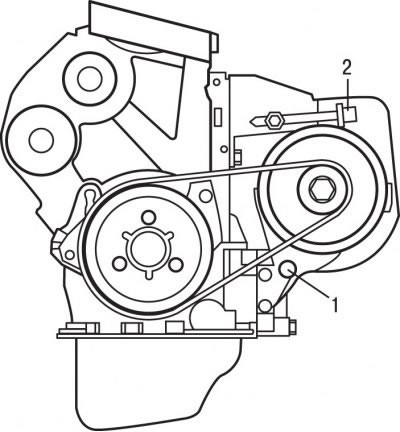
Figure 3.33. Location of the lower generator mounting bolt (1) and the belt tension adjustment bolt (2) on the TU5JP4 engine
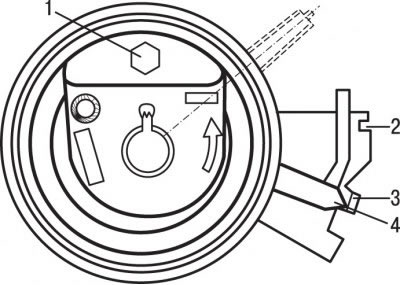
Figure 3.37. TU3JP engine toothed belt tension adjustment mechanism: 1 - adjusting eccentric with hex head; 2 - final belt tension mark; 3 - belt pre-tension mark; 4 - pointer
Loosen the tightening torque of nut 1 (see figure 3.33), holding the tension roller 2, then using the adjusting eccentric 1 (figure 3.37) move the tension roller 6 clicks horizontally towards the water pump, which will loosen the timing belt tension.
Remove the timing belt 4 (see figure 3.36).
Caution! Do not turn the engine crankshaft with the timing belt removed, as the pistons may hit the valves.
Engine TU5JP4
Disconnect the cable from the negative battery terminal.
Remove the right front wheel.
Remove the engine splash shield.
Remove the accessory drive belt.
Unscrew the central bolt and remove the accessory drive belt pulley from the crankshaft.
Support the engine with a jack using a platform and stands so that the weight of the engine is supported by the jack.
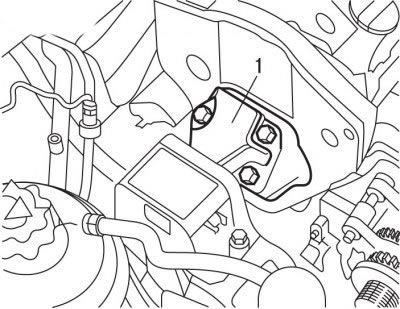
Figure 3.15. Location of the right engine support (1)
Unscrew the bolts and remove the right support 1 (see Figure 3.15) engine assembly.
Remove the upper and lower timing belt covers.
While turning the engine crankshaft in the direction of working rotation, set the piston of the 1st cylinder to TDC and use a special device to fix the engine flywheel from turning.
Secure the camshafts using special pins.
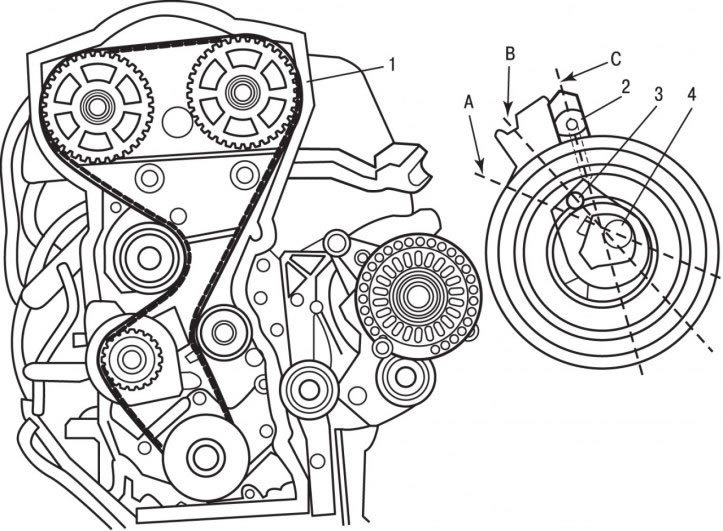
Figure 3.38. Positions of the toothed belt tensioner mechanism on the TU5JP4 engine: 1 - toothed belt; 2 - pointer; 3 - hex head; 4 - tension roller mounting bolt; A - position of maximum loosening of the toothed belt tension; B - position of normal tension of the toothed belt; C - position of maximum tension of the toothed belt
Remove bolt 4 (figure 3.38) fastenings of the timing belt tension roller.
Using hex head 3, turn the tension roller clockwise until the pointer aligns with mark A, which will result in maximum release of the timing belt tension. Fix the tension roller in this position.
Caution! Do not turn the timing belt tensioner roller a full turn.
Remove the timing belt.
Attention!
- 1. Do not twist or bend the timing belt. Prevent the timing belt from coming into contact with oil, coolant or fuel.
- 2. If the timing belt teeth have chipped, the water pump, oil pump or camshaft may be seized.
- 3. A broken timing belt on a running engine can be caused by the pistons hitting the valves, which can cause the valves to become deformed.
- 4. Check valve clearances. On deformed valves they will be significantly larger than required.
- 5. If the outer surface of the timing belt is significantly worn or delaminated, check the condition of the idler pulley raceway. If wear or damage is found on only one side of the belt, check the timing belt guide and timing belt pulley alignment. If there are any defects on the timing belt, it must be replaced.
- 6. The previously removed belt is installed in accordance with the marks applied.
Note: If it is necessary to turn the camshaft with the timing belt removed, the crankshaft must not be in the TDC position of the piston of the first cylinder, as this may cause the pistons to hit the open valves and damage the engine. To do this, mark the position and turn the crankshaft a quarter turn in one direction or the other.
Installation
TU3JP engine
Check the smoothness and uniformity of rotation of the tension roller.
Check that the flywheel and camshaft pulley are locked in position.
Install the new belt, keeping the section of the belt between the crankshaft pulley and the camshaft pulley tight, in the following order:
- crankshaft pulley;
- camshaft pulley;
- water pump drive pulley;
- tension roller.
Remove the special tool and pin that secure the flywheel and camshaft from turning.
For the hex head of the adjusting eccentric 1 (see figure 3.37) turn the tension roller counterclockwise until pointer 4 aligns with mark 2. Holding the roller in this position, tighten nut 1 (see figure 3.36) torque of 20 Nm.
Turn the engine crankshaft 10 revolutions clockwise until the piston of the 1st cylinder is at TDC.
Using a special device, secure the engine flywheel from turning 1 (see figure 3.35).
When the timing mechanism is installed correctly, a special pin 3 (see figure 3.36) should secure the camshaft pulley.
While holding roller 2 in the same position, loosen nut 1.
For hex head 1 (see figure 3.37) turn the tension roller clockwise using the adjusting eccentric so that pointer 4 aligns with mark 2 of the final belt tension.
While holding the roller in this position, tighten nut 1 (see figure 3.36) torque of 20 Nm.
Remove the special device that prevents the flywheel from turning.
Check the position of pointer 4 (see figure 3.37).
If pointer 4 is not aligned with mark 2 of the final belt tension, it is necessary to loosen the tension roller mounting nut and repeat the toothed belt tensioning operations.
Turn the engine crankshaft two turns clockwise until the piston of the 1st cylinder is at TDC.
Check the correct installation of the valve timing mechanism by fixing the flywheel and camshaft pulley in a certain position using a special device 1 (see figure 3.35) and pin 3 (see figure 3.36). Otherwise, repeat the timing belt tensioning operations.
Reinstall the timing belt covers.
Reinstall the accessory drive pulley and secure it with the bolt, tightening it to a torque of 25 Nm.
Install the right upper engine mount and accessory drive belt.
Connect the cable to the negative terminal of the battery.
Engine TU5JP4
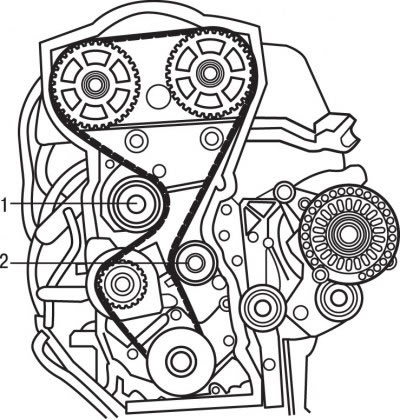
Figure 3.39. Location of the guide rollers (1 and 2) of the toothed belt on the TU5JP4 engine
Make sure that guide rollers 1 and 2 (figure 3.39) rotate smoothly and evenly.
On the reverse side of the timing belt there are three marks C, D and E (see figure 3.38), located opposite teeth 1, 52 and 72. The marks are white paint strokes on the back of the timing belt opposite the corresponding teeth.
Install the timing belt.
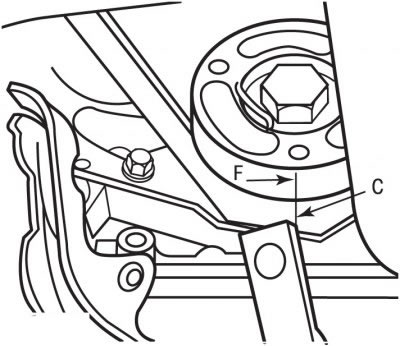
Figure 3.40. Alignment of the mark (C) of the toothed belt with the groove (F) of the crankshaft pulley
Align mark C on the timing belt with groove F (figure 3.40) crankshaft pulley.
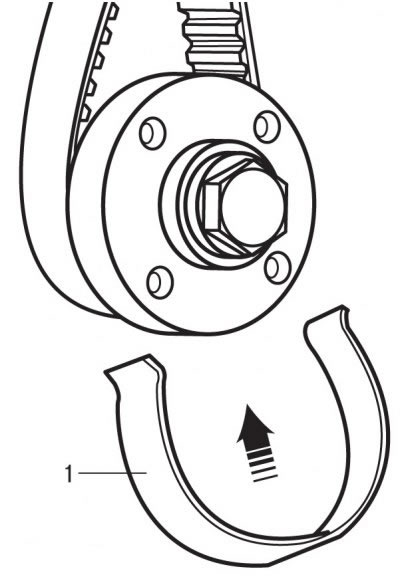
Figure 3.41. Direction of installation of the special device (1) on the crankshaft timing belt pulley
To support the timing belt, install a special device 1 on the crankshaft pulley (figure 3.41).
For hexagon 3 (see figure 3.38) turn the tension roller counterclockwise until pointer 2 is set to position C for maximum toothed belt tension, and in this position tighten the tension roller mounting bolt to a torque of 10 Nm.
Remove the special devices that prevent the flywheel and camshaft pulleys from turning.
Turn the engine crankshaft four turns clockwise until the piston of the 1st cylinder is at TDC and use a special device to secure the engine flywheel from turning.
Loosen the tension roller mounting bolt.
For hexagon 3 (see figure 3.38) turn the tension roller counterclockwise until pointer 2 is set to position B for normal timing belt tension, and in this position tighten the tension roller mounting bolt to a torque of 22 N·m.
Remove the special device that prevents the flywheel from turning.
Turn the engine crankshaft two turns clockwise until the piston of the 1st cylinder is at TDC and check the position of the tension roller, which can deviate by ±2.0 mm in relation to the position in which it was previously tightened. Otherwise, repeat the timing belt tension adjustment operations.
Check the correct installation of the valve timing mechanism by fixing the flywheel and camshaft pulleys in a certain position using special devices. Otherwise, repeat the timing belt tensioning operations.
Remove the special devices that prevent the flywheel and camshaft pulleys from turning.
Reinstall the timing belt covers.
Install the accessory drive belt pulley onto the crankshaft and secure it with the bolt, tightening it to a torque of 25 Nm.
Install the accessory drive belt and adjust its tension.
Install the right engine mount, engine splash shield and right front wheel.
Connect the cable to the negative terminal of the battery.