
English Русский
Български
Беларускі
Український
Српски
Hrvatski
Română
Polski
Slovenský
Magyar
Bookmark Articles Sitemap Contacts
Company Hyundai Company Opel Company Skoda Company Kia Company Mitsubishi Company LADA Company Audi
PeugeotBook.ru


Series 100   Series 200   Series 300   400-500   Series 600   Crossovers   Others
 
Peugeot 305 (1977-1989) Peugeot 306 (1993-2002) Peugeot 307 (2001-2008)

Exhaust gas system (Peugeot 307)

  • Main
  • 30X
  • Peugeot 307 (2001-2008)
  • Power unit
  • Petrol engines TU3 and TU5
  • Exhaust gas system
0
Table of contents: Catalytic converter 🠇 Operation of vehicles with a…🠇 Safety requirements for using a…🠇
The exhaust system is used to remove exhaust gases into the atmosphere, preventing even minimal amounts of them from entering the vehicle's interior and reducing engine noise.

Caution! The connecting element in the exhaust pipe must be protected from any mechanical damage. The connecting element in the exhaust inlet pipe must not be bent more than 20° in the rotation angle or displaced by 20 mm in the axial direction and 25 mm in the radial direction, otherwise it will be damaged.
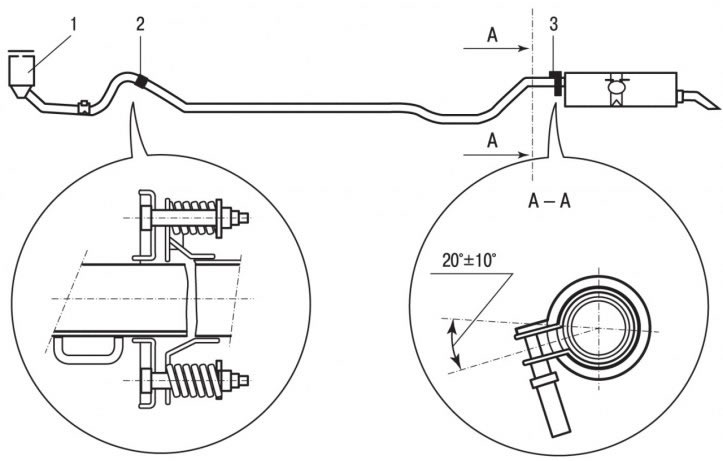

Figure 3.50. Exhaust system: 1 - oxygen concentration sensor; 2 - bolt hinge joint; 3 - clamp

Figure 3.50. Exhaust system: 1 - oxygen concentration sensor; 2 - bolt hinge joint; 3 - clamp


The exhaust system consists of an exhaust manifold, an exhaust pipe, mufflers and a catalytic converter (figure 3.50).

The exhaust system elements are connected using threaded connections and clamps.

Source available on the website: Peugeotbook.ru

Catalytic converter


All vehicles are equipped with catalytic converters to reduce the amount of harmful substances emitted into the atmosphere with exhaust gases.


The inlet and outlet cones with pipes and mounting flanges, as well as heat reflectors that hold the ceramic lining, are welded to the neutralizer body, made of stainless steel. The entire internal volume of the housing is occupied by a ceramic porous monolith-catalyst, fixed with rings or a stainless steel mesh. The catalyst is a filter in which the entire internal and external surface of the pores in contact with gases is covered with a very thin layer of an alloy containing platinum, rhodium and palladium. The porous catalyst has a large surface area covered with this alloy of very expensive metals, which is what mainly determines the high price of catalytic converters.

The catalyst causes a reaction that converts potentially hazardous hydrocarbons and carbon monoxide in the exhaust gases into harmless gases and water vapor.

All models with a catalytic converter have a closed-loop fuel supply system, meaning that based on a signal from the oxygen concentration sensor installed in the exhaust system, the control unit constantly optimizes the composition of the fuel-air mixture.

The catalytic converter operates effectively at temperatures of +300…+800°C.

Operation of vehicles with a catalytic converter


The catalytic converter is a reliable and simple device that does not require maintenance. To ensure its service life is maximized, the following requirements must be met.

Safety requirements for using a catalytic converter


Do not use leaded gasoline in a vehicle equipped with a catalytic converter, as the lead will coat the precious metals in the catalytic converter grid, reducing their effectiveness and ultimately causing damage to the catalytic converter.


Always keep the ignition and fuel systems in good working order.

Do not operate the vehicle with a faulty ignition system until the fault has been corrected.

If the engine control lamp lights up while the engine is running, you should contact a service station as soon as possible. If the engine management system is damaged, then in addition to increased fuel consumption and deterioration of the engine's dynamic characteristics, the catalytic converter may fail.

Do not start the engine by towing.

Do not turn off the ignition at high engine speed.

Do not use fuel or motor oil additives as they may contain substances that can damage the catalytic converter.

Do not operate the vehicle if blue smoke is emitted from the exhaust pipe.

After the engine has stopped, the exhaust system continues to emit heat for a long time, so you should avoid parking your car on grass or dry leaves.

Remember that the neutralizer is fragile, so avoid impacts when removing it or other components of the exhaust system.
This article is available at russian, bulgarian, belarusian, ukrainian, serbian, croatian, romanian, polish, slovak, hungarian
Article reviewed by editor: Sidorov Timofey
Share information:
Previous
Peugeot 307: Petrol engines TU3 and TU5
Next

Power supply system — design description
Water pump — removal and installation
Replacing the coolant
Lubrication system — removal, inspection and installation
Changes in the timing drive components of the TU3JP engine
 
See similar information for other Peugeot models

➨ Exhaust system — general information and component renewal Peugeot 106 (1991-2003)
➨ Exhaust system (diesel engine) Peugeot 207 (2006-2014)
➨ Exhaust system (diesel) Peugeot 405 (1987-1997)
➨ Exhaust system — leak test Peugeot 605 (1989-2000)
➨ Exhaust system — removal and installation Peugeot 806 (1994-2002)
Link to this article in different formats
Comments and feedback from visitors
No comments yet


Add two numbers 39 + 16


Peugeot 307 (2001-2008) 
  • User manual
  • Keys, doors and alarm
  • Controls and instruments
  • Driving and operation
  • Maintenance
  • Power unit
  • Petrol engines TU3 and TU5
  • Petrol engines EW10
  • Diesel engines DV10
  • Diesel engines DW10
  • Transmission
  • Clutch and drive shafts
  • Mechanical gearbox
  • Automatic gearbox
  • Chassis, running gear
  • Front suspension
  • Rear suspension
  • Steering
  • Brake system
  • Body and interior
  • Exterior (external elements)
  • Interior (internal elements)
  • Doors, locks and windows
  • Heating and air conditioning
  • Electrical equipment
  • Equipment and devices
  • Power devices
  • Airbags
  • Electrical circuits
Peugeot 306 (1993-2002) 
  • General information
  • Introduction to manual
  • Specifications
  • Gasoline engine
  • Engine repair
  • Lubrication system
  • Cooling system
  • Fuel injection
  • Ignition system
  • Diesel engine
  • Engine repair
  • Lubrication system
  • Cooling system
  • Fuel injection
  • Transmission
  • Clutch
  • Gearbox
  • Drive shafts
  • Chassis, running gear
  • Steering system
  • Front suspension
  • Rear suspension
  • Brake system
  • Electrical equipment
  • Power devices
  • Electrical circuits
Peugeot 305 (1977-1989) 
  • General information
  • Maintenance
  • Power unit
  • Gasoline engines
  • Diesel engines
  • Cooling system (gasoline)
  • Cooling system (diesel)
  • Fuel system (gasoline)
  • Fuel system (diesel)
  • Ignition system
  • Transmission
  • Clutch
  • Mechanical gearbox BB8
  • Mechanical gearbox BE1
  • Automatic gearbox ZF4
  • Shafts, hubs and wheels
  • Chassis, running gear
  • Brake system
  • Car suspension
  • Steering
  • Body and interior
  • Exterior (external elements)
  • Interior (internal elements)
  • Electrical equipment
  • Equipment and devices
  • Headlights and lighting
  • Power devices
  • Electrical circuits
  • Wiring diagrams (diesel)
PeugeotBook.ru © 2018–2026 | Mobile version | Sitemap: EN BG BY UA RS HR RO PL SK HU | Write message | Site search | Add to bookmarks | Peugeot owners
106 (1991-2003) | 206 (1998-2012) | 207 (2006-2014) | 305 (1977-1989) | 306 (1993-2002) | 307 (2001-2008) | 405 (1987-1997) | 406 (1995-2004) | 605 (1989-2000) | Partner-I (1996-2008) | Eurovans-807 (2002-2014) | Eurovans-806 (1994-2002) | J5 (1981-1993) |
Cookies are used to ensure the correct display of pages on the site.