
English Русский
Български
Беларускі
Український
Српски
Hrvatski
Română
Polski
Slovenský
Magyar
Bookmark Articles Sitemap Contacts
Company Hyundai Company Opel Company Skoda Company Kia Company Mitsubishi Company LADA Company Audi
PeugeotBook.ru


Series 100   Series 200   Series 300   400-500   Series 600   Crossovers   Others
 
Peugeot 405 (1987-1997) Peugeot 406 (1995-2004)

Features of the rear suspension of 4x4 vehicles (Peugeot 405)

  • Main
  • 40X
  • Peugeot 405 (1987-1997)
  • Chassis, running gear
  • Rear suspension
  • Features of the rear suspension of 4x4 vehicles
0

Rear suspension elements (4 x 4 powertrain)
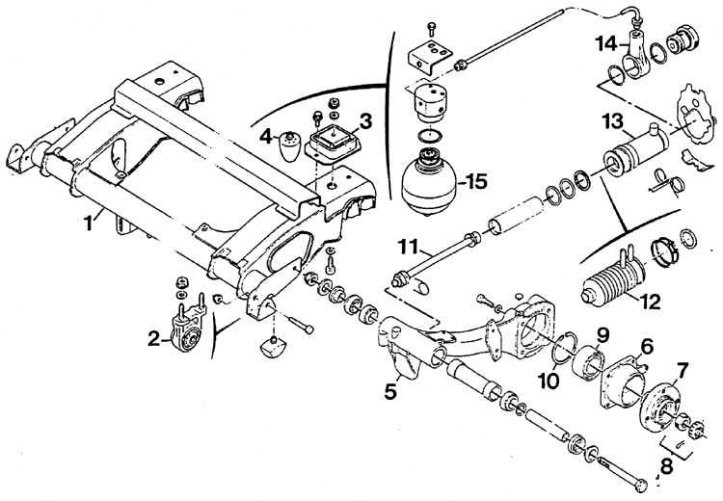


1 – rear suspension cross member, 2 – body mount support, 3 – metal-rubber element, 4 – suspension…

1 – rear suspension cross member, 2 – body mount support, 3 – metal-rubber element, 4 – suspension buffer, 5 – suspension arm, 6 – hub base, 7 – hub, 8 – axle shaft nut, 9 – bearing, 10 – mounting ring, 11 – control tailpiece, 12 – casing, 13 – cylinder, 14 – branch, 15 – reservoir


Checking the height h of the rear suspension
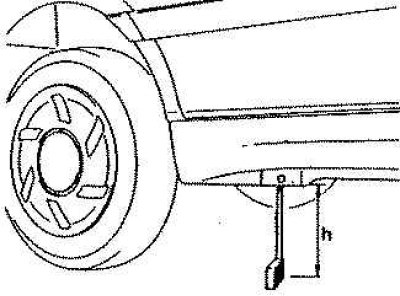


Checking the height h of the rear suspension


Peugeot 405 vehicles with four-wheel drive (4 x 4) are equipped with hydropneumatic rear suspension, which maintains a constant rear body height regardless of the vehicle load.

A special tank filled with nitrogen is exposed to the suspension elements via a hydraulic circuit. The gas acts in this case as a spring, and the oil, throttled in calibrated pipelines, acts as a shock absorber. Instead of acting on a coil spring, the suspension arm acts on a piston, which converts this action into wheel movement. Maintaining the main pressure is a prerequisite for ensuring the normal suspension height. This pressure is created by an electrically driven hydraulic pump. The required pressure is determined by a switch whose action depends on the height of the body.


Regardless of the load on the vehicle, the height of the body remains constant.

The rear suspension has two special levers mounted on conical bearings, the tightness of which is ensured by sealing rings. Each of the levers has a round hole on the side of the drive axle hub. Each lever also has a socket for the ball joint of the intermediate tailpiece, transmitting movement to the suspension cylinder.

Each of the two suspension cylinders has a piston and an element connecting it to the suspension arm, a sealing and leak detection housing, a connection to the shock absorber element and a branch supplying fluid to the reservoir.

The reservoir is adjusted to a pressure of 4.0 MPa and has four connections: to two suspension cylinders, to a high-pressure hydraulic pump and to a pressure regulator.

The hydraulic pump is activated by a body height sensor connected to the stabilizer via connectors.

[Source available on the website: PEUGEOTBOOK]

Electrically controlled drain valve opens the liquid outlet in case of too high pressure (reduced load on the trunk, reduced load on the rear suspension).

The hydraulic fluid reservoir supplies the circuit. It receives excess fluid and fluid when the drain valve is opened. From this reservoir, the fluid is supplied to the high-pressure pump through a filter.

The pressure regulator matches the braking force to the load on the rear axle (depending on the pressure in the circuit).

A special switch attached to the tank holder limits the pressure to a maximum value of 13.5 MPa.

The rear suspension crossmember carries all the elements, as well as the drive axle. It is attached to the body at the front with two elastic supports, and at the rear - with two metal-rubber elements.
This article is available at russian, bulgarian, belarusian, ukrainian, serbian, croatian, romanian, polish, slovak, hungarian
Article reviewed by editor: Shirokov Arseny
Share information:
Previous
Peugeot 405: Rear suspension
Next

Rear wheel hubs — removal and installation
Adjusting the height of the body suspension
Removal and installation the rear suspension
Rear suspension arm — removal and installation
Stabilizer — removal and installation
Replacement of the tank
Removal and installation the suspension arm
Removal and installation the suspension cylinder
Bleeding air from the hydraulic circuit
Removal and installation the pump
See similar information for other Peugeot models

➨ Rear suspension assembly — general Peugeot 106 (1991-2003)
➨ Features of front suspension wheel bearings Peugeot 207 (2006-2014)
➨ Rear suspension strut — bulkhead Peugeot 305 (1977-1989)
➨ Rear wheel suspension — removal and installation Peugeot 605 (1989-2000)
➨ Rear suspension — removal and installation Peugeot 806 (1994-2002)
Link to this article in different formats
Comments and feedback from visitors
No comments yet


Add two numbers 19 + 40


Peugeot 406 (1995-2004) 
  • General information
  • User manual
  • Maintenance (gasoline)
  • Maintenance (diesel)
  • Power unit
  • Gasoline engines
  • Diesel engines
  • Engine overhaul
  • Cooling and heating
  • Fuel system (gasoline)
  • Fuel system (diesel)
  • Engine electrical equipment
  • Transmission
  • Clutch and drive shafts
  • Mechanical gearbox
  • Automatic gearbox
  • Chassis, running gear
  • Brake system
  • Car suspension
  • Steering
  • Body and interior
  • Exterior (external elements)
  • Interior (internal elements)
  • Doors, locks and windows
  • Electrical equipment
  • Equipment and devices
  • Electrical circuits
Peugeot 405 (1987-1997) 
  • General information
  • User manual
  • Maintenance
  • Power unit
  • Petrol engines 1.4 l
  • Petrol engines 1.6-2.0 l
  • Diesel engines
  • Ignition system
  • Fuel system (carburetor)
  • Single point fuel injection
  • Multipoint fuel injection
  • Cooling and lubrication system
  • Exhaust system
  • Transmission
  • Clutch
  • Manual gearbox MA
  • Manual gearbox BE
  • Automatic gearbox
  • Drive shafts
  • Chassis, running gear
  • Steering
  • Front suspension
  • Rear suspension
  • Brake system
  • Body and interior
  • Exterior (external elements)
  • Interior (internal elements)
  • Doors, locks and windows
  • Electrical equipment
  • Equipment and devices
  • Electrical circuits
PeugeotBook.ru © 2018–2026 | Mobile version | Sitemap: EN BG BY UA RS HR RO PL SK HU | Write message | Site search | Add to bookmarks | Peugeot owners
106 (1991-2003) | 206 (1998-2012) | 207 (2006-2014) | 305 (1977-1989) | 306 (1993-2002) | 307 (2001-2008) | 405 (1987-1997) | 406 (1995-2004) | 605 (1989-2000) | Partner-I (1996-2008) | Eurovans-807 (2002-2014) | Eurovans-806 (1994-2002) | J5 (1981-1993) |
Cookies are used to ensure the correct display of pages on the site.