



For a diesel engine, a faulty injector can be identified with the engine running by loosening the union nut of the fuel supply line of each injector in turn. If, when loosening the union nut of the fuel line of the corresponding injector, the idle speed does not change and remains constant, then this injector is faulty.
A defective injector may manifest itself in the following:
- frequent burnout of the glow plug. The time interval between forced replacement of spark plugs is very short;
- black exhaust outlet;
- high fuel consumption;
- engine overheating;
- loud knocking in the engine;
- loss of engine power;
- uneven engine running.
You can also check the fuel injectors of a diesel engine in the following way.
1. Disconnect the return fuel line from the injectors and put a special adapter 1 on them (see illustration).
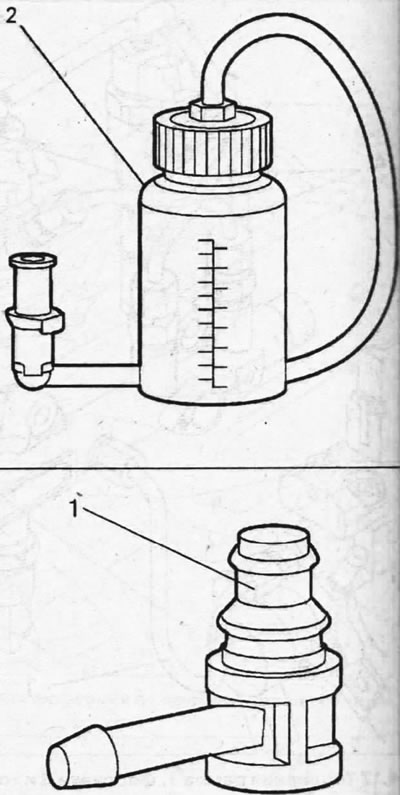
5.1. Place a special adapter on the injector to perform the test
Caution! Do not remove the rubber tubes from the fuel return line connectors.
2. Connect the measuring container 2 to the adapter on the fuel injector to collect the fuel and secure the container to the hood (see illustration 5.1).
3. Start the engine, if it starts, and let it idle for about two minutes. If the engine does not start, operate the starter for 15 seconds.
As a result of these actions, fuel will flow into the measuring container without being injected into the combustion chambers and returned by the injectors to the fuel tank. The volume of this fuel is small and the thickness of the fuel layer in the measuring container should be only a few millimeters. If one or more injectors have a significant volume of returned fuel, then these injectors should be replaced.
(View the original on the website: PeugeotBook)
4. Replace the high return volume injector with a new one and repeat the above test.