
English Русский
Български
Беларускі
Український
Српски
Hrvatski
Română
Polski
Slovenský
Magyar
Bookmark Articles Sitemap Contacts
Company Hyundai Company Opel Company Skoda Company Kia Company Mitsubishi Company LADA Company Audi
PeugeotBook.ru


Series 100   Series 200   Series 300   400-500   Series 600   Crossovers   Others
 
Partner I (1996-2008) Peugeot 807 (2002-2014) Peugeot 806 (1994-2002) Peugeot J5 (1981-1993)

Fuel system — pressure relief and pressure increase (Peugeot Partner I)

  • Main
  • Пежо
  • Partner I (1996-2008)
  • Power unit
  • Power and exhaust (petrol)
  • Fuel system — pressure relief and pressure increase
0
Table of contents: Pressure relief 🠇 Pressure increase 🠇
Note: Before you begin, please read the warning provided in paragraph 1.


Pressure relief


Caution: The following procedure will only relieve pressure in the fuel system, but remember that fuel still remains in the system components, so use caution when disconnecting any of them.


1. The fuel system referred to in this paragraph includes the in-tank fuel pump, fuel filter, fuel injectors, fuel rail, and the lines and hoses connecting these components. All of them contain fuel, which will be under pressure when the engine is running and/or the ignition is on. The pressure remains for some time after the ignition is switched off and should be released in a controlled manner before working on any of the above components.

2. Disconnect the ground cable from the battery (see "Disconnecting the battery").

3. Some models are equipped with a safety valve, which is located on the fuel rail (figure 7.3). On these models, unscrew the cap on the valve and place a suitable container under the valve. Wrap the valve with a rag and relieve the pressure in the system by pressing on the valve core with a suitable screwdriver. Be prepared for fuel to leak when you press the valve; keep a rag handy. Hold the valve until fuel stops flowing from the valve. After releasing the pressure, screw the cap securely onto the valve.
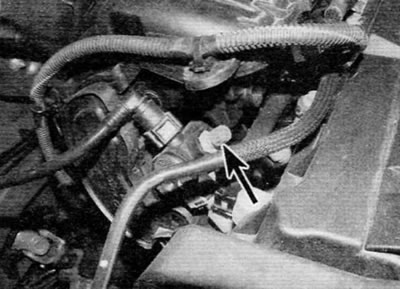
Figure 7.3. Fuel rail relief valve (marked with an arrow) (1.6L model shown)

Figure 7.3. Fuel rail relief valve (marked with an arrow) (1.6L model shown)


[Text taken from the website: peugeotbook.ru]

4. If there is no valve on the fuel rail, you must disconnect the fuel line to relieve pressure. Place a suitable container under the connection and wrap the connection with a thick layer of rags to prevent a possible jet of fuel under pressure from escaping. Slowly release and disconnect the fuel line and collect all leaking fuel in a container. Cap the line/connection to minimize fuel leakage and prevent dirt from entering the fuel system.

Pressure increase


5. After any work on the fuel system, the pressure in the system should be increased as described below.

6. Fully depress the accelerator pedal and then turn on the ignition. Keep the pedal depressed for approximately 1 second and then release it. After this, the ECU should activate the fuel pump for 20-30 seconds to fill the fuel system. After the fuel pump has stopped, the ignition can be turned off.
This article is available at russian, bulgarian, belarusian, ukrainian, serbian, croatian, romanian, polish, slovak, hungarian
Article reviewed by editor: Nikonova Veronica
Share information:
Previous
Partner I: Power and exhaust (petrol)
Next

Engine Management System — general information
Unleaded Gasoline — general information and uses
Accelerator pedal removal and installation
Accelerator cable — removal, installation and adjustment
Air cleaner assembly and air intake ducts — removal and…
Fuel pump — removal and installation
Fuel level indicator sensor — removal and installation
Fuel tank — removal and installation
Engine management system — checking and adjustment
Throttle body — removal and installation
See similar information for other Peugeot models

➨ Tyre condition and pressure Peugeot 106 (1991-2003)
➨ On-board tire pressure monitoring system Peugeot 207 (2006-2014)
➨ Pressure testing of the cooling system Peugeot 305 (1977-1989)
➨ Relieving pressure in the fuel system Peugeot 405 (1987-1997)
➨ High pressure fuel pump — removal, installation and adjustment Peugeot 605 (1989-2000)
Link to this article in different formats
Comments and feedback from visitors
No comments yet


Add two numbers 46 + 28


Partner I (1996-2008) 
  • General information
  • Introduction to the guide
  • Faults en route
  • Weekly checks
  • User manual
  • Maintenance (petrol)
  • Maintenance (diesel)
  • Power unit
  • Petrol engines
  • Diesel engines «XUD»
  • Diesel engines «DW»
  • Overhaul of petrol engines
  • Overhaul of diesel engines
  • Cooling and heating
  • Power and exhaust (petrol)
  • Power and exhaust (XUD diesels)
  • Power and exhaust (DW diesels)
  • Emission reduction
  • Starting and charging system
  • Transmission
  • Clutch
  • Mechanical gearbox
  • Drive shafts
  • Chassis, running gear
  • Brake system
  • Car suspension
  • Steering
  • Body and interior
  • Exterior (external elements)
  • Interior (internal elements)
  • Doors, locks and windows
  • Electrical equipment
  • Equipment and devices
  • Electrical circuits
Peugeot 807 (2002-2014) 
  • General information
  • Operating instructions
  • Maintenance
  • Troubleshooting
  • Power unit
  • Gasoline engines
  • Diesel engines
  • Cooling and heating
  • Fuel injection (petrol)
  • Fuel system (diesel)
  • Fuel system
  • Exhaust system
  • Ignition system
  • Transmission
  • Clutch
  • Manual gearbox
  • Automatic gearbox
  • Chassis, running gear
  • Brake system
  • Car suspension
  • Steering system
  • Body and interior
  • Exterior (external elements)
  • Interior (internal elements)
  • Electrical equipment
  • Power devices
  • Electrical circuits
Peugeot 806 (1994-2002) 
  • General information
  • User manual
  • Maintenance
  • Power unit
  • Petrol engines
  • Diesel engines
  • Lubrication system
  • Cooling system
  • Fuel injection (petrol)
  • Fuel system (diesel)
  • Ignition and exhaust systems
  • ECM Bosch Motronic MP 3.2
  • ECM Magneti-Marelli (MM)
  • Transmission
  • Clutch
  • Mechanical gearbox
  • Chassis, running gear
  • Brake system
  • Car suspension
  • Steering
  • Electrical equipment
  • Equipment and devices
  • Electrical circuits
Peugeot J5 (1981-1993) 
  • General information
  • Introduction to manual
  • Specifications
  • Gasoline engine
  • Engine repair
  • Lubrication system
  • Cooling system
  • Fuel system
  • Ignition system
  • Diesel engine
  • Engine repair (DB9)
  • Lubrication system (DB9)
  • Cooling system (DB9)
  • Fuel injection (DB9)
  • Engine repair (U25)
  • Lubrication system (U25)
  • Cooling system (U25)
  • Fuel injection (U25)
  • Transmission
  • Clutch
  • Gearbox
  • Drive shafts
  • Chassis, running gear
  • Steering system
  • Car suspension
  • Brake system
  • Electrical equipment
  • Power devices
  • Electrical circuits
PeugeotBook.ru © 2018–2026 | Mobile version | Sitemap: EN BG BY UA RS HR RO PL SK HU | Write message | Site search | Add to bookmarks | Peugeot owners
106 (1991-2003) | 206 (1998-2012) | 207 (2006-2014) | 305 (1977-1989) | 306 (1993-2002) | 307 (2001-2008) | 405 (1987-1997) | 406 (1995-2004) | 605 (1989-2000) | Partner-I (1996-2008) | Eurovans-807 (2002-2014) | Eurovans-806 (1994-2002) | J5 (1981-1993) |
Cookies are used to ensure the correct display of pages on the site.